Tuesday, July 28, 2015


Thursday, July 23, 2015
8 things you didn’t know about Dr. Seuss

Theodor “Ted” Seuss Geisel, better known as Dr. Seuss, on his last visit to his hometown of Springfield, Massachusetts in 1986. Photo courtesy of Springfield Union-News
A long-lost manuscript from the beloved author and illustrator Dr.
Seuss will be released next week, marking a quarter-century since his
swan song “Oh, the Places You’ll Go!” empowered us to move mountains.
The posthumous “What Pet Should I Get?” arrives July 28, two years after
the author’s widow unearthed the story’s text and sketches. It features
the siblings from “One Fish Two Fish Red Fish Blue Fish” on a trip to
the pet store, which we know is never that sensible with a Seuss book.
Philip
Nel, author of “Dr. Seuss: American Icon,” and Guy McLain, director of
the Wood Museum of Springfield History, discuss how the author’s
advertising beginnings gave way to Zooks and Zummers, pulling children’s
literature away from the tsk-tsking of the Dick and Jane books and
obliterating the boring belief that young readers ought to be prim and
proper.
Thing 1. He got his sense of poetry from his mother. Read more...
“We have reached a point of no return” Russia’s most renowned librarian talks to ‘Meduza’ about state inspections, foreign agents, and cultural exchange
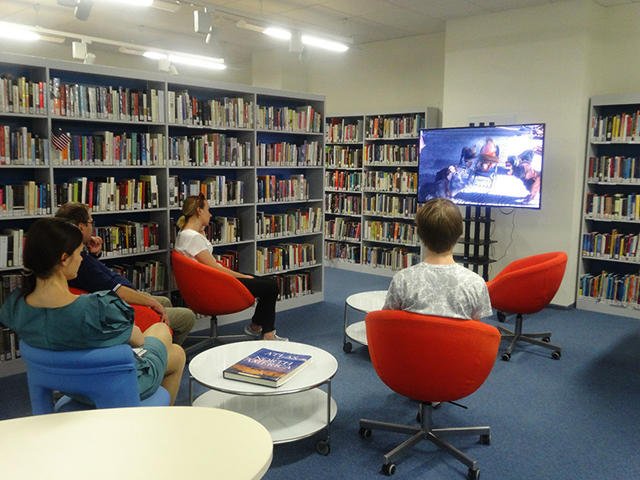 |
Американский культурный центр, занятия летней школы сценаристов. Июнь 2015-го
Фото:
Photo: American Center's vk.com page
|
Renowned librarian and cultural critic Ekaterina Genieva passed away on July 9 in Israel after a battle with cancer. Genieva had served as the head of the All-Russia State Library of Foreign Literature for nearly a quarter of a century, right up until her death. In the late 1990s and early 2000s, she also worked as the President of George Soros’ Open Society Institute in Russia. This week, the Open Society Institute came under government scrutiny for “threatening Russia’s interests.” Authorities had also been paying special attention to Genieva’s library, asking her to shut down the American Cultural Center, one of many international organizations her library hosts. Shortly before she passed away, Ekaterina Genieva was interviewed by Katerina Gordeeva for Meduza. Genieva shared her thoughts about the Ministry of Culture, about Russia’s “spy fever,” and about the importance of cultural exchange.
Read more: https://meduza.io/en/feature/2015/07/10/we-have-reached-a-point-of-no-return
Wednesday, July 22, 2015
How libraries can compete with Google and Amazon
 |
| Every kid needs a tablet nowadays. (AP Photo/Eric Gay) |
Visit the Central branch of New York City’s Queens Library at 12:55 pm on a Tuesday, and you’ll see about 100 people outside, waiting for the doors to open. At 1 pm they file in: Some settle in the comfy saucer chairs, while others rest in armchairs facing four TVs and open a newspaper. Splashes of blue and green interrupt white walls, and computer areas are separated by category: job information, adult learning center, and “young adult learning.”
But the reach of the Queens Library extends beyond the walls of its 65 physical branches. Dotting the borough are thousands of New Yorkers logged into their own mini-libraries, using the library’s mobile app to do research for homework, or the WiFi hotspots they checked out to fill in the holes in broadband access at home, or accessing e-books on one of the libraries’ tablets they can take home.
Throughout the country, library initiatives are emerging to keep up with technological advances. And libraries are finding that one population they can serve better than anyone else is low-income Americans.
Read more: http://qz.com/454586/how-libraries-can-compete-with-google-and-amazon/
Victory for school libraries as Senate passes education bill Posted by: Jessica McGilvray July 17, 2015 in Legislation, School Libraries

The Senate made great strides this week to ensure needed reform to the Elementary and Secondary Education Act (ESEA). After much debate and across the aisle discussion, yesterday the Senate overwhelmingly passed S. 1177, the Every Child Achieves Act, by a vote of 81-17.
As we discussed in a previous post, the inclusion in the bill of the bi-partisan Reed-Cochran amendment, makes S. 1177 a monumental step forward for schools, their libraries and the millions of students they serve. Most fundamentally and importantly, the amendment (approved 98-0) makes explicit that ESEA funds may be used to support school libraries and “effective school library programs” in multiple ways.
Read more: http://www.districtdispatch.org/2015/07/victory-for-school-libraries-as-senate-passes-education-bill/
Tuesday, July 21, 2015
All Those Techies Who Predicted the Demise of the Public Library Were Wrong
July 16, 2015

Indisputable fact--Americans love their public libraries. Evidence to support this statement abounds. A 2013 report by the Pew Research Center’s Internet and American Life Project noted that in the previous decade “every other major institution (government, churches, banks, corporations) has fallen in public esteem except libraries, the military, and first responders.” The study also found that 91% of those surveyed over sixteen years old said libraries are “very” or “somewhat” important to their communities, and 98% identified their public library experience as “very” or “mostly positive.”
Another Pew study found 94% of parents believe libraries are important for their children; 84% said because libraries develop a love of reading and books. Read more...
Adults Are More Likely To Believe There Are Books That Should Be Banned Than Movies, Television Shows, or Video Games
Percentage who feel some books should be banned has increased 10 points since 2011; Three in ten Americans are more likely to read a book if it’s banned
08:00 AM EDT Jul 8, 2015
NEW YORK, N.Y. – In just four years, the percentage of Americans who believe there are any books that should be banned has increased by more than half: 28% believe this to be the case today, vs. 18% in 2011. One-fourth (24%) are unsure, which leaves nearly half of Americans convinced that no books should be banned completely (48%).
- Politically speaking, Republicans are nearly twice as likely as Democrats or Independents to believe there are any books that should be banned completely (42% vs. 23% & 22%, respectively).
- In addition, adults who have completed high school or less are more likely than those with higher levels of education to believe there are any books that should be banned (33%, vs. 25% some college, 24% college grad, 23% post grad).
“The things they're doing and saying in films right now just shouldn't be allowed.” ― Mae West
When asked to consider other types of media, adults are less likely to say there are any movies, television programs, or video games which should be banned completely. Only 16% of Americans each believe there are any movies or television programs that should be banned completely, and one fourth say the same about video games (24%). In light of this, perhaps it’s not surprising that seven in ten adults believe a rating system (similar to that used for movies) should be applied to books (71%).
Similar to books, Republicans are more likely than Democrats or Independents to believe there’s ever a call for outright bans in each of these categories.
- Movies: 24% Republicans vs. 15% Democrats & 12% Independents
- Television: 23% Republicans vs. 16% Democrats & 12% Independents
- Video games: 32% Republicans vs. 23% Democrats & 20% Independents
- Read more...
Thursday, July 16, 2015
Go Set A Watchman - An Opinion Piece
Go Set A Watchman - An Opinion Piece
 To Fans of "To Kill A Mockingbird"
We at Brilliant Books want to be sure that our customers are aware that “Go Set A Watchman” is not a sequel or prequel to ‘To Kill A Mockingbird'. Neither is it a new book. It is a first draft that was originally, and rightfully, rejected. The book, and some of the characters therein, are very much a product of this era in the South.
We suggest you view this work as an academic insight rather than as a nice summer novel. This situation is comparable to James Joyce's stunning work 'A Portrait of the Artist as a Young Man', and his original draft 'Stephen Hero'. 'Hero' was initially rejected, and Joyce reworked it into the classic 'Portrait'. 'Hero' was eventually released as an academic piece for scholars and fans—not as a new 'Joyce novel'. We would have been delighted to see “Go Set A Watchman” receive a similar fate.
It is disappointing and frankly shameful to see our noble industry parade and celebrate this as “Harper Lee’s New Novel”. This is pure exploitation of both literary fans and a beloved American classic (which we hope has not been irrevocably tainted.) We therefore encourage you to view “Go Set A Watchman” with intellectual curiosity and careful consideration; a rough beginning for a classic, but only that.
Go to homepage: http://www.brilliant-books.net/go-set-watchman-opinion-piece
Wednesday, July 15, 2015
How to talk to your kids about prejudice with the help of 12 of our favorite books

It’s been a big few weeks for America, hasn’t it? From the heartbreak of the Charleston shootings to the landmark #LoveWins Supreme Court decision to the Girl Scouts donor dust-up, people everywhere are talking about prejudice.
While I’ve seen such a beautiful swell of love, support and compassion for all kinds of people all over my social media this past month, I’ve also talked to lots of moms who are wondering how to talk to kids about prejudice and racism. Because even as my kids help me pick out wedding presents for all our friends, prejudice most definitely still exists whether it’s because of the color of your skin or the country your family came from.
Read more: http://coolmompicks.com/blog/2015/07/07/12-childrens-book-help-talk-to-kids-about-prejudice/
Subscribe to:
Posts (Atom)