Pages

Showing posts with label internet. Show all posts

Wednesday, April 26, 2017

Google to Revise Search Rankings to Downplay Fake News, Hate Speech | April 25, 2017

Fake news | Google | Information retrieval

by Wayne Rash

NEWS ANALYSIS: Google says it will downgrade the search rank of websites that show a clear pattern of distributing fake news, hate speech or deliberately misleading information.


By now you’re familiar with the problem of fake news. Some sites, claiming to provide news actually work with an agenda to present stories that spread their point of view, regardless of any connection with the facts.

The issue of fake news or what used to be known as political propaganda, came to the forefront during the presidential campaign in 2016, when it appears that the Russian government was working to help create and spread fake news in an effort to derail the campaign of Hillary Clinton.

Such efforts are continuing in Europe during current elections in Germany and France and again the Russian government is suspected to be backing those efforts. But fake news isn’t just the purview of the Russians. A number of right-wing and “alt-right” groups are also hard at work doing the same thing. Read more...

Monday, February 27, 2017

Meet Alan Emtage, the Black Technologist Who Invented ARCHIE, the First Internet Search Engine | February 21, 2017

Internet | Technology | Black History Month

Courtesy Alan Emtage  
At a time when “googling” has become the generic term for conducting an internet search, it can be hard to remember that search had a long history before Google came along. But it’s worth revisiting that past during Black History Month, because the pre-Google era saw one of the most momentous black contributions to the development of the internet: the invention of internet search itself, by Alan Emtage. Read more...

Tuesday, February 21, 2017

The Trump administration’s other war on the media | February 14, 2017

Opinion | Net Neutrality | Digital Divide | Journalism

By  Katrina vanden Heuvel

FCC Commissioner Ajit Pai in Washington in 2013. (Susan Walsh/Associated Press)

The Trump administration’s unrelenting attacks on the media and assault on reality have been well covered by journalists and media outlets that find themselves in the new administration’s crosshairs. Yet while the White House’s insistence on “alternative facts” may be more visibly ominous, there is another growing threat to the independent media that also demands our attention. 

Despite his crusade against the press, Trump’s contempt does not seem to apply to the massive conglomerates — such as Comcast and Verizon — with so much influence over what the American people watch on television and read on the Internet. And at a time when extreme commercialization has helped drive the decline of accountability journalism, Trump and his recently appointed Federal Communications Commission chairman, Ajit Pai, have signaled their intention to exacerbate the problem. Read more...

Thursday, December 1, 2016

Here's how to outsmart fake news in your Facebook feed


(CNN)Just because it's on the internet doesn't make it true. It seems so simple, but if everyone knew that, Facebook and Google wouldn't have to pull bogus news sites from their advertising algorithms and people wouldn't breathlessly share stories that claim Donald Trump is a secret lizard person or Hillary Clinton is an android in a pantsuit.
It doesn't have to be this way. Fake news is actually really easy to spot -- if you know how. Consider this your New Media Literacy Guide.
NOTE: As we put this together, we sought the input of two communications experts: Dr. Melissa Zimdars, an associate professor at Merrimack College in Massachusetts whose dynamic list of unreliable news sites has gone viral, and Alexios Mantzarlis, the head of the International Fact-Checking Network at the Poynter Institute.
First, know the different types of misleading and false news
1. Fake news
These are the easiest to debunk and often come from known sham sites that are designed to look like real news outlets. They may include misleading photographs and headlines that, at first read, sound like they could be real.
2. Misleading news
These are the hardest to debunk, because they often contain a kernel of truth: A fact, event or quote that has been taken out of context. Look for sensational headlines that aren't supported by the information in the article.
3. Highly partisan news
A type of misleading news, this may be an interpretation of a real news event where the facts are manipulated to fit an agenda.
4. Clickbait
The shocking or teasing headlines of these stories trick you into clicking for more information -- which may or may not live up to what was promised.
5. Satire
This one is tough, because satire doesn't pretend to be real and serves a purpose as commentary or entertainment. But if people are not familiar with a satire site, they can share the news as if it is legitimate. Read more...

Wednesday, February 17, 2016

Indie Bookstores Are Back, With a Passion By FRANCIS X. CLINES FEB. 12, 2016


Stocking the shelves at Book Culture in New York City. CreditBrian Harkin for The New York Times


Thursday, December 31, 2015

Raiders of the Lost Web If a Pulitzer-finalist 34-part series of investigative journalism can vanish from the web, anything can. by ADRIENNE LAFRANCE OCT 14, 2015


The web, as it appears at any one moment, is a phantasmagoria. It’s not a place in any reliable sense of the word. It is not a repository. It is not a library. It is a constantly changing patchwork of perpetual nowness.

You can't count on the web, okay? It’s unstable. You have to know this.   
Digital information itself has all kinds of advantages. It can be read by machines, sorted and analyzed in massive quantities, and disseminated instantaneously. “Except when it goes, it really goes,” said Jason Scott, an archivist and historian for the Internet Archive. “It’s gone gone. A piece of paper can burn and you can still kind of get something from it. With a hard drive or a URL, when it’s gone, there is just zero recourse.”

There are exceptions. The Internet Archive’s Wayback Machine has a trove of cached web pages going back to 1996. Scott and his colleagues are saving tens of petabytes of data, chasing an ideal that doubles as their motto: Universal Access to All Knowledge. The trove they’ve built is extraordinary, but it’s far from comprehensive. Today’s web is more dynamic than ever and therefore more at-risk than it sometimes seems.


Read more...

Wednesday, September 2, 2015

Introducing the Archive Corps Meet the man behind a new effort to save documents and other artifacts before they disappear.


Jason Scott / Flickr

Jason Scott has something of a reputation. He’s a historian who works for the Internet Archive, and he’s known in some circles as the guy who can save bits of history right before they disappear.
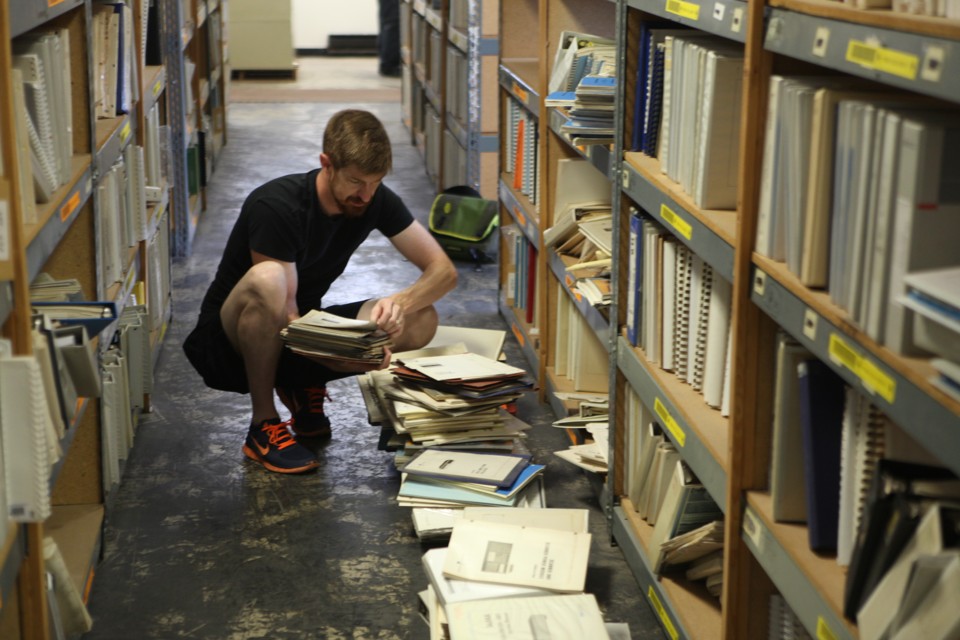
So when he found out that a small store in Maryland that sold manuals for machinery was going out of business, and was going to get rid of its collection of nearly 200,000 obscure booklets in just a few days, Scott got to work. 

He got to Maryland on a Friday to check out the stockpile at Manuals Plus. By Wednesday of the next week he had rallied over 70 volunteers to put together 1,600 boxes of manuals (nobody counted exactly how many booklets fill those boxes, but the guess is between 50,000 and 75,000) that now sit in three storage containers. The whole endeavor cost about $9,000, most of which was donated to the project.

Read more: http://www.theatlantic.com/technology/archive/2015/09/introducing-the-archive-corps/403135/?utm_source=SFTwitter