Pages

Showing posts with label activism. Show all posts

Thursday, February 23, 2017

'Not Sitting Quietly Anymore': How Librarians Are Fighting Trump | by Arianna Rebolini

Librarians | Activism | Social justice

February 20, 2017

Photo by B. Harvey via Stocksy  

Though some people may think the job involves more shushing than rallying, many librarians consider "making America read again" to be a radical political proposition. 

When Audrey Lorberfeld woke up in her Brooklyn apartment on Saturday, January 28, she was, like much of the country, angry. In the first week of his presidency, Donald Trump had already signed executive orders reinstating an expanded global gag rule, calling for the construction of a border wall between the United States and Mexico, reopening the possibility of the Dakota Access pipeline, and, on Friday, January 27, barring any travelers into the US from seven Muslim-majority countries.

Within hours of the order's signing, two Iraqis who'd flown into JFK—53-year-old Hameed Khalid Darweesh, arriving from Iraq, and 33-year-old Haider Sameer Abdulkhaleq Alshawi, arriving from Sweden—were detained. Overnight, while lawyers representing the two refugees worked to file a suit for their release, news of their detention spread, and by 11 AM on Saturday, organizations like the New York Immigration Coalition (NYIC) had put out a call for protesters outside JFK's Terminal 4.
Read more...


Tuesday, February 14, 2017

Why these librarians are protesting Trump’s executive orders | Elizabeth Flock

Activism | Access | Fake news | Immigration Ban

February 13, 2017

A “Libraries Are For Everyone” poster in Arabic. Credit: Rebecca McCorkindale

“Libraries Are For Everyone.” That’s the message of a series of images created by Rebecca McCorkindale in the days after President Donald Trump announced the temporary travel ban on seven Muslim-majority countries. She never expected her signs of inclusion to go further than a handful of libraries. 

But by the time she’d woken up the following day, she had received messages from librarians across the world wanting their languages represented. And libraries across the country — in Illinois, Minnesota, California, Virginia — had begun putting up the images as posters, along with displays about books on Islam, empathy and being a good neighbor. 

McCorkindale, who is assistant library director and creative director at the Gretna, Nebraska, public library, said she created the images because she believes librarians can and should be activists.
“Libraries are the heart of a community, for anyone and everyone that lives there, regardless of their background,” she said. “And so we strongly believe that libraries are not neutral. We stand up for human rights.”

She is not the only one. Since Mr. Trump took office a little more than three weeks ago, a vocal and growing number of librarians across the country have begun to take a more politically active stance.
Read more...

Wednesday, February 1, 2017

How to Build an Autocracy | David Frum "The Atlantic" March 2017

Democracy | Activism | Advocacy

The preconditions are present in the U.S. today. Here’s the playbook Donald Trump could use to set the country down a path toward illiberalism.


It’s 2021, and President Donald Trump will shortly be sworn in for his second term. The 45th president has visibly aged over the past four years. He rests heavily on his daughter Ivanka’s arm during his infrequent public appearances.

Fortunately for him, he did not need to campaign hard for reelection. His has been a popular presidency: Big tax cuts, big spending, and big deficits have worked their familiar expansive magic. Wages have grown strongly in the Trump years, especially for men without a college degree, even if rising inflation is beginning to bite into the gains. The president’s supporters credit his restrictive immigration policies and his TrumpWorks infrastructure program. Read article

Listen to the audio version of this article:

Tuesday, January 24, 2017

In Discarded Women’s March Signs, Professors Saw a Chance to Save History | By Fernanda Zamudio-Suaréz January 24, 2017


Archives | Women's studies | Research

Dwayne Desaulniers, AP Images
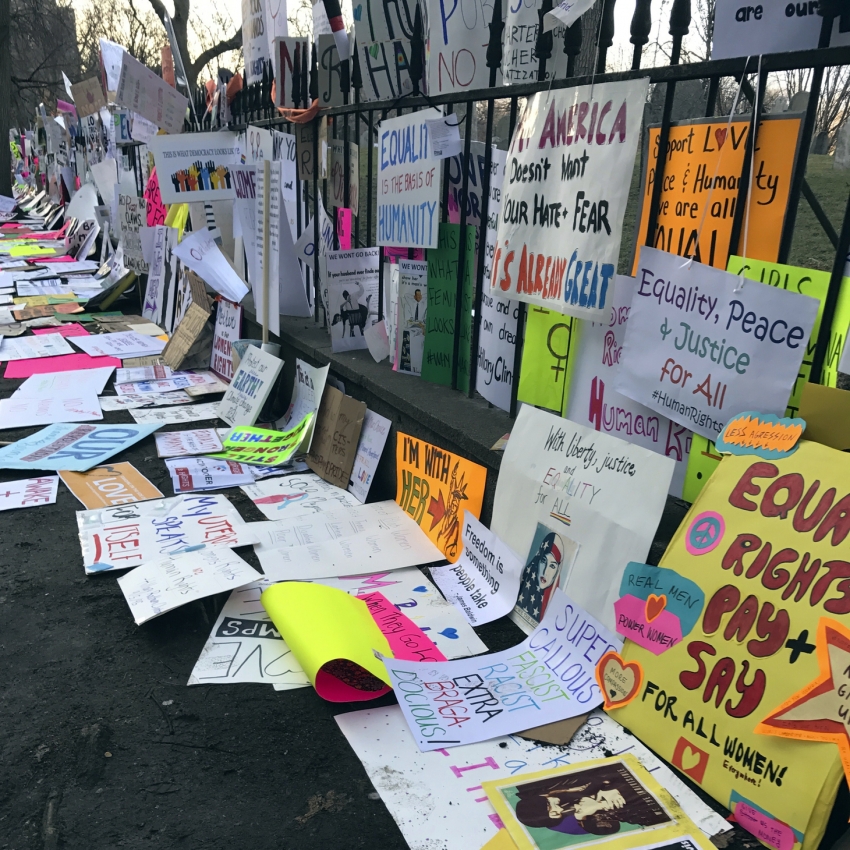
Signs line the fence surrounding Boston Common after the Boston Women's March for America on Saturday. Some of those signs could end up in an archive at Northeastern U. 


The signs were pink, blue, black, white. Some were hoisted with wooden sticks, and others were held in protesters’ hands. A few sparkled with glitter, and some had original designs, created on computers with the help of a few internet memes.

Still, at the Boston Women’s March for America on Saturday, hundreds of the signs criticizing President Trump’s campaign promises and administrative agenda ended up wrapped around the fence near Boston Common, laid down like a carpet covering the sidewalk.

After leaving a late lunch with some colleagues, Nathan Felde, a design professor at Northeastern University, stopped to admire the signs. He was struck by their originality, and how most had come from amateur artists. Parks employees told him they had been instructed to dispose of the signs that evening, he said.

"There was that moment where, in looking at that work, it was almost instinctual to say, ‘This all has to be saved,’ and then acting on it before we knew what we were going to do next," Mr. Felde said.
The workers said Mr. Felde and his group were free to take signs. So he rented a van, his colleagues and a few onlookers loaded them up, and off to a newly rented storage unit they went. Dietmar Offenhuber, an assistant professor of art and design and public policy, said the collected signs filled a 40-square-foot storage unit.

Now the group wants to archive the collection, physically and online, with the help of Northeastern University’s library. Read more...

Monday, July 1, 2013

A Conversation with Alice Walker | American Libraries Magazine

A Conversation with Alice Walker | American Libraries Magazine

The bestselling author discusses her role as a global citizen and her connection with nature, history, and activism
Writer Alice Walker. Photo by Ana Elena

Alice Walker is a remarkably prolific and versatile writer of conscience. She will always be remembered for her indelible and life-changing masterpiece, The Color Purple, for which she won the Pulitzer Prize, becoming the first African American to do so. Walker has written six other groundbreaking novels as well as thought-provoking books for children and a collection of powerful poetry and essays, works that are deeply concerned with matters of justice, equality, politics, art, environmentalism, and spirituality.

Walker’s books have been translated into more than two dozen languages, and 15 million copies have been sold. A world-traveler and tireless and courageous activist as well as a bestselling author, she has been recognized with numerous honors, including a National Book Award, a Guggenheim Fellowship, and the Lennon/Ono Grant for Peace, which she donated to an orphanage in East Africa for children who lost parents to AIDS.

Walker has two new books out: an essay collection titled The Cushion in the Road: Meditation and Wandering as the Whole World Awakens to Being in Harm’s Way (The New Press, 2013), and The World Will Follow Joy: Turning Madness into Flowers (The New Press, 2013), a poetry collection.

Alice Walker will be appearing at the ALA Annual Conference in Chicago this June. On behalf of American Libraries, Booklist Senior Editor Donna Seaman reached Walker at her home in Mexico.

AMERICAN LIBRARIES: Can you describe how you work on the many forms of literature you create, from poetry and essays to fiction and books for children? Read more...