Pages

Showing posts with label academic libraries. Show all posts

Thursday, August 17, 2017

Personal archiving : preserving our digital heritage Ed. Donald T. Hawkins | Review

Digital preservation | Archiving | Institutional repositories 

Reviewer:  Stephanie L. Gross, MSLIS

 
Personal archiving : preserving our digital heritagePersonal archiving : preserving our digital heritage by Donald T. Hawkins

My rating: 4 of 5 stars


Reviewer bio:

I am an academic librarian whose primary responsibility is to oversee the electronic reserves component of Springshare LibGuides. Recently I was appointed to serve on the task group to explore, report and advice the establishment of an institutional repository at my university. Having already read much literature concerning IR, I have begun widening my reading to include material that examines IR and its various components from a variety of viewpoints, academic, technical and personal.

Review:

This book is an anthology created by specialists in libraries, archives and technology. It is a rich, yet succinct, volume compiled as a primer for lay individuals who are involved in archiving personal material. Much of the focus is on preserving, organizing and sharing memorabilia. However, true to expectation, an equal emphasis is given to the preservation of digital files from various formats. Some attention is devoted to records management, although that is from a more introductory, philosophical perspective. What I believe to be the strength of this work is its practical advice to both lay and professionals alike. It is specific and technical enough to satisfy academic librarians who are not trained as archivists. Often we are tasked with aiding and guiding library users (students and faculty) in the preservation of their personal data. Those who are interested in understanding specific aspects of establishing and maintaining an institutional repository, including the compilation and promotion of best practices will certainly need to research further. However, this handbook does indeed list and annotate various resources (e.g. Library of Congress, Internet Archives) which is extremely helpful. There are two chapters dedicated to the preservation of email from faculty, scholars and researchers. Much is made of the chronic conundrum of “store and ignore”, benign negligence, concerning the backing up of files and precious data. The mandate to keep up with current technology, upgrading equipment and the appropriate hardware and software is underscored. (A pitch for able institutions to take on this responsibility is made, especially regarding work by scholars and communities.) Budgeting is given sufficient space to gain an appreciation of the magnitude of the demands on resources, both monetary and human. The final chapters look into the future, including intelligent discussions and projections relating to issues of ownership, copyright and social media. Although various software firms and websites are mentioned by name and have already disappeared by the time of this writing, their absence does not diminish the usefulness of their mention. The principles and philosophy of the services remain valid into the present.

Recommended audience:

Public libraries, academic libraries, special libraries, archives, museums

Recommended added subject heading:

Institutional repositories.
Digital libraries.


View all my reviews

Tuesday, July 11, 2017

Virtual reality and smoothie bars: What’s in at Bay Area university libraries?

Academic Libraries | Library Design | User Experience

College students still need help finding and interpreting information.

PUBLISHED: | UPDATED:
Rodrigo Gris, a summer session student from Spain studying art history, works in one of the new study carrels in Moffitt Library at UC Berkeley in Berkeley, Calif. on Thursday, July 6, 2017. (Kristopher Skinner/Bay Area News Group)
Librarians at UC Berkeley are holding workshops for students on what to do with the information they collect using drones. At Stanford, they’re experimenting with virtual reality. And across the Bay Area, as more textbooks gather dust and coursework moves online, universities are reimagining their libraries.

“We’re like fish,” said Sonoma State University librarian Karen Schneider. “If we don’t keep swimming, we die.” 

University libraries used to warehouse knowledge, but they’re places where it’s created now. And that, students and school officials say, makes them more relevant than ever.

Numbers back up that notion. While book circulation is down at each of the libraries the Bay Area News Group surveyed, the number of students using library space is up.

Librarians say students are looking for places where they can take the work they do individually online and use it to collaborate as part of a team in the real world.

“The digital age has actually raised the importance of spaces for people to actually come together,” said Jeffrey MacKie-Mason, Cal’s librarian and chief digital scholarship officer. Read more...

Tuesday, January 24, 2017

In Discarded Women’s March Signs, Professors Saw a Chance to Save History | By Fernanda Zamudio-Suaréz January 24, 2017


Archives | Women's studies | Research

Dwayne Desaulniers, AP Images
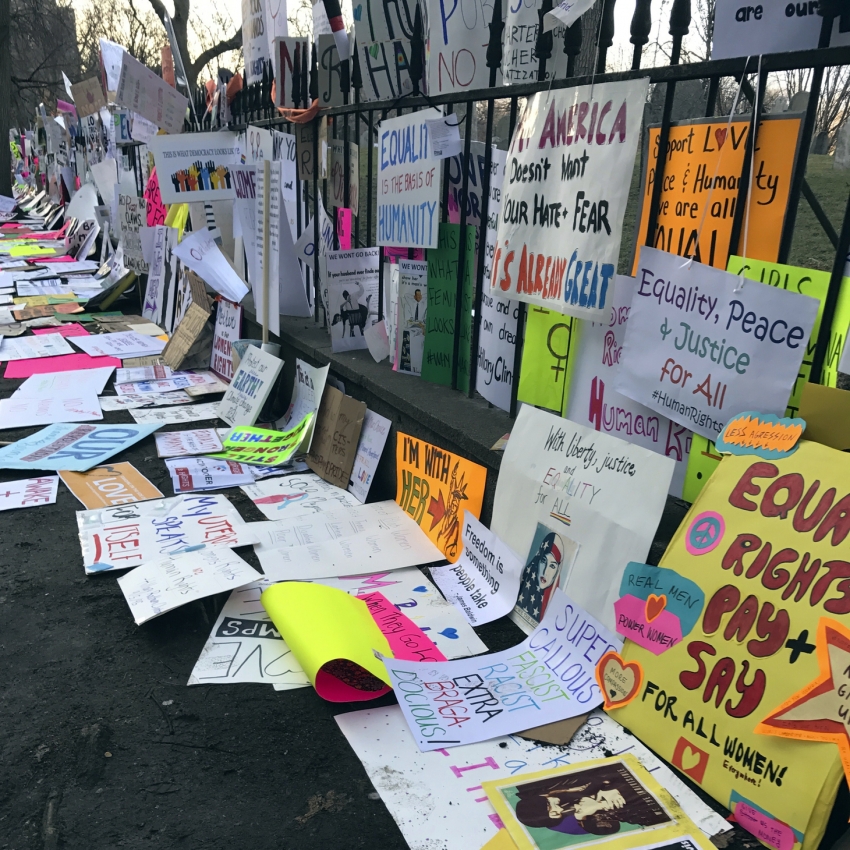
Signs line the fence surrounding Boston Common after the Boston Women's March for America on Saturday. Some of those signs could end up in an archive at Northeastern U. 


The signs were pink, blue, black, white. Some were hoisted with wooden sticks, and others were held in protesters’ hands. A few sparkled with glitter, and some had original designs, created on computers with the help of a few internet memes.

Still, at the Boston Women’s March for America on Saturday, hundreds of the signs criticizing President Trump’s campaign promises and administrative agenda ended up wrapped around the fence near Boston Common, laid down like a carpet covering the sidewalk.

After leaving a late lunch with some colleagues, Nathan Felde, a design professor at Northeastern University, stopped to admire the signs. He was struck by their originality, and how most had come from amateur artists. Parks employees told him they had been instructed to dispose of the signs that evening, he said.

"There was that moment where, in looking at that work, it was almost instinctual to say, ‘This all has to be saved,’ and then acting on it before we knew what we were going to do next," Mr. Felde said.
The workers said Mr. Felde and his group were free to take signs. So he rented a van, his colleagues and a few onlookers loaded them up, and off to a newly rented storage unit they went. Dietmar Offenhuber, an assistant professor of art and design and public policy, said the collected signs filled a 40-square-foot storage unit.

Now the group wants to archive the collection, physically and online, with the help of Northeastern University’s library. Read more...

Thursday, June 16, 2016

Library Field Responds to Orlando Tragedy

Vigil at Orlando’s Dr. Phillips Center, June 13
Photo credit: Erin Sullivan


By on June 15, 2016


In the wake of the shooting in Orlando’s Pulse nightclub on the night of June 12, which killed 49 people and injured 53 others, library administration and staff, organizations and vendors have stepped up with statements of solidarity, offers of help, and opportunities to join forces with the LGBTQ and Latino communities—the shooting occurred during Pulse’s Latin night—to mourn those killed and wounded.

LOCAL LIBRARIES STAY STRONG
Mary Anne Hodel, director and CEO of Orlando’s Orange County Library System (OCLS), posted a message on the library’s homepage, decrying the “despicable act of violence, and pointing users to a resource guide assembled by OCLS for those coping with the loss and looking for ways to support others. She  added, “Moving forward, we will be exploring other ways that OCLS can be part of the healing process. Thank you, Orlando, for being so strong and so brave. We are proud to be part of this community.”

The Orlando Public Library (OPL) branch of OCLS broadcast news on the big screens in its lobby and Library Central area, which has a stage and seating area. “We have also given staff info on how to access our Employee Assistance Program, to make sure that anybody who needs a grief counselor has access to one,” OCLS public relations administrator Erin Sullivan told LJ. Library managers are also accommodating staff members who wish to donate blood, as there is currently a five to seven hour wait at local blood banks.


OCLS has set up monetary donation opportunities through its staff association, and has donation boxes throughout library branches for nonperishable food items for the families of victims. And the library is giving in more ephemeral ways as well. OCLS will be providing the LGBTQ community with information about its EPOCH (Electronically Preserving Obituaries as Cultural Heritage) database, a community-sourced obituary website created through a grant from the Institute of Museum and Library Services, so that victims’ families and friends will be able to post and access obituaries.

In addition, reported Hiawassee branch manager Ken Gibert, the OPL Reference Central department has been collecting photographs of flowers, gifts, and displays at the candlelight vigil held on the night of June 13 at Orlando’s Dr. Phillips Center, to post on the Orlando Memory heritage site.

While the library has been concentrating on ways to help, it has also been on the receiving end of others’ generosity. Digital distributor OverDrive donated 50 ebooks on grief, coping with tragedy, and healing to OCLS, Gibert told LJ. ILS provider SirsiDynix has made a monetary donation.

All branches have installed banners in their windows proclaiming #OrlandoStrong, one of several hashtags for social media users to show solidarity and get updates. Read more...

Wednesday, May 4, 2016

Has the library outlived its usefulness in the age of Internet? You’d be surprised by Donald A. Barclay

April 28, 2016 6.09am EDT
U.S. institutions of higher education and U.S. local governments are under extraordinary pressure to cut costs and eliminate from institutional or governmental ledgers any expenses whose absence would cause little or no pain.
In this political climate, academic and public libraries may be in danger. The existence of vast amounts of information – a lot of it free – on the Internet might suggest that the library has outlived its usefulness.
But has it? The numbers tell a very different story.
In spite of the findings of a survey in which Americans say they are using public libraries less, the usage numbers reported by libraries indicate the opposite. Read more...
Libraries are no longer cold, forbidding spaces. Howard County Library System FollowCC BY-NC-ND

Tuesday, April 14, 2015

7 Classrooms: library as pedagogical incubator - The Ubiquitous Librarian - The Chronicle of Higher Education

Three years ago we had two classrooms in our library. They looked like this:


207_old
The former “training-based” classrooms at VT Library. Photo: R. Miller

These were suitable for training-based instruction but our program
has evolved. Librarians wanted to be able to reach more students (larger
class sizes) as well as utilize many different teaching methods.

We’re
upgrading both rooms this summer.

read more...

Friday, January 23, 2015

Yeshiva University News » Gottesman Library to Get Makeover

New Design Will Create Updated Student-Focused Research and Study Center


The Mendel Gottesman Library,
research center and student hub at Yeshiva University’s Wilf campus,
will soon undergo a major renovation. Thanks to a generous donation from
David S. Gottesman, former chairman of the YU Board of Trustees, and
his wife, Ruth, the library is receiving a complete overhaul that will
see the ground level through the fourth floor revamped. Mr. Gottesman, a
grandson of Mendel Gottesman, also participated in the planning and
design of the library.


The library renovations will feature new floor-to-ceiling windows

“The library was completed in 1969 and has really terrific features,
but modes of study and learning have changed significantly since then,”
said Dean of YU’s Libraries Pearl Berger. “Fifty or 60 years ago, the
primary function of library buildings was to house collections. While
library collections retain great significance, today’s university
libraries are student-centered and are designed to support the variety
of learning activities in which students engage. The planned renovation
is focused upon our students, with the aim of creating library
environments that support student needs.”


“Times have changed, but the facility has essentially remained the
same,” said Vice President for Administrative Services Jeffrey
Rosengarten, who is spearheading the project. “We knew that as a leading
academic research institution, we needed to focus on updating the
library to meet 21st century demands.” Read more...


Thursday, September 11, 2014

Wait. Stop. What is a photocopy? Three insights from our Library Student Advisory Board


September 10, 2014, 4:04 pm  By Brian Mathews The Ubiquitous Librarian
 
The mission of our Library Student Advisory Board is to help us gain a better understanding of the student experience at our university. We talk about a lot of different ideas and issues. I want to share three that surprised me.


Photocopying? We were talking about printing and I asked the students if they ever photocopied (we have all-in-one machines that do printing, copying, and scanning) and the students were silent. After some strange looks someone finally asked what’s a photocopy?
Apparently everything is a print these days. Reproduction of a page of paper doesn’t seem to be a very common activity. I explained what it was and felt like I was describing a telegraph. I guess with journals migrating to predominately digital formats that most undergrads do not need to photocopy articles. Most of their own content is digital as well — so there is no copying notes, forms, or anything like that. Next time I might tour them around the microfilm and VCRs.
Note: the grad students knew about photocopying
Reservable study space? No thanks. Last semester I asked them about offering a few desks or study carrels that students could reserve. Instead of hunting around for a quiet place to read, what if you could schedule it? The group was unanimously opposed. They felt this was fine for group spaces because people needed to assemble at an appointed time, but they didn’t want to see this for individuals. They preferred the first-come-first-serve approach and said that it is hard to predict in advance exactly when you might study; the logistics involved didn’t seem worthwhile.
Share my data, please. Another theme we discussed was personal data. Students said it would be helpful to have a simple dashboard where they could see how busy the library is at a given time. They were not particularly interested in desktop computer availability (which is easy to provide) but more focused on the inventory of quiet area seating and group tables. An engineer in the group started mapping out how we could do this with sensors but with 1,000+ seats that could be challenging.
The suggestion that received the most traction was requiring students to swipe their ID cards when they accessed the building. They do this now at the gym, residential halls, and various computer labs: it’s not usual. I brought up the concept of privacy but that didn’t resonate with them. The consensus was that if the data could be compiled and shared in a meaningful way (generally displaying the busyness of the building) that it would be valuable to them.
Secondly, they thought it might be useful for the library and other campus planners to gather accurate demographics: how many first-year students are using the library, how many engineering students, how long people tended to stay in the library, etc. We talked a bit about the value of these analytics— they brought this up, not me.
The eye-opener for me was how surprised they were that we were not already collecting this information. We do require students to swipe their ID after midnight, but they were advocating for something more. It’s always interesting to see things through the ever-changing eyes of the user.

Friday, February 15, 2013

Association of Research Libraries (ARL®) :: ARL-CARL Joint Statement in Support of Dale Askey and McMaster University

Association of Research Libraries (ARL®) :: ARL-CARL Joint Statement in Support of Dale Askey and McMaster University

For immediate release:
February 14, 2013
For more information, contact:
Elliott Shore
ARL Executive Director
elliott@arl.org
Brent Roe
CARL Executive Director
brent.roe@carl-abrc.ca

ARL-CARL Joint Statement in Support of Dale Askey and McMaster University

The Association of Research Libraries (ARL) and the Canadian Association of Research Libraries (CARL) share a commitment to freedom of opinion and expression of ideas and are strongly opposed to any effort to intimidate individuals in order to suppress information or censor ideas. We further share the belief that a librarian must be able to offer his or her assessment of a publisher’s products or practices free from such intimidation. Read more...
Enhanced by Zemanta

Tuesday, January 22, 2013

Library Cube


Discovering the Impact of Library Use and Student Performance


Brian Cox is Manager Quality and Marketing, and Margie Jantti is University Librarian at the University of Wollongong Library.

Key Takeaways

  • Without a valid, reliable way to collect data from various library and enterprise systems, it's difficult to quantitatively assert how a library adds value.
  • The University of Wollongong Library developed the Library Cube, a tailored database and reporting function that joins library usage data with student data, including demographic and academic performance information.
  • Analysis of the resulting data reveals a strong correlation between students' grades and use of information resources the library provides.
By providing access to information resources, academic libraries play a significant role in the student experience. To date, efforts to assess the impact of accessing library-owned or subscribed content have largely focused on satisfaction surveys, feedback, and "return on investment" projects such as contingent valuation. Although surveys and feedback systems provide data and information on a range of service elements, they are limited in their capacity to provide information and insight into the perceived value gained by engaging with the library — that is, on a client's return on effort for using library services and resources. They are also unable to identify non-users effectively. Faculty awareness and knowledge of student use of library information resources is equally limited. Read more...

Thursday, July 26, 2012

The Benefits of Faculty-Librarian Collaborations | Faculty Focus

The Benefits of Faculty-Librarian Collaborations | Faculty Focus

By: in Instructional Design July 16, 2012

Community College instructors have a great deal to teach: study skills, a college orientation to education, and the actual course information for their discipline. They also know that their students must be information literate, must know how to find supplementary information for each course, how to use information effectively, and how to credit their sources appropriately. In this regard, Washington State Community and Technical Colleges have been working under an LSTA grant on Information Literacy from 2008-2012 (Washington). Lower Columbia College libraries have been using the grant to integrate librarians or library tutorials into face-to-face and online classes, thereby offering information literacy instruction to students without increasing the teaching load of the discipline instructors. When incorporated with research assignments, this instruction, along with embedded librarians, facilitates both student learning and faculty grading of assignments. Read more...

Andrea Gillaspy-Steinhilper is a reference librarian at Lower Columbia College.
References:
Business Administration subject guide.” (rev. 2011) Lower Columbia College Library Services. Retrieved May 2012 from http://lowercolumbia.edu/nr/exeres/9CC35863-7A1D-4F77-88D0-6E2E2F083DC9.
“Determining the level of scholarship, authorship, and audience of an article.” (2011). Lower Columbia College Library Services. Retrieved 29 June 2012 from https://lstahighlights.files.wordpress.com/2012/06/ppt_scholarly_v_popular.pdf.
GillaspySteinhilper, A. (Winter 2012). “Cancer and genetic mutations.” Tegrity Recording. Lower Columbia College Library Services. Retrieved 11 May 2012 from https://tegr.it/y/aom1.
Washington State Community and Technology Colleges LSTA Grant 2008-2012. (25 April 2012). Retrieved 11 May 2012 from http://informationliteracywactc.pbworks.com/w/page/19923193/FrontPage.
Add Comment
Enhanced by Zemanta

Wednesday, March 14, 2012

Tablet Ownership Triples Among College Students - Wired Campus - The Chronicle of Higher Education

Tablet Ownership Triples Among College Students - Wired Campus - The Chronicle of Higher Education

March 14, 2012, 3:01 am
[Creative Commons licensed Flickr photo by sridgway]
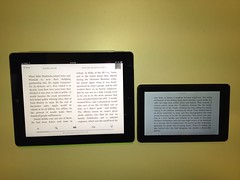
 The number of college students who say they own tablets has more than tripled since a survey taken last year, according to new poll results released today. The Pearson Foundation sponsored the second-annual survey, which asked 1,206 college students and 204 college-bound high-school seniors about their tablet ownership. The results suggest students increasingly prefer to use the devices for reading. Read more
Enhanced by Zemanta

Tuesday, November 1, 2011

2.011 Conference - Library 2.0

2.011 Conference - Library 2.0

It's virtual, and it's FREE. Register today! November 2-4, 2011.


Visit Library 2.0


So far 4000 people have registered from 149 countries.  This is truly a global event not to be missed!
Enhanced by Zemanta