Pages

Showing posts with label #fakenews. Show all posts

Monday, November 6, 2017

Media Literacy E-Resources | Reference 2018

Reference | Media| Information literacy

By Gary Price & Mahnaz Dar on November 1, 2017

The fight against “fake news” isn’t new to librarians, but with patrons anxious about identifying misinformation, these resources are more crucial than ever. Moving beyond the basics, these free tools provide creative avenues for honing media literacy skills, from uncovering politicians’ suppressed tweets to accessing the latest in facial recognition software.

Court Listener


Read more...

Wednesday, October 18, 2017

In Italian Schools, Reading, Writing and Recognizing Fake News

Europe | Fake news | Social media | Italy

Laura Boldrini, president of Italy’s Chamber of Deputies, spearheaded a project to educate high-school students on how to recognize fake news and conspiracy theories online.
Andreas Solaro / Agence France-Presse — Getty Images
 
 
ROME — After reading the horrors in Dante’s “Inferno,” Italian students will soon turn to the dangers of the digital age. While juggling math assignments, they’ll also tackle worksheets prepared by reporters from the national broadcaster RAI. And separate from the weekly hour of religion, they will receive a list of what amounts to a new set of Ten Commandments for the digital age.

Among them: Thou shalt not share unverified news; thou shall ask for sources and evidence; thou shall remember that the internet and social networks can be manipulated.
The lessons are part of an extraordinary experiment by the Italian government, in cooperation with leading digital companies including Facebook, to train a generation of students steeped in social media how to recognize fake news and conspiracy theories online.

“Fake news drips drops of poison into our daily web diet and we end up infected without even realizing it,” said Laura Boldrini, the president of the Italian lower house of Parliament, who has spearheaded the project with the Italian Ministry of Education. Read more...

Friday, September 8, 2017

Trust and Distrust in Online Fact-Checking Services

Fact Checking | Fake News  | Media literacy


While the internet has the potential to give people ready access to relevant and factual information, social media sites like Facebook and Twitter have made filtering and assessing online content increasingly difficult due to its rapid flow and enormous volume. In fact, 49% of social media users in the U.S. in 2012 received false breaking news through social media.8 Likewise, a survey by Silverman11 suggested in 2015 that false rumors and misinformation disseminated further and faster than ever before due to social media. Political analysts continue to discuss misinformation and fake news in social media and its effect on the 2016 U.S. presidential election.


Read article:


Trust and Distrust in Online Fact-Checking Services: Even when checked by fact checkers, facts are often still open to preexisting bias and doubt.

Tuesday, May 9, 2017

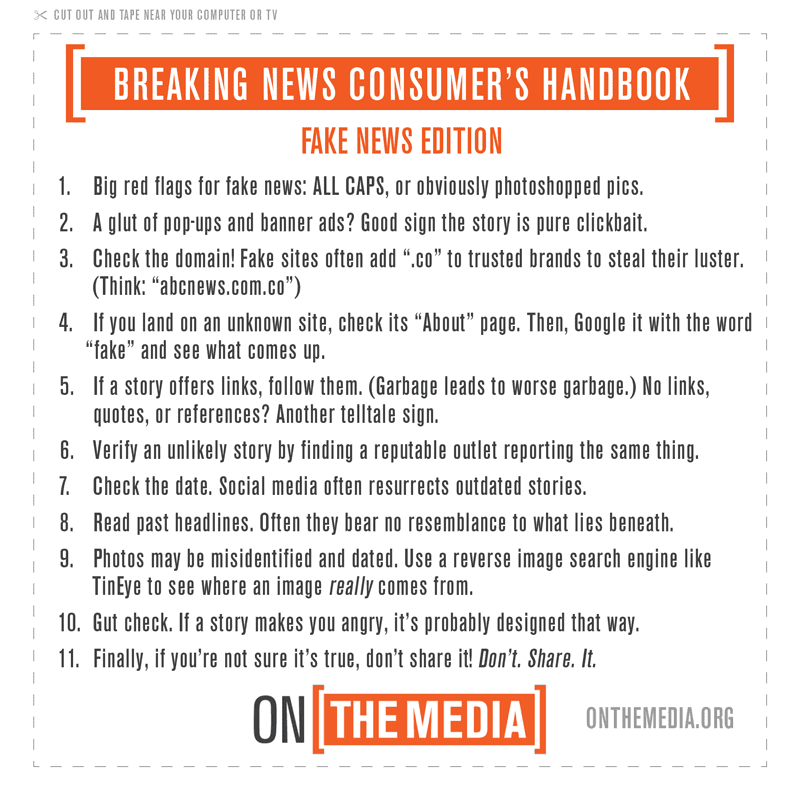
Breaking News Consumer's Handbook: Fake News Edition | WNYC

Fake news | Media | Podcast

November 18, 2016


Wednesday, April 26, 2017

Google to Revise Search Rankings to Downplay Fake News, Hate Speech | April 25, 2017

Fake news | Google | Information retrieval

by Wayne Rash

NEWS ANALYSIS: Google says it will downgrade the search rank of websites that show a clear pattern of distributing fake news, hate speech or deliberately misleading information.


By now you’re familiar with the problem of fake news. Some sites, claiming to provide news actually work with an agenda to present stories that spread their point of view, regardless of any connection with the facts.

The issue of fake news or what used to be known as political propaganda, came to the forefront during the presidential campaign in 2016, when it appears that the Russian government was working to help create and spread fake news in an effort to derail the campaign of Hillary Clinton.

Such efforts are continuing in Europe during current elections in Germany and France and again the Russian government is suspected to be backing those efforts. But fake news isn’t just the purview of the Russians. A number of right-wing and “alt-right” groups are also hard at work doing the same thing. Read more...

Monday, March 6, 2017

Facebook has quietly rolled out its long-awaited solution to fake news | 4 March 2017

Fake news | Media literacy | Social Media

by Emma Hinchliffe


Since people first started complaining about "fake news" on Facebook, the phrase has evolved—from a useful way to identify false-information-masquerading-as-traditional-news, to a term that means basically nothing, now wielded by President Donald Trump against stories he doesn't like, and also, drunk people in bars screaming about things and/or sports results they disagree with.

But the original problem still genuinely exists. And Facebook finally came out with its long-awaited response to beginning to cut away at the issue.

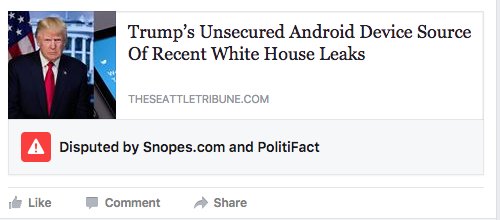
Spotted on Twitter on Friday night, the tool identifies links to sites known to produce misinformation. The tool cites third-party fact-checking organizations like Snopes and Politifact—the kind of sites that Trump supporters also like to dispute.  Read more...

Thursday, March 2, 2017

Fighting Fake News: How libraries can lead the way on media literacy | December 27, 2016

Fake news | Information literacy | Journalism

by Marcus Banks

Illustration: Rebecca Lomax/American Libraries  
Librarians—whether public, school, academic, or special—all seek to ensure that patrons who ask for help get accurate information.


Given the care that librarians bring to this task, the recent explosion in unverified, unsourced, and sometimes completely untrue news has been discouraging, to say the least. According to the Pew Research Center, a majority of US adults are getting their news in real time from their social media feeds. These are often uncurated spaces in which falsehoods thrive, as revealed during the 2016 election. To take just one example, Pope Francis did not endorse Donald Trump, but thousands of people shared the “news” that he had done so.

Completely fake news is at the extreme end of a continuum. Less blatant falsehoods involve only sharing the data that puts a proposal in its best light, a practice of which most politicians and interest group spokespeople are guilty.

The news-savvy consumer is able to distinguish fact from opinion and to discern the hallmarks of evasive language and half-truths. But growing evidence suggests that these skills are becoming rarer. A November 2016 study by the Stanford History Education Group (SHEG) showed that students have difficulty separating paid advertising from news reporting, and they are apt to overlook clear evidence of bias in the claims they encounter. These challenges persist from middle school to college.

According to SHEG Director Sam Wineburg, professor at Stanford Graduate School of Education, “nothing less than our capacity for online civic reasoning is at risk.”

Librarians and journalists: natural allies

Read more...

Thursday, February 23, 2017

Yellow Journalism: The “Fake News” of the 19th Century

Fake news | Journalism | Alternate facts |Tabloids
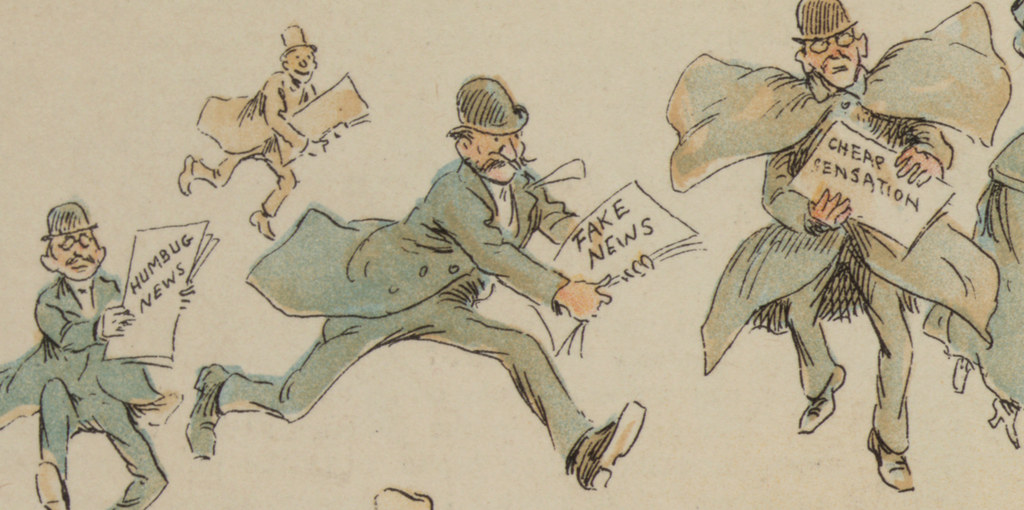
Detail from The Fin de Siècle Newspaper Proprietor, an illustration featured in an 1894 issue of Puck magazine. Amid the flurry of eager paper-clutching public, one holds a publication brandished with the words “Fake News”. See full image below — Source.  
It is perhaps not so surprising to hear that the problem of “fake news” — media outlets adopting sensationalism to the point of fantasy — is nothing new. Although, as Robert Darnton explained in the NYRB recently, the peddling of public lies for political gain (or simply financial profit) can be found in most periods of history dating back to antiquity, it is in the late 19th-century phenomenon of “Yellow Journalism” that it first seems to reach the widespread outcry and fever pitch of scandal familiar today. Why yellow? The reasons are not totally clear. Some sources point to the yellow ink the publications would sometimes use, though it more likely stems from the popular Yellow Kid cartoon that first ran in Joseph Pulitzer’s New York World, and later William Randolph Hearst’s New York Journal, the two newspapers engaged in the circulation war at the heart of the furore.

Although these days his name is somewhat synonymous with journalism of the highest standards, through association with the Pulitzer Prize established by provisions in his will, Joseph Pulitzer had a very different reputation while alive. After purchasing The New York World in 1884 and rapidly increasing circulation through the publication of sensationalist stories he earned the dubious honour of being the pioneer of tabloid journalism. He soon had a competitor in the field when his rival William Randolph Hearst acquired the The New York Journal in 1885 (originally begun by Joseph’s brother Albert). The rivalry was fierce, each trying to out do each other with ever more sensational and salacious stories. At a meeting of prominent journalists in 1889 Florida Daily Citizen editor Lorettus Metcalf claimed that due to their competition “the evil grew until publishers all over the country began to think that perhaps at heart the public might really prefer vulgarity”.  Read more...

Tuesday, February 21, 2017

Trump ally Roger Stone: Americans can now choose 'alternative' truths | February 20, 2017

Fake news | Alternate media | Book review | Author interview

Ed Pilkington
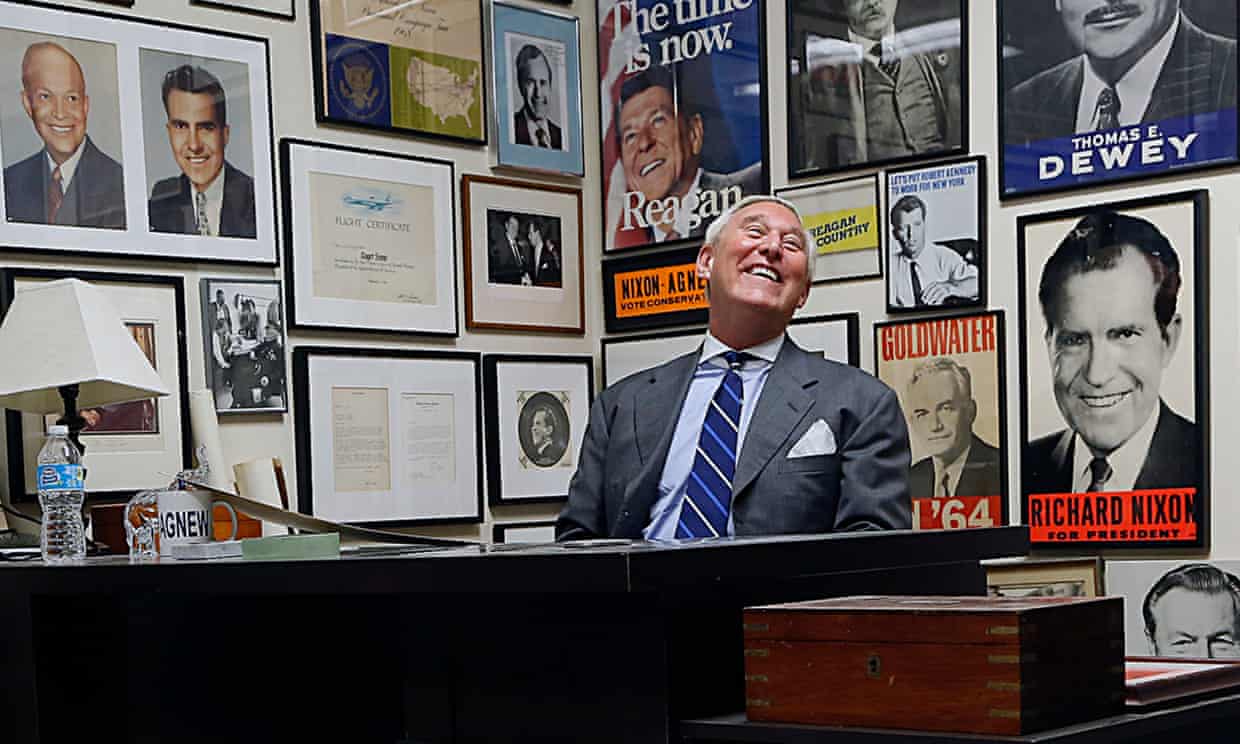
Roger Stone, pictured at his office in Fort Lauderdale, Florida: ‘Politics is a contact sport.’ Photograph: Miami Herald/MCT via Getty Images     
As Donald Trump was hitting his stride at his White House press conference this week, doing what he does best – denigrating journalists, spreading falsehoods about his electoral victory, offering science lessons on the uses of uranium – text messages started pinging on the cellphones of news anchors sitting in the front row.

“He should do this with a therapist, not on live TV,” one text reportedly said. It came from an interesting source: a Republican US senator.

It is one month into the Trump administration and all of Washington, most of the United States, and sizable chunks of the globe are transfixed by the new White House incumbent. While his supporters remain ecstatic about his entirely unorthodox approach to the most powerful job on Earth, millions of others – among them, it seems, Republican senators – are scratching their own heads and wondering how to understand what is going on inside his. Read more...