Pages

Showing posts with label Digital divide. Show all posts

Tuesday, February 21, 2017

The Trump administration’s other war on the media | February 14, 2017

Opinion | Net Neutrality | Digital Divide | Journalism

By  Katrina vanden Heuvel

FCC Commissioner Ajit Pai in Washington in 2013. (Susan Walsh/Associated Press)

The Trump administration’s unrelenting attacks on the media and assault on reality have been well covered by journalists and media outlets that find themselves in the new administration’s crosshairs. Yet while the White House’s insistence on “alternative facts” may be more visibly ominous, there is another growing threat to the independent media that also demands our attention. 

Despite his crusade against the press, Trump’s contempt does not seem to apply to the massive conglomerates — such as Comcast and Verizon — with so much influence over what the American people watch on television and read on the Internet. And at a time when extreme commercialization has helped drive the decline of accountability journalism, Trump and his recently appointed Federal Communications Commission chairman, Ajit Pai, have signaled their intention to exacerbate the problem. Read more...

Wednesday, February 24, 2016

Introducing Open eBooks


"Today, the White House announced that the Open eBooks app to put ebooks in the hands of lower-income children and young adults aged 4-18, is up and running. The Open eBooks service to provide age appropriate reading materials, was developed in partnership with the Digital Public Library of America, the New York Public Library, FirstBook, and Baker & Taylor. With the app, the Open eBooks service can begin."
First Lady Michelle Obama released a video (1:02) explaining the initiative.

Thursday, February 4, 2016

The loss of libraries is another surefire way to entrench inequality Mary O'Hara Mary O'Hara

 ‘Having a library within walking distance of home was a way for a young girl from a poor background to access the same breadth of reading material as anyone else.’ Photograph: Getty Images

As someone who grew up in a home without books, no spare cash to buy them and no tradition of reading bedtime stories, my local library offered something unique and indispensable. It’s hard to think of anything that brought me more joy as a primary school-aged child than walking back from the Falls Road library in west Belfast with a bundle of books.

Having a library within walking distance of home was a way for a young girl from a poor background to access the same breadth of reading material as anyone else – at no expense. It stripped away at least some of the disadvantage that came with being from a low-income family. So every time I hear of another library closure – and there were more than 100 last year alone in Scotland, Wales and England, according to official figures – it hits a nerve. The loss of libraries is simply another surefire way to entrench inequality.
From providing books for people of all ages and backgrounds, to kids clubs and hubs for older people, to computer terminals that those with no access to the internet can use to find job vacancies, libraries are about as democratic and diverse as is possible to imagine. When properly funded and resourced they are educational and social anchors in communities everywhere. Yet, despite knowing all this, in the past five years the relentless funding constraints placed on local authorities have seen library budgets slashed by an astounding amount.  Read more...


Thursday, November 12, 2015

Libraries are changing international development By Jacob Brogan


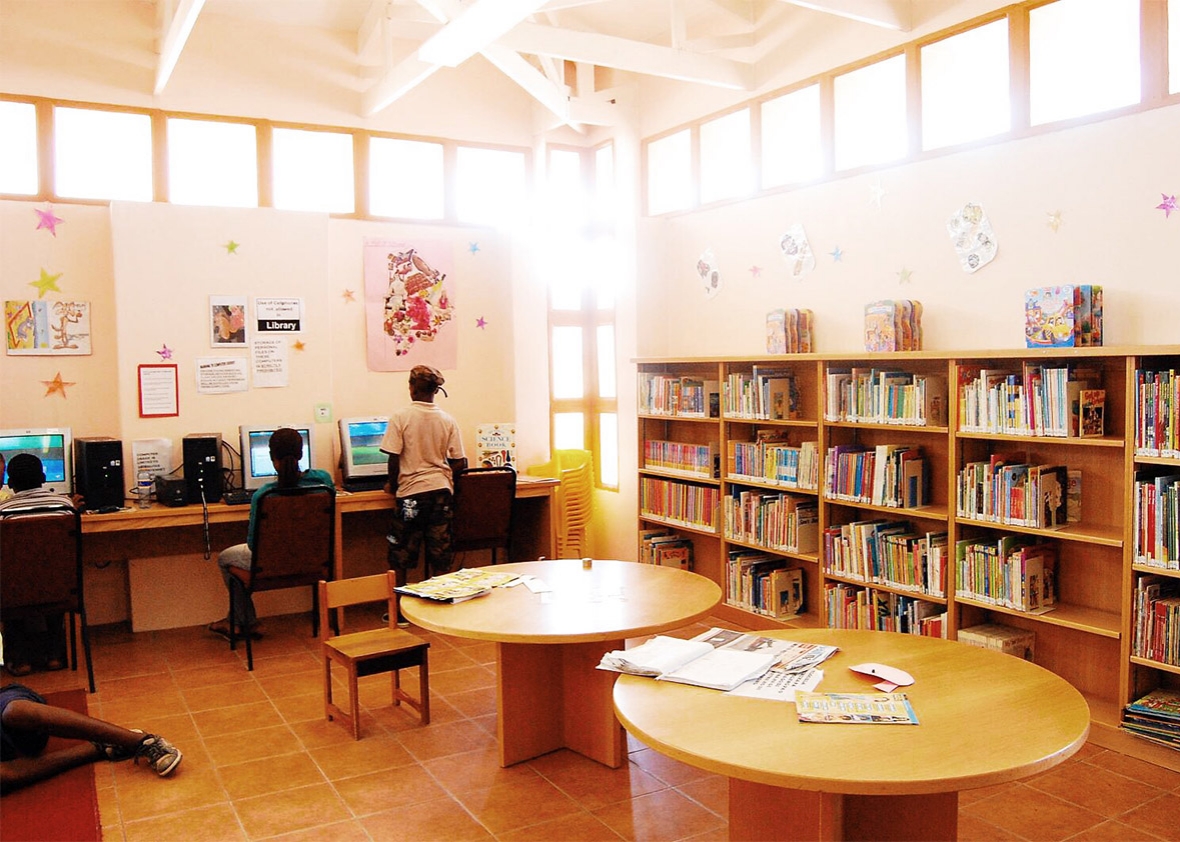
Mmankgodi Community Library in Botswana, where the Gates Foundation has helped create library services designed to encourage small business development.


This article is part of Future Tense, a collaboration among Arizona State UniversityNew America, and Slate. On Thursday, Nov. 12, Future Tense will host an event in Washington, D.C., on the future of the library. For more information and to RSVP, visit the New America website.
Discussions of the future of libraries are often surprisingly nostalgic endeavors, producing laments for vanished card catalogs or shrinking book stacks rather than visions of what might be. Even at their most hopeful, such conversations sometimes lose track of the pragmatic functions that libraries serve. Imagined as unchanging archives, libraries become mere monuments to our analog past. But envisioning them as purely digital spaces also misses the mark, capturing neither what they can be nor the way their patrons use them.
According to a recent report by the Pew Research Center, low-income and minority Americans are far more likely than others to assert that they would be negatively affected if their local library closed. The survey suggests that this has much, or more, to do with access to computers and the Internet—which is critical for job searchers and entrepreneurs—as it does with the opportunity to check out books. Public libraries aren’t just educational destinations; they also provide access to economic opportunities available through few other venues.  Read more...

Wednesday, July 22, 2015

How libraries can compete with Google and Amazon

Every kid needs a tablet nowadays. (AP Photo/Eric Gay)


Visit the Central branch of New York City’s Queens Library at 12:55 pm on a Tuesday, and you’ll see about 100 people outside, waiting for the doors to open. At 1 pm they file in: Some settle in the comfy saucer chairs, while others rest in armchairs facing four TVs and open a newspaper. Splashes of blue and green interrupt white walls, and computer areas are separated by category: job information, adult learning center, and “young adult learning.”

But the reach of the Queens Library extends beyond the walls of its 65 physical branches. Dotting the borough are thousands of New Yorkers logged into their own mini-libraries, using the library’s mobile app to do research for homework, or the WiFi hotspots they checked out to fill in the holes in broadband access at home, or accessing e-books on one of the libraries’ tablets they can take home.

Throughout the country, library initiatives are emerging to keep up with technological advances. And libraries are finding that one population they can serve better than anyone else is low-income Americans.


Read more: http://qz.com/454586/how-libraries-can-compete-with-google-and-amazon/

Monday, August 13, 2012

Three essential features of any ebook business model for your library | District Dispatch

Three essential features of any ebook business model for your library | District Dispatch
Jazzy Wright


Nationwide, many libraries are facing constraints from publishers on how ebooks can be used—publishers are limiting the number of ebook loans, perpetuating the print model of one user per ebook license purchased, and restricting consortial and interlibrary loans.
To address library concerns about the ebook market, the American Library Association (ALA) today released “Ebook Business Models for Public Libraries,(pdf)” a report that describes general features and attributes of the current ebook environment and outlines constraints and restrictions of current business models. Additionally, the timely report suggests opportunities for publishers to showcase content through public libraries.
The report was created by the ALA Digital Content & Libraries Working Group (DCWG), an ALA working group created to address digital content issues and assist libraries in the adoption of new digital formats and content. Read More


 Copyright, Digital Divide, Digital Literacy, Library Advocacy, OITP, Public Libraries, Technology, the Internet, and Telecommunications and tagged , , , , , , .
Enhanced by Zemanta