Fake news | Journalism | Alternate facts |Tabloids
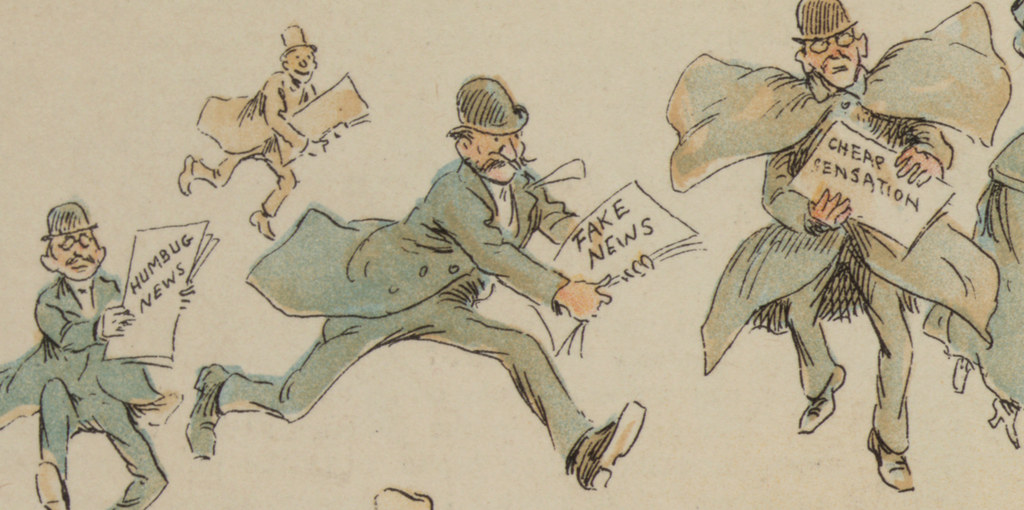 |
| Detail from The Fin de Siècle Newspaper Proprietor, an illustration featured in an 1894 issue of Puck
magazine. Amid the flurry of eager paper-clutching public, one holds a
publication brandished with the words “Fake News”. See full image below —
Source. | | |
It is perhaps not so surprising to hear that the problem of “fake news” —
media outlets adopting sensationalism to the point of fantasy — is
nothing new. Although, as Robert Darnton
explained in the NYRB
recently, the peddling of public lies for political gain (or simply
financial profit) can be found in most periods of history dating back to
antiquity, it is in the late 19th-century phenomenon of “Yellow
Journalism” that it first seems to reach the widespread outcry and fever
pitch of scandal familiar today. Why yellow? The reasons are not
totally clear. Some sources point to the yellow ink the publications
would sometimes use, though it more likely stems from the popular Yellow
Kid cartoon that first ran in Joseph Pulitzer’s
New York World, and later William Randolph Hearst’s
New York Journal, the two newspapers engaged in the circulation war at the heart of the furore.
Although these days his name is somewhat synonymous with journalism of
the highest standards, through association with the Pulitzer Prize
established by provisions in his will, Joseph Pulitzer had a very
different reputation while alive. After purchasing
The New York World
in 1884 and rapidly increasing circulation through the publication of
sensationalist stories he earned the dubious honour of being the pioneer
of tabloid journalism. He soon had a competitor in the field when his
rival William Randolph Hearst acquired the
The New York Journal
in 1885 (originally begun by Joseph’s brother Albert). The rivalry was
fierce, each trying to out do each other with ever more sensational and
salacious stories. At a meeting of prominent journalists in 1889
Florida Daily Citizen
editor Lorettus Metcalf claimed that due to their competition “the evil
grew until publishers all over the country began to think that perhaps
at heart the public might really prefer vulgarity”.
Read more...