Pages

Showing posts with label censorship. Show all posts

Thursday, January 14, 2021

Defining Censorship Before Denouncing It ( Posted by Larry M. Elkin, CPA, CFP®)


If the opinion editors at The New York Times decline to publish your cogent and insightful essay on a matter of great public importance, are they practicing censorship?

No. They are exercising editorial judgment, or maybe mere business judgment, depending on the pressures they feel nowadays to get audiences to engage with their content. It may be good judgment or bad judgment, but it is not censorship. Censorship occurs when the government restricts or compels expression under threat of penalties, which may be administrative, judicial or extrajudicial, such as directing a mob to your home. The New York Times is a privately owned, privately run platform, which its proprietors may offer to or withhold from contributors as they see fit. To demand they do otherwise would run afoul of the First Amendment’s press and speech freedom guarantees.


Read artcile: https://www.palisadeshudson.com/2021/01/defining-censorship-before-denouncing-it/

Tuesday, March 13, 2018

Banning literature in prisons perpetuates system that ignores inmate humanity

Censorship | Prison libraries | Human rights


Lawsuit among latest reminders that reading, education can help ensure that prisoners who gain freedom, keep it
(Photo: John David Mercer, AP)   

Last month, the publisher of Prison Legal News became one of the latest organizations to take action against the nation's prison systems for censorship.

The Human Rights Defense Center lawsuit targets the Illinois Department of Corrections and alleges that it keeps HRDC literature out of the hands of prisoners, including the monthly Prison Legal News magazine — which covers court rulings and other aspects of the criminal justice system.

 Read more:

https://www.usatoday.com/story/opinion/policing/spotlight/2018/03/09/banning-literature-prisons-perpetuates-system-ignores-inmate-humanity/397501002/

Tuesday, May 16, 2017

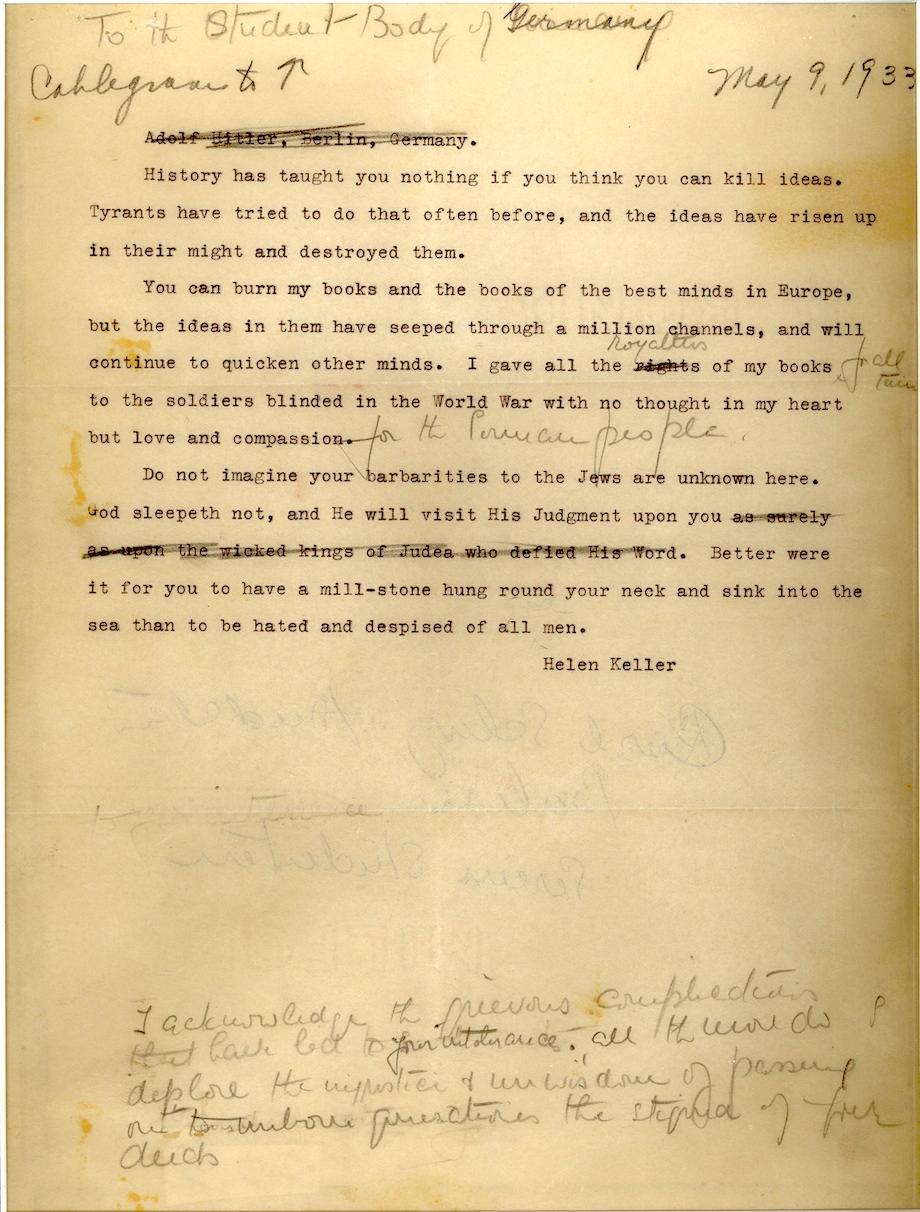
Helen Keller Writes a Letter to Nazi Students Before They Burn Her Book: “History Has Taught You Nothing If You Think You Can Kill Ideas” (1933)

Book burning | Holocaust | Diversity

Open culture  | History May 16, 2017

Helen Keller achieved notoriety not only as an individual success story, but also as 
 prolific essayist, activist, and fierce advocate for poor and marginalized people. She “was a lifelong radical,” writes Peter Dreier at Yes! magazine, whose “investigation into the causes of blindness” eventually led her to “embrace socialism, feminism, and pacifism.” Keller supported the NAACP and ACLU, and protested strongly against patronizing calls for her to “confine my activities to social service and the blind.” Her critics, she wrote, mischaracterized her ideas as “a Utopian dream, and one who seriously contemplates its realization indeed must be deaf, dumb, and blind.”

Twenty years later she found a different set of readers treating her ideas with contempt. This time, however, the critics were in Nazi Germany, and instead of simply disagreeing with her, they added her collection of essays, How I Became a Socialist, to a list of “degenerate” books to be burned on May 10, 1933. Such was the date chosen by Hitler for “a nationwide ‘Action Against the Un-German Spirit,’” writes Rafael Medoff, to take place at German Universities—“a series of public burnings of the banned books” that “differed from the Nazis’ perspective on political, social, or cultural matters, as well as all books by Jewish authors.”  Read more...

Wednesday, February 22, 2017

Preserving U.S. Government Websites and Data as the Obama Term Ends | December 15, 2016

Internet archive | Government Websites | Data preservation

 Posted by Jefferson

Long before the 2016 Presidential election cycle librarians have understood this often-overlooked fact: vast amounts of government data and digital information are at risk of vanishing when a presidential term ends and administrations change.  For example, 83% of .gov pdf’s disappeared between 2008 and 2012. 


That is why the Internet Archive, along with partners from the Library of Congress, University of North Texas, George Washington University, Stanford University, California Digital Library, and other public and private libraries, are hard at work on the End of Term Web Archive, a wide-ranging effort to preserve the entirety of the federal government web presence, especially the .gov and .mil domains, along with federal websites on other domains and official government social media accounts.

While not the only project the Internet Archive is doing to preserve government websites, ftp sites, and databases at this time, the End of Term Web Archive is a far reaching one.

Read more....

Tuesday, February 14, 2017

Why these librarians are protesting Trump’s executive orders | Elizabeth Flock

Activism | Access | Fake news | Immigration Ban

February 13, 2017

A “Libraries Are For Everyone” poster in Arabic. Credit: Rebecca McCorkindale

“Libraries Are For Everyone.” That’s the message of a series of images created by Rebecca McCorkindale in the days after President Donald Trump announced the temporary travel ban on seven Muslim-majority countries. She never expected her signs of inclusion to go further than a handful of libraries. 

But by the time she’d woken up the following day, she had received messages from librarians across the world wanting their languages represented. And libraries across the country — in Illinois, Minnesota, California, Virginia — had begun putting up the images as posters, along with displays about books on Islam, empathy and being a good neighbor. 

McCorkindale, who is assistant library director and creative director at the Gretna, Nebraska, public library, said she created the images because she believes librarians can and should be activists.
“Libraries are the heart of a community, for anyone and everyone that lives there, regardless of their background,” she said. “And so we strongly believe that libraries are not neutral. We stand up for human rights.”

She is not the only one. Since Mr. Trump took office a little more than three weeks ago, a vocal and growing number of librarians across the country have begun to take a more politically active stance.
Read more...

Wednesday, October 5, 2016

How Banning Books Marginalizes Children by Paul Ringel

Banned Books

Oct. 1, 2016 [from The Atlantic]
Since the 1800s, attitudes about which books are “appropriate” for kids to read have too often suppressed stories about different cultures and life experiences. Comstock / Getty

Every year since 1982, an event known as Banned Books Week has brought attention to literary works frequently challenged by parents, schools, and libraries. The books in question sometimes feature scenes of violence or offensive language; sometimes they’re opposed for religious reasons (as in the case of both Harry Potter and the Bible). But one unfortunate outcome is that 52 percent of the books challenged or banned in the last 10 years feature so-called “diverse content”—that is, they explore issues such as race, religion, gender identity, sexual orientation, mental illness, and disability. As a result, the organizers of Banned Books Week, which started Sunday, chose the theme “Celebrating Diversity” for 2016.

Since the inception of the American children’s literature industry in the 1820s, publishers have had to grapple with the question of who their primary audience should be. Do kids’ books cater to parents and adult cultural gatekeepers, or to young readers themselves? But as books that address issues of diversity face a growing number of challenges, the related question of which children both the industry and educators should serve has become more prominent recently. Who benefits when Sherman Alexie’s The Absolutely True Diary of Part-Time Indian, which deals with racism, poverty, and disability, is banned for language and “anti-Christian content”? Who’s hurt when Jessica Herthel and Jazz Jennings’s picture book I Am Jazz, about a transgender girl, is banned? The history of children’s book publishing in America offers insight into the ways in which traditional attitudes about “appropriate” stories often end up marginalizing the lives and experiences of many young readers, rather than protecting them Read more...

Thursday, June 16, 2016

The Freedom to Read: The history of ALA's vital statement on intellectual freedom

March 15, 2016

US President Dwight D. Eisenhower (left) and Dartmouth President John Sloan Dickey at the Dartmouth College commencement, June 14, 1953. Courtesy of Dartmouth College Library   

“Don’t join the book burners,” President Dwight D. Eisenhower implored Dartmouth College graduates on June 14, 1953. “Don’t be afraid to go to your library and read every book as long as any document does not offend your own ideas of decency.”

Eisenhower’s words shocked many because they constituted his first public challenge to McCarthyism—an ethos enveloping the country at the time and fed by Senator Joseph McCarthy (R-Wis.), who inferred communist conspiracies everywhere in American culture, including books on the shelves of 194 information libraries that the US State Department operated in 61 foreign countries.

Like-minded individuals also saw communist threats in the images on the covers of magazines, paperbacks, and comics that were stacked face-out on newsstand racks across the country. The US House of Representatives even set up a Select Committee on Current Pornographic Materials to investigate the publishers. Outside Washington, the National Organization for Decent Literature (NODL) sponsored by the Roman Catholic Church issued monthly lists of condemned titles that local parishioners used to police newsstands (and, on occasion, local public library shelves). Owners who passed muster received NODL seals of approval to display in their windows; sales at newsstands that did not display a seal invariably suffered. Read more...

Wednesday, September 30, 2015

It’s Banned Books Week again. Can we stop yelling at each other about it?

Author Jacqueline Woodson (Marty Umans)

   
Early in her career as a writer, Jacqueline Woodson got some disturbing news from none other than Judy Blume.
Blume was editing an anthology of works by banned authors and wanted to include her.
“But I haven’t been banned,” Woodson said.
“Oh, yes you have!” Blume told her.
Woodson, the author of such books as “Brown Girl Dreaming” and “Hush,” has since won a National Book Award and been named Young People’s Poet Laureate by the Poetry Foundation. Yet she still finds her work under fire in libraries and schools around the country for its depiction of sexuality, drug use, prison and interracial relationships.
According to the American Library Association, books for young adults — the kind Woodson writes — are now “the majority of the most frequently challenged books.”
During Banned Books Week (Sept. 27 to Oct. 3), you’ll see the usual celebrations of censored classics, such as “I Know Why the Caged Bird Sings” and “The Catcher in the Rye,” alongside more recent works, such as “The Kite Runner” and the “Harry Potter” series. Many bookstores, like One More Page Books in Arlington, Va., have set up special displays to promote titles that have weathered persistent objections.
Read more: https://www.washingtonpost.com/entertainment/books/its-banned-books-week-again-can-we-stop-yelling-at-each-other-about-it/2015/09/27/d7860518-6399-11e5-9757-e49273f05f65_story.html?postshare=661443447417043

Monday, August 31, 2015

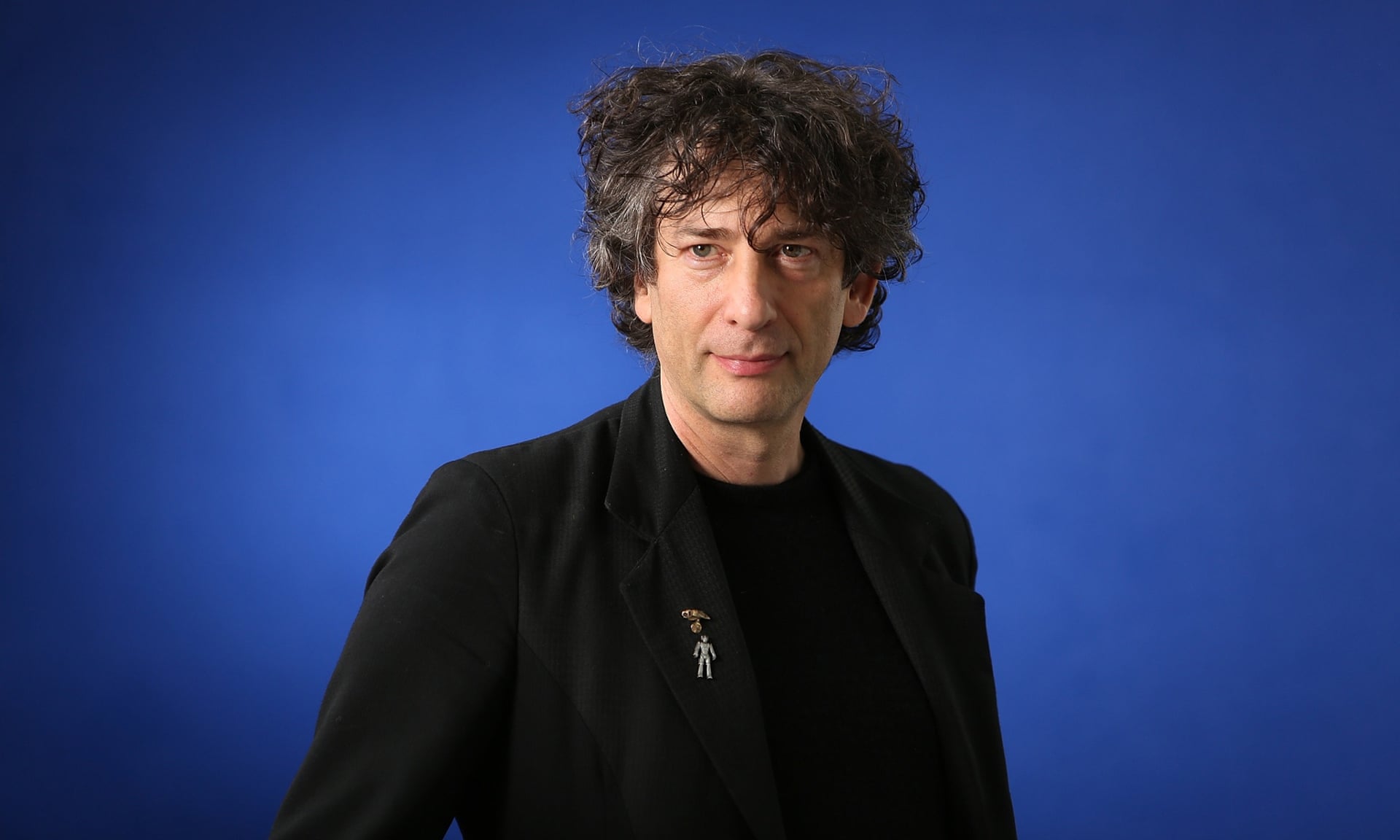
Neil Gaiman: 'my parents didn’t have any kind of rules about what I couldn’t read'

Do you remember reading any books as a child that were in some way disapproved of or forbidden? If yes, did they traumatise you for life, or did the subversive element make them more enjoyable?

I was really lucky in that my parents definitely didn’t seem to have any kind of rules about what I couldn’t read. And that was wonderful, because it meant that whatever was on the shelves, if it was interesting, I could pick it up and I was allowed to read it.


Read more: http://www.theguardian.com/childrens-books-site/2015/aug/29/neil-gaiman-banned-books-censorship-interview?CMP=fb_us

Thursday, July 23, 2015

“We have reached a point of no return” Russia’s most renowned librarian talks to ‘Meduza’ about state inspections, foreign agents, and cultural exchange


Американский культурный центр, занятия летней школы сценаристов. Июнь 2015-го Фото:
Photo: American Center's vk.com page

Renowned librarian and cultural critic Ekaterina Genieva passed away on July 9 in Israel after a battle with cancer. Genieva had served as the head of the All-Russia State Library of Foreign Literature for nearly a quarter of a century, right up until her death. In the late 1990s and early 2000s, she also worked as the President of George Soros’ Open Society Institute in Russia. This week, the Open Society Institute came under government scrutiny for “threatening Russia’s interests.” Authorities had also been paying special attention to Genieva’s library, asking her to shut down the American Cultural Center, one of many international organizations her library hosts. Shortly before she passed away, Ekaterina Genieva was interviewed by Katerina Gordeeva for Meduza. Genieva shared her thoughts about the Ministry of Culture, about Russia’s “spy fever,” and about the importance of cultural exchange.
Requirements imposed on public educational and cultural projects are becoming ever more stringent. Against this backdrop, the Library of Foreign Literature looks almost provocative: it’s a whole community of intellectuals, you have books about tolerance, you host concerts with musicians who have gone out of favor with the state, you also host a dozen foreign cultural centers in this building. How close are you to becoming a “foreign agent?”


Read more: https://meduza.io/en/feature/2015/07/10/we-have-reached-a-point-of-no-return

Tuesday, July 21, 2015

Adults Are More Likely To Believe There Are Books That Should Be Banned Than Movies, Television Shows, or Video Games

Percentage who feel some books should be banned has increased 10 points since 2011; Three in ten Americans are more likely to read a book if it’s banned

08:00 AM EDT Jul 8, 2015 


NEW YORK, N.Y. – In just four years, the percentage of Americans who believe there are any books that should be banned has increased by more than half: 28% believe this to be the case today, vs. 18% in 2011.  One-fourth (24%) are unsure, which leaves nearly half of Americans convinced that no books should be banned completely (48%).
  • Politically speaking, Republicans are nearly twice as likely as Democrats or Independents to believe there are any books that should be banned completely (42% vs. 23% & 22%, respectively).  
  • In addition, adults who have completed high school or less  are more likely than those with higher levels of education to believe there are any books that should be banned (33%, vs. 25% some college, 24% college grad, 23% post grad).
These are some of the results of The Harris Poll® of 2,244 U.S. adults surveyed online and in English between March 11 and 16, 2015.
“The things they're doing and saying in films right now just shouldn't be allowed.”  ― Mae West
When asked to consider other types of media, adults are less likely to say there are any movies, television programs, or video games which should be banned completely. Only 16% of Americans each believe there are any movies or television programs that should be banned completely, and one fourth say the same about video games (24%).  In light of this, perhaps it’s not surprising that seven in ten adults believe a rating system (similar to that used for movies) should be applied to books (71%).
Similar to books, Republicans are more likely than Democrats or Independents to believe there’s ever a call for outright bans in each of these categories.
  • Movies: 24% Republicans vs. 15% Democrats & 12% Independents
  • Television: 23% Republicans vs. 16% Democrats & 12% Independents
  • Video games: 32% Republicans vs. 23% Democrats & 20% Independents
  • Read more...


Tuesday, February 24, 2015

ISIS Burns 8000 Rare Books and Manuscripts in Mosul - Yahoo Finance

ISIS Burns 8000 Rare Books and Manuscripts in Mosul


While
the world was watching the Academy Awards ceremony, the people of Mosul
were watching a different show. They were horrified to see ISIS members
burn the Mosul public library. Among the many thousands of books it
housed, more than 8,000 rare old books and manuscripts were burned.

“ISIS militants bombed the Mosul Public Library.
They used improvised explosive devices,” said Ghanim al-Ta'an, the
director of the library. Notables in Mosul tried to persuade ISIS
members to spare the library, but they failed. Read more...

Monday, November 3, 2014

Poverty and class: the latest themes to enter the US banned-books debate | Mary O’Hara | Society | The Guardian


Young readers in Florida enjoy the freedom to choose their library
books, but campaigners are attempting to restrict content that deals
with the challenges of low income. Photograph: Paul Hennessy/Polaris 
Late last month, for the 32nd year in a row, Banned Books Week was marked across the US. Spearheaded by the American Library Association’s (ALA) Office for Intellectual Freedom,
the annual salute to the freedom to read has become a fixture. It aims
to counterbalance perennial challenges to the content of books and
efforts to get them banned, usually from schools and libraries.

The ALA collects information on which books are objected to and
reports on prominent recurring themes that tend to generate moral or
ideological indignation. Subjects such as religion, race, gender, sexuality and allegations of sexually explicit content or offensive language frequently top the list. Read article...

Tuesday, August 27, 2013

Libraries vary in availability of materials to minors - chicagotribune.com


When library trustees in north suburban Morton Grove learned that a 16-year-old employee would oversee the showing of an R-rated film at the institution, some of them requested that an adult take over the job.

The incident represents another page in the ongoing debate over the accessibility of adult-themed materials to young library patrons.

"It would be highly offensive to a great number of residents of Morton Grove that the library is using their tax money to employ a 16-year-old to show movies that, under the same circumstances, that person would not be allowed to attend … without parental accompaniment," said Trustee Catherine Peters. Read more...
Enhanced by Zemanta

Monday, December 19, 2011

Book burning - Wikipedia, the free encyclopedia

Book burning -

Books burned by the Nazis, on display at Yad Vashem


Book burning, biblioclasm or libricide is the practice of destroying, often ceremoniously, books or other written material and media. In modern times, other forms of media, such as phonograph records, video tapes, and CDs have also been ceremoniously burned, torched, or shredded. The practice, usually carried out in public, is generally motivated by moral, religious, or political objections to the material.
Some particular cases of book burning are long and traumatically remembered - because the books destroyed were irreplaceable and their loss constituted a severe damage to cultural heritage, and/or because this instance of book burning has become emblematic of a harsh and oppressive regime. Such were the destruction of the Library of Alexandria, the obliteration of the Library of Baghdad, the burning of books and burying of scholars under China's Qin Dynasty, the destruction of Aztec codices by Spanish conquistadors and priests, and the Nazi book burnings of Jewish literature.
Although one motivation for book burning may be censorship, it is in most cases an act of displaying severe displeasure, hatred, or contempt for the book's contents or author, or to attract attention for the outrage perceived by those who highly appreciate the book and its content. For example, the burning of Beatles records after a remark by John Lennon concerning Jesus Christ, the destruction of the Sarajevo National Library, and the 2010 Qur'an-burning controversy.

From Wikipedia.  For full article, please click headline above.
Enhanced by Zemanta