Pages

Showing posts with label Reading. Show all posts

Wednesday, November 28, 2018

Bibliotherapy: how reading and writing have been healing trauma since World War I

Bibliotherapy | War trauma | World War I | Wounded veterans

15 November 2018
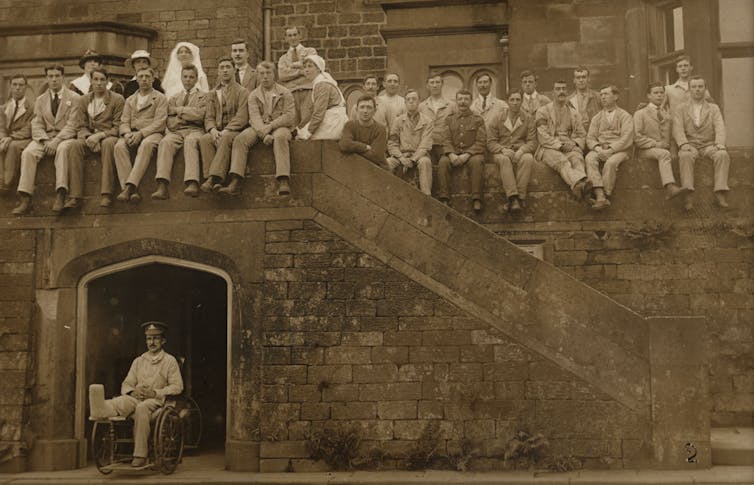
Longshaw Lodge Convalescent Home for Wounded Soldiers, Grindleford, near Sheffield. Tyne & Wear Archives & Museums


Bibliotherapy – the idea that reading can have a beneficial effect on mental health – has undergone a resurgence. There is mounting clinical evidence that reading can, for example, help people overcome loneliness and social exclusion. One scheme in Coventry allows health professionals to prescribe books to their patients from a list drawn up by mental health experts. 

Even as public library services across Britain are cut back, the healing potential of books is increasingly recognised.

The idea of the healing book has a long history. Key concepts were forged in the crucible of World War I, as nurses, doctors and volunteer librarians grappled with treating soldiers’ minds as well as bodies. The word “bibliotherapy” itself was coined in 1914, by American author and minister Samuel McChord Crothers. Helen Mary Gaskell (1853-1940), a pioneer of “literary caregiving”, wrote about the beginnings of her war library in 1918:
Surely many of us lay awake the night after the declaration of War, debating … how best we could help in the coming struggle … Into the mind of the writer came, like a flash, the necessity of providing literature for the sick and wounded.
The well-connected Gaskell took her idea to the medical and governmental authorities, gaining official approval. Lady Battersea, a close friend, offered her a Marble Arch mansion to store donated books, and The Times carried multiple successful public appeals. As Gaskell wrote:
What was our astonishment when not only parcels and boxes, but whole libraries poured in. Day after day vans stood unloading at the door.

Read more...

Thursday, August 31, 2017

How To Be a Book Lover on a Budget | BookRiot

Books | Budget | AudioBooks

by Rah Carter August 30, 2017

The book world can be full of snobbery. BookTube videos will tell us that if we can afford to pay for internet we can afford to buy every book we read. Never mind that the books I read per month are worth more than the price of my internet bill.  But this is part of an attitude that overflows with blind privilege and callousness. Many of us on tight budgets can’t afford to buy every, or even any, book that we read. Or we don’t have the space to keep them. Or we don’t have access to good bookstores. Or other circumstances that prevent us from living up to this bookish ideal. And that is okay. It is okay to read and love books in a way that fits your personal economic and social circumstances. Anyone who suggests otherwise is a jerk.

First let’s talk about libraries, the most obvious port of call when looking at reading on a budget. If you live within easy access of a public library, they can be an absolute lifeline. While homeless, I found that libraries are warm, dry, comfortable, free places to go. [This is also useful if you don’t have heating/air-conditioning in your home]. I could use their electricity for free to charge my phone. There is access to free WiFi and computers and a quiet place to study or relax. Many libraries also offer classes for adults and activities for children. And then there’s all the books, audiobooks, music, DVD’s, games, newspapers to read, borrow, and play for free or a very low fee. 

If the public library isn’t accessible for you, or you want more choice, there are other options.


save money on booksRead more

Tuesday, August 29, 2017

Bookshelves and Tips for Organising a Book Collection | Bookriot

Books | Reading


Ah, the perennial problem: too many books and too little space. What to do when, once again, your bookshelves are full and not every book has a proper home? The topic of book organising is one we’ve covered before (on unusual bookshelves, tips and steps on organising your collection, and ways to organise your books other than alphabetically), but given that this seems to be an ongoing dilemma, I thought it was a topic worth revisiting. 


Organising a collection

Historically, public libraries were established for the creation of an enlightened citizenry and for the purposes of disseminating and archiving knowledge. Contemporary libraries have shifted in focus and exhibit multiple functions and purposes, including leisure and entertainment. This is evident in not only the content of their collections, but also in the order and display of collections. This also speaks to issues of power and knowledge: the power inherent in curation and display of knowledge, and the ability to influence which books are borrowed and read. How do librarians decide which classification system to use? How easy is it for serendipitous discovery? The way books are shelved and displayed affect how readers can find them; a library is not simply a collection of books, but a collection of books ordered in such a way that items can be found. Read more...

Tuesday, July 11, 2017

Want to Raise Your Child to Love Reading? Read These Secrets

Children's books | Literacy | Reading


A class at Public School 682, the Academy of Talented Scholars, in Brooklyn. Credit Joshua Bright for The New York Times

“You’re the children’s books editor?” Someone has said this to me, usually with a smile, at least once a week in the almost three years I’ve been at The New York Times. “What a cool job!” is the subtext. But lurking in the background are almost always other questions, sometimes more pressing ones about kids’ reading in general. “What should my second grader be reading?” a colleague asked the other day, adding, “She’s obsessed with the books in that series with the different flower fairies, and I can’t get her interested in anything else.” A neighbor recently approached me with a worried look and said, “My 10-year-old will only read graphic novels. What should I do?”

Clearly, there’s a lot of uncertainty out there among parents when it comes to children’s books, and also an earnest desire to make the right choices and do the right thing. Parents realize the stakes are high, and childhood passes quickly.

So when the Guides team approached Pamela Paul, the editor of the Book Review, about writing a guide to raising readers, and she asked if I was interested, I jumped at the chance. (Find it here.)

Much of what I do every day is sift through new books, deciding which ones we should assign for review, or which ones might make for a good feature story. I try to balance for different ages, different genres and books by authors from a variety of backgrounds. There’s always the thrill of discovering a book I can’t wait to tell our readers about. Read more...

Monday, June 12, 2017

How to Raise a Reader | The New York Times | Books

Children's literature | Reading | Parenting


From the moment you’re expecting your first child, you are bombarded with messages about the importance of reading. For good reason: The benefits of reading at every stage of a child’s development are well documented. Happily, raising a reader is fun, rewarding and relatively easy.
When you purchase a recommended book through our site, we earn an affiliate commission.

Start Them Early

First, Reacquaint Yourself With Reading

If you’ve let reading slide to the margins of your life, now is the time to bring it back. Make the space, and time, for books you read for yourself, and books you read with your child. If you want to raise a reader, be a reader.
 

Baby Books Are a Necessity


You may think you’re off the hook with books until your baby is at least vertical, but not so. Even newborns benefit from the experience of hearing stories (and they can’t complain about your taste in books). So take advantage. Here’s how:
Read more...


Monday, May 8, 2017

People who read books tend to be nicer than those who don't - [study]

Culture | Books | Reading


Reading: pretty good, apparently Credit: Danny Lawson/PA Wire 
 
Does reading books make you a nicer person? Or are nicer people more likely to be drawn to reading?

A recent study by researchers at Kingston University found that people who read works of fiction tend to be kinder and more empathetic.

"Exposure to fiction relates to a range of empathetic abilities," said researchers, who addressed the British Psychological Society conference in Brighton last week. Read more...

Monday, April 24, 2017

Meet the 13-Year-Old Pakistani Girl on a Mission to Read the World | April 24, 2017

Reading | Books | World Book Day | Literature

Celebrating World Book Day Every Day


A year ago, 12-year-old Aisha Esbhani, sitting in her home in Karachi, Pakistan, looked up at her bookshelf and realized that it was filled almost entirely with books by North American and British authors. Dissatisfied, Esbhani set herself a major challenge: to read a book from every country in the world, “as well as some extra territories.” To get help, she started a Facebook page for her project, and sent out a call for recommendations.

Not a usual project for a teenager, perhaps. When I asked Esbhani how she became such an avid reader, she told me that as a child, her mother would buy her books like Beauty and the Beast and Cinderella—but while she loved the movies, “the books never really caught my interest. Then, my brother gave me A Series of Unfortunate Events by Lemony Snicket. That series began my reading journey!” Well, I’m sure she’s not alone in that regard. Read more...


Saturday, April 8, 2017

WHY THE PRINTED BOOK WILL LAST ANOTHER 500 YEARS | October 14, 2015 By Adam Sternbergh

Books | Print vs. E-books | Reading | Trends


It’s always an intellectual mistake to assume that the thing you love the most might be the exception. I remember listening to a public-radio conversation a few years ago in which two people debated the necessity and romance of record stores (a very large and storied one in NYC had just closed) and thinking, Well, of course record stores are going to close, it’s sad but it’s the way of the world, and feeling kind of smug about it because I don’t frequent record stores. And then realizing a moment later that in two, or five, or maybe ten years time—or maybe sooner—I could be listening to two people on the radio having this exact same wistful conversation about bookstores.
I didn’t feel so smug after that.
Bookstores are a sacred space for me and books are hallowed objects. I’ve worked in two of the former and owned and treasured an innumerable number of the latter. (I honestly don’t know the number of books I currently own; I do know that when my wife and I moved most recently, our moving company charged us extra afterward because we’d seriously underestimated the number of boxes of books.) My first and favorite activity in any new city is to locate and visit the best bookstore; I literally Google the city’s name and “best bookstore” and see what comes up. This almost never fails to lead me not only to a great bookstore but to the best, most interesting neighborhood in town. Read more...

Wednesday, March 8, 2017

365 Books by Women Authors to Celebrate International Women’s Day All Year | March 8, 2017

Books | International Women's Day | Reader's advisory | Women writers

by Gwen Glazer, Librarian, Readers Services, NYPL


For over a century, International Women's Day has been observed on March 8 — and this year, we've compiled 365 books by women authors from across the globe to keep the celebration going all year long.

This list includes a vast range of women authors, and we hope you find some old favorites and some new discoveries. And we hope that readers can draw strength and inspiration from these 365 books — and the women who wrote them — in the year ahead.

And if you've ever heard someone say they “just couldn't find” a great woman author to read, now you have not one, but 365 suggestions.

1. Leila Aboulela, The Kindness of Enemies
2. Susan Abulhawa, The Blue Between Sky and Water
3. Chimamanda Ngozi Adichie, Half of a Yellow Sun
4. Etel Adnan, Sea and Fog
5. Marjorie Agosín, A Cross and a Star
6. Ama Atta Aidoo, An Angry Letter in January and Other Poems
7. Naja Marie Aidt, Rock, Paper, Scissors
8. Anna Akhmatova, The Complete Poems of Anna Akhmatova
9. Michelle Alexander, The New Jim Crow
10. Elizabeth Alexander, The Light of the World

Read more...

Wednesday, February 8, 2017

Want to Raise Successful Kids? Neuroscience Says Read to Them Like This (but Most Parents Don't)

Reading | Literacy | Parenting | Children's Literature

Read to young children in this way, and they'll develop greater intellectual empathy -- and become more successful.

By Bill Murphy Jr.

CREDIT: Getty Images  
If you're like most parents, you'll do just about anything you can to increase the odds that your kids will be successful.

So, what if I were to tell you there's a simple thing you can to do to make it more likely that they'll be successful in life -- specifically by increasing the likelihood that they'll learn to read other people, and even predict how they'll react?

What's more, while this parenting practice might be a bit more time-consuming than some alternatives, it can also be a lot of fun and increase your bond with your children.

We're talking about the way that parents read to their young kids. Neuroscientists say there's a trick that can make the daily bedtime ritual (one my wife and I enjoy with our daughter, and that you might well enjoy with your kids, too) far more effective and beneficial.
Here's the background -- plus how it works and why:

First off, of course, read to your kids. 

Read more...

Wednesday, January 25, 2017

1984 climbs the bestseller list — almost 70 years after it was published | January 24, 2017


Tuesday, January 10, 2017

Rumors of the Demise of Books Greatly Exaggerated | Gallup

Reading habits | Literacy

January 6, 2017

Rumors of the Demise of Books Greatly Exaggerated

by Art Swift and Steve Ander

Story Highlights

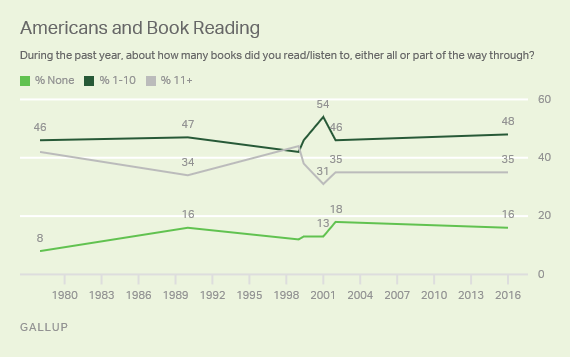
35% say they read more than 11 books in the past year
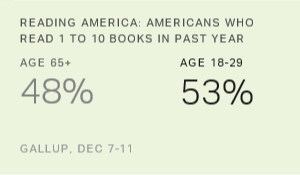
53% of young adults read between one and 10 books in the past year
73% prefer printed books to e-readers or audio books

WASHINGTON, D.C. -- Despite the abundance of digital diversions vying for their time and attention, most Americans are still reading books. In fact, they are consuming books at nearly the same rate that they were when Gallup last asked this question in 2002 -- before smartphones, Facebook or Twitter became ubiquitous. More than one in three (35%) appear to be heavy readers, reading 11 or more books in the past year, while close to half (48%) read between one and 10 and just 16% read none.


Rumors of the Demise of Books Greatly Exaggerated | Gallup: Rumors of the Demise of Books Greatly Exaggerated

Internet Truth Debunked: INTERNET LISTS DEBUNKED - Surprising Book Facts | Saturday, 25 October 2014

Reading habits | Infographics | Literacy

Internet Truth Debunked: INTERNET LISTS DEBUNKED - Surprising Book Facts:A pretty infographic showing with statistics to remind you how society is just getting stupider will always get a lot of reshares.  Maybe people are getting stupider, because they accept statistics on pretty infographics as true...


The infographic was created by Rob Brewer in in 2012, later realising the errors in the original he created a new one:


Since the new one are far less surprising and far less emotive than the original, guess which one still gets shared around?

Rob Brewer notes where the original statistics come from and why he now thinks they're dubious on the page above.  Here's an more detailed look at it from a link on his page.

The stats come from a speech given by Jenkins in 2003, so wherever possible, 2002 statistics are used below.  It's important to note that however accurate the statistics in the speech, the speech was to industry people about the industry. Read more...

Tuesday, December 20, 2016

Science Says You Should Still Keep Reading Print Books Over e-Books

Reading

Penn Collins | December 19, 2016 

E-book devices like the Kindle and Nook have already changed the industry of publishing in their relatively short lives. Much as the iPod did with music, now authors can self-publish right from their laptops and readers can carry with them every book they own in something about the size and weight of a paperback.

But while the e-book readers might seem good, uh, on paper, you might consider continuing to read print books for the foreseeable future. Science has given us several reasons why the health and wellness benefits of reading printed material outweigh the convenience and affordability of their digital brethren.
Daily Mail


Read more...

Thursday, November 3, 2016

Outrage in Bronx as Barnes & Noble Is Set to Close

Books & Bookstores

By SARAH MASLIN NIR NOV. 2, 2016


Shauna Rose and her son, Nicholai, 4, visited the children’s section of the Barnes & Noble in the Bronx on Wednesday. She says they go there every day after school and read the picture book “I Need My Monster.” Credit Amir Levy for The New York Times

Every day after school, 4-year-old Nicholai Rose demands that his mother take him first to the park then to the Barnes & Noble in the Baychester neighborhood of the Bronx. There, they snuggle in a corner in the children’s section and, each time, read “I Need My Monster,” his favorite picture book.
In a few months their ritual will end — permanently — when the store closes for good, leaving the Bronx, a borough with nearly 1.5 million people, without one general-interest bookstore. For residents, the closing carries a painful sting the borough knows too well, of being long underserved and overlooked, which persists even as the Bronx is experiencing a renaissance.

“How am I going to tell him that the bookstore is going?” said Nicholai’s mother, Shauna Rose, 29, as she sat in the store on Wednesday, the monster book on her lap. “And there’s nothing else.”

With 50,000 titles in its inventory, the Barnes & Noble opened in the Bronx in 1999. Two years ago, it nearly closed after the landlord sought to raise the rent. But it remained open after a public outcry, and after elected officials stepped in to assist in the rent negotiations. It has withstood the economic crunch that shut down smaller bookshops in the borough over the years. While there are a few bookstores in the Bronx attached to various universities and some stores that sell religious texts, the Barnes & Noble remains the last of its kind, until it closes in January, because of a rent increase. It will replaced by a Saks Off 5th store. Read more...

Wednesday, September 28, 2016

Donate Your Books to Prisons: What, Why, and How by Becky Stone

Prison Libraries

www.bestcollegesonline.com
When you research how to donate your books to prisons, the same phrase comes up over and over again: that books are a lifeline for prisoners.

As someone who is fortunate enough that most of my experience with the prison system has happened through Netflix, I took that to mean simply that when you’re in the same small space day after day, it gets boring. But providing prisoners with books offers so much more than relief from monotony.

According to a Baltimore Sun article about Maryland’s prison libraries:

Many who are within a year or two of release use library services to prepare for re-entry — to get their GED, to improve their vocabularies and language skills. The recidivism rate in the United States varies, from 50 percent to as high as 67 percent in some states, and there are two main reasons for that level of failure: the employment challenge facing ex-offenders on the outside and the lack of preparation for re-entry on the inside.

Read more.... 

Tuesday, July 19, 2016

Library on wheels serve Gazans

NADOLU AGENCY
GAZA
Published July 12, 2016
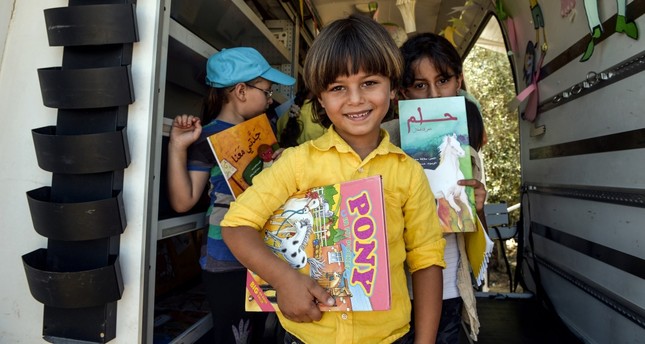
The German-French Cultural Center brought a traveling library vehicle to Gaza from the West Bank on May 16, which aims to instill a love of reading in children by enabling them to read books at colorful chairs and tables. The traveling library which remain in Gaza until August, and made its first stop in the Huzaa town of Khan Yunis province, one of the main targets of Israel's attack on Palestine in July 2014. Children living in Huzaa previously had no access to a library. Thanks to the traveling library, children are able to enter the magical world of books, drawings and enchanting stories, as well as spending time with the staff of the library enjoying entertaining activities.

Mahmud al-Askalani, the coordinator of the traveling library, told Anadolu Agency (AA) how the library works: "The traveling library offers its services in Gaza three months a year. Then we will head to West Bank and open the doors of the magical world of the books to children living there."

Friday, June 10, 2016

Can reading make you happier? by Ceridwen Dovey

June 9, 2015

“Can Reading Make You Happier?” by Ceridwen Dovey (June 9th)ILLUSTRATION BY SARAH MAZZETTI
Several years ago, I was given as a gift a remote session with a bibliotherapist at the London headquarters of the School of Life, which offers innovative courses to help people deal with the daily emotional challenges of existence. I have to admit that at first I didn’t really like the idea of being given a reading “prescription.” I’ve generally preferred to mimic Virginia Woolf’s passionate commitment to serendipity in my personal reading discoveries, delighting not only in the books themselves but in the randomly meaningful nature of how I came upon them (on the bus after a breakup, in a backpackers’ hostel in Damascus, or in the dark library stacks at graduate school, while browsing instead of studying). I’ve long been wary of the peculiar evangelism of certain readers: You must read this, they say, thrusting a book into your hands with a beatific gleam in their eyes, with no allowance for the fact that books mean different things to people—or different things to the same person—at various points in our lives. I loved John Updike’s stories about the Maples in my twenties, for example, and hate them in my thirties, and I’m not even exactly sure why.Read more...

Thursday, June 9, 2016

7 Short Books Worth More Than an MBA By Geoffrey James Contributing editor, Inc.com

CREDIT: Getty Images
Over the past few decades, the value of an MBA has declined, probably because the academic world can't keep up with the rapid pace of change in the business world.
Relatively few entrepreneurs have MBAs, but I'll bet that almost all of the successful ones have read and truly treasure these seven short, easy-to-read classics:

1. As a Man Thinketh


Author: James Allen

What It Teaches: Most people labor under the misconception that their life is the result of fate, luck, or circumstances. This book explains that your life is what you make of it, and the only way you'll be successful in life is if you're first successful in your mind. This is the foundation of a successful career in business.  (It's also one of the top 10 motivational books of all time.)

Best Quote: "A man only begins to be a man when he ceases to whine and revile, and commences to search for the hidden justice which regulates his life. And as he adapts his mind to that regulating factor, he ceases to accuse others as the cause of his condition, and builds himself up in strong and noble thoughts; ceases to kick against circumstances, but begins to use them as aids to his more rapid progress, and as a means of the hidden powers and possibilities within himself." Read more...

Tuesday, June 7, 2016

11 Bookish Things To Add To Your Summer Bucket List by Alex Weiss

Spencer Platt/Getty Images News /Getty Images

Ever since I was a kid, writing up a summer bucket list has been a constant tradition. My past bucket lists have included silly things like attaining the phone number of my middle school crush or reading an insane number of books before school started back up. Bucket lists can include anything from embarking on road-trip adventures to facing a big fear that's been holding you back. It's anything you want, and if you're a book lover like myself, odds are you have a bucket list that contains a lot of books, too.

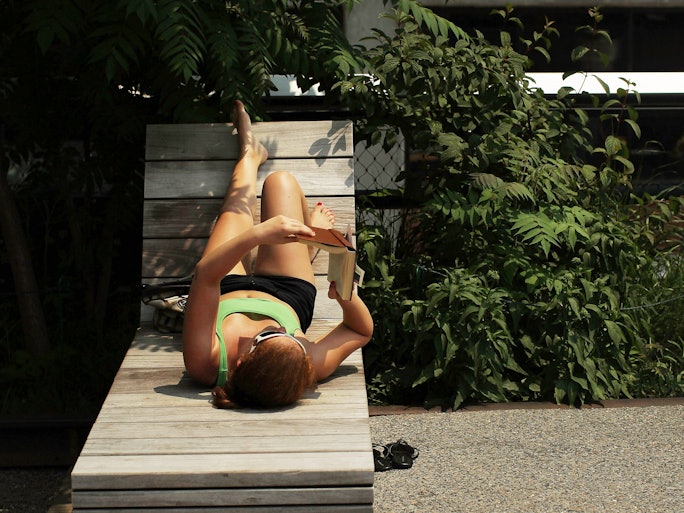
Spending your summer days with a good book and glass of lemonade is what dreams are made of — at least for book nerds. It's not so much about the tan or the temperature of the beach waves, but more so about the characters and settings within the books we hold close to our hearts. While you probably have a good number of books you're adding to your bucket list this year, consider adding a couple book-related activities to it as well. After all, you will need a little time in-between books that break your heart or blow your mind.

Gather your closest book loving friends and plan for one fantastic summer full of bookstores, arts and crafts, writing, and a whole lot of reading with these 11 fun things to add to your summer book bucket list:

1. Visit A New Or Your Favorite Bookstore Once A Week

 Read more...