Showing posts with label access. Show all posts
Showing posts with label access. Show all posts
Thursday, May 31, 2018


Tuesday, March 13, 2018
Banning literature in prisons perpetuates system that ignores inmate humanity
Censorship | Prison libraries | Human rights
Lawsuit among latest reminders that reading, education can help ensure that prisoners who gain freedom, keep it
 | |||
| (Photo: John David Mercer, AP) |
Last month, the publisher of Prison Legal News became one of the latest organizations to take action against the nation's prison systems for censorship.
The Human Rights Defense Center lawsuit targets the
Illinois Department of Corrections and alleges that
it keeps HRDC literature out of the hands of prisoners, including
the monthly Prison Legal News magazine — which covers court rulings and other aspects of the criminal justice system.
Read more:
https://www.usatoday.com/story/opinion/policing/spotlight/2018/03/09/banning-literature-prisons-perpetuates-system-ignores-inmate-humanity/397501002/
Monday, December 18, 2017
What public libraries will lose without net neutrality
Net neutrality | Public Libraries | Access
A Q&A with NYPL president Tony Marx and associate director of information policy Greg Cram
By
The FCC will vote on a measure
today that would repeal net neutrality and pave the way for the end of
the free, open internet as we’ve always known it. Librarians aren't
happy about it.
Yesterday, The Verge published an op-ed
written by the heads of the New York Public Library, the Brooklyn
Library, and the Queens Library systems, which called the measure
“appalling,” and argued that the end of an open internet would
contribute to inequality of education and opportunity, widening “the
already yawning digital divide.” Later, in a phone call, the New York
Public Library’s CEO and president Anthony Marx and associate director
of information policy Greg Cram broke the issue down further, explaining
exactly which library resources an open internet protects, who would be
hurt the most by net neutrality’s rollback, and why handing the
internet to ISPs could threaten the basic foundation of American
democracy.
This interview has been edited for clarity and length.
What stake do public libraries have in this issue?
Greg Cram: So, for fiscal year 2017 [the
New York Public Library] provided 3.1 million computer sessions — and
that’s sessions across all of the branches — using 4,700 computers. And
in addition to that, we provided 3 million wireless sessions. For the
first quarter of fiscal year 2018 we had 16.2 million pageviews on our
digital collections.
Anthony Marx: That gives us a little bit
of the sense of the scale of how much of the library goes across wires,
and the simple fact is that the poorest of New York rely on the library
as the only place they can go and get free use of computers and free
Wi-Fi. It’s one of the reasons why the library is the most visited civic
institution in New York. We have also, in recent years, been lending
people what we call hot spots, which are Wi-Fi boxes they can take home,
typically for a year. That gives them digital access at home —
broadband access — which something like 2 million New Yorkers can’t afford and don’t have.
We’re still doing thousands of those. We’d like to do more and we’re
exploring how to do more, because in this day and age, if you don’t have
internet access that works and goes fast enough, you can’t do your
homework, you can’t do research, you can’t apply for jobs, you can’t find jobs.
Tuesday, May 16, 2017
Public Outcry Saves Saskatchewan Library Funds
Library advocacy | Public libraries | Access |Funding | Activism
 | ||
| Drop Everything and Read rally, Fox Valley, Sask. Photo credit: Susan Rose |
By on May 15, 2017
The announcement by Saskatchewan Education Minister Don Morgan wrapped up a tumultuous five weeks in which a determined and unified library community prevailed over what were considered long odds.
They saw thousands of petition signatures, a claim by Morgan that usage had declined significantly and some parts of Saskatchewan might have too many libraries—rebutted point by point by the nonprofit Saskatchewan Library Association (SLA)—sinking poll numbers for the political party in power, a protest aimed directly at elected officials, and a sudden halt to Saskatchewan’s popular interlibrary loan system. Read more...
Wednesday, February 22, 2017
Preserving U.S. Government Websites and Data as the Obama Term Ends | December 15, 2016
Internet archive | Government Websites | Data preservation
Posted by Jefferson
That is why the Internet Archive, along with partners from the Library of Congress, University of North Texas, George Washington University, Stanford University, California Digital Library, and other public and private libraries, are hard at work on the End of Term Web Archive, a wide-ranging effort to preserve the entirety of the federal government web presence, especially the .gov and .mil domains, along with federal websites on other domains and official government social media accounts.
While not the only project the Internet Archive is doing to preserve government websites, ftp sites, and databases at this time, the End of Term Web Archive is a far reaching one.
Read more....
Tuesday, February 7, 2017
Long Overdue: Why public libraries are finally eliminating the late-return fine
Public libraries | Access | Community outreach
by Ruth Graham | ||||
| A thing of the past? Photo illustration by Slate. Images via jmbatt, simo988/iStock. |
More than a century later, similar dramas are still enacted in libraries across the country every day. In some districts, up to 35 percent of patrons have had their borrowing privileges revoked because of unpaid fines. Only these days, it’s librarians themselves who often lament what the Detroit reporter called “a tragedy enacted in this little court of equity.” Now some libraries are deciding that the money isn’t worth the hassle—not only that, but that fining patrons works against everything that public libraries ought to stand for. Read more...
Tuesday, January 31, 2017
ALA opposes new administration policies that contradict core values - News and Press Center
Advocacy | Human Rights | Library Ethics
ALA opposes new administration policies that contradict core values - News and Press Centerfor Immediate Release
Mon, 01/30/2017
Contact:
Macey Morales
Deputy Director
Public Awareness Office
American Library Association
(312) 280-4393
CHICAGO
— Today American Library Association President Julie Todaro released
the following statement responding to recent actions by the new
administration and specifically addressing issues regarding access to
information, discrimination and intellectual freedom.
“We are shocked and dismayed by recent executive orders and other
actions by the new administration, which stand in stark contrast to the
core values of the American Library Association (ALA). Our core values
include access to information; confidentiality/privacy; democracy;
equity, diversity and inclusion; intellectual freedom; and social
responsibility.
“The American Library Association strongly opposes any actions that
limit free access to information, undermine privacy or discriminate on
any basis. This includes the temporary suspension of visas and entrance
to the US based on anyone’s nationality or religion as well as the
increased scrutiny of any individual’s communication such as mobile
phone and/or social media activity.
“Our nation’s 120,000 public, academic, school and special libraries
serve all community members, including people of color, immigrants,
people with disabilities and the most vulnerable in our communities,
offering services and educational resources that transform communities,
open minds, and promote inclusion and diversity.
“ALA believes that the struggle against racism, prejudice,
stereotyping and discrimination is central to our mission. We will
continue to speak out and support efforts to abolish intolerance and
cultural invisibility, stand up for all the members of the communities
we serve, and promote understanding and inclusion through our work.
“We will continue to speak out and support our members as they work
tirelessly for access to library and information resources on behalf of
all of their community members, while advocating for privacy,
intellectual freedom, critical global research, information literacy,
ongoing access to scientific research, and fair and equitable treatment
for everyone.
“As our strategic plan states, ‘ALA recognizes the critical need for
access to library and information resources, services, and technologies
by all people, especially those who may experience language or
literacy-related barriers; economic distress; cultural or social
isolation; physical or attitudinal barriers; racism; discrimination on
the basis of appearance, ethnicity, immigrant status, housing status,
religious background, sexual orientation, gender identity, gender
expression; or barriers to equal education, employment and housing.’
“We encourage our members to continue to speak out and show their
support for and work on behalf of our core values, in their communities
as well as with their local, state and national elected and appointed
officials. Additionally, ALA has tools and resources online to help you
advocate for our core values:
and speaking out for its members and constituents in these chaotic,
unprecedented and challenging times. We appreciate the library
community’s continued support.”
— Today American Library Association President Julie Todaro released
the following statement responding to recent actions by the new
administration and specifically addressing issues regarding access to
information, discrimination and intellectual freedom.
“We are shocked and dismayed by recent executive orders and other
actions by the new administration, which stand in stark contrast to the
core values of the American Library Association (ALA). Our core values
include access to information; confidentiality/privacy; democracy;
equity, diversity and inclusion; intellectual freedom; and social
responsibility.
“The American Library Association strongly opposes any actions that
limit free access to information, undermine privacy or discriminate on
any basis. This includes the temporary suspension of visas and entrance
to the US based on anyone’s nationality or religion as well as the
increased scrutiny of any individual’s communication such as mobile
phone and/or social media activity.
“Our nation’s 120,000 public, academic, school and special libraries
serve all community members, including people of color, immigrants,
people with disabilities and the most vulnerable in our communities,
offering services and educational resources that transform communities,
open minds, and promote inclusion and diversity.
“ALA believes that the struggle against racism, prejudice,
stereotyping and discrimination is central to our mission. We will
continue to speak out and support efforts to abolish intolerance and
cultural invisibility, stand up for all the members of the communities
we serve, and promote understanding and inclusion through our work.
“We will continue to speak out and support our members as they work
tirelessly for access to library and information resources on behalf of
all of their community members, while advocating for privacy,
intellectual freedom, critical global research, information literacy,
ongoing access to scientific research, and fair and equitable treatment
for everyone.
“As our strategic plan states, ‘ALA recognizes the critical need for
access to library and information resources, services, and technologies
by all people, especially those who may experience language or
literacy-related barriers; economic distress; cultural or social
isolation; physical or attitudinal barriers; racism; discrimination on
the basis of appearance, ethnicity, immigrant status, housing status,
religious background, sexual orientation, gender identity, gender
expression; or barriers to equal education, employment and housing.’
“We encourage our members to continue to speak out and show their
support for and work on behalf of our core values, in their communities
as well as with their local, state and national elected and appointed
officials. Additionally, ALA has tools and resources online to help you
advocate for our core values:
- Advocacy: http://www.ala.org/offices/ola/
- Diversity, Literacy, and Outreach Services: http://www.ala.org/offices/diversity/
- Government Relations: http://www.ala.org/offices/ogr/
- Information and Technology Policy: http://www.ala.org/offices/oitp/
- Intellectual Freedom: http://www.ala.org/offices/oif/
- Libraries Respond: http://www.ala.org/advocacy/diversity/libraries-respond
and speaking out for its members and constituents in these chaotic,
unprecedented and challenging times. We appreciate the library
community’s continued support.”
# # #
Monday, December 19, 2016
Stand, Fight, Resist
Advocacy & Activism
Jason Griffey | December 16, 2016
The idea that libraries are neutral spaces has been well and disabused over the last few years. From the services we offer to the collections that we curate, the decisions that libraries and librarians make are political ones that reflect values. Sometimes those are the values of the organization, sometimes the values of the individuals, and sometimes they are the values of the communities that the library serves. Those values are illustrated by our technologies, our ontologies, and our descriptors. Those who attempt to hold that “neutrality” of information access is an ideal for which to strive have had a hard time holding to that stance as increasing numbers of librarians question and deconstruct our profession. I would like to suggest something even stronger…that even if it were possible for libraries to be neutral spaces, that to create such a space would be morally questionable, and potentially actively morally wrong.
I say this as someone who firmly believes in the maxim of combating bad speech with more speech. I am not here advocating controls or restrictions on speech. But it is not the responsibility of every library to collect and distribute literature of hate, or falsehoods, or lies. Some libraries do need to collect everything, the good and the bad, for archival and historical study purposes, but those libraries are fairly obviously identified in practice and the vast majority of libraries should and could take a stand with their actions, programs, policies, and collections to be on the side of justice and scientific fact.
Neutrality favors the powerful, and further marginalizes the marginalized. In the face of the current political climate, with the use of opinions as bludgeons and disinformation as the weapon of choice for manipulation and intellectual coercion, it is up to those who value fact and believe in the care of those in need to stand up and positively affirm that to do otherwise is evil.
Read article
Wednesday, October 5, 2016
How Banning Books Marginalizes Children by Paul Ringel
Banned Books
Oct. 1, 2016 [from The Atlantic] | ||
| Since the 1800s, attitudes about which books are “appropriate” for kids to read have too often suppressed stories about different cultures and life experiences. Comstock / Getty |
Since the inception of the American children’s literature industry in the 1820s, publishers have had to grapple with the question of who their primary audience should be. Do kids’ books cater to parents and adult cultural gatekeepers, or to young readers themselves? But as books that address issues of diversity face a growing number of challenges, the related question of which children both the industry and educators should serve has become more prominent recently. Who benefits when Sherman Alexie’s The Absolutely True Diary of Part-Time Indian, which deals with racism, poverty, and disability, is banned for language and “anti-Christian content”? Who’s hurt when Jessica Herthel and Jazz Jennings’s picture book I Am Jazz, about a transgender girl, is banned? The history of children’s book publishing in America offers insight into the ways in which traditional attitudes about “appropriate” stories often end up marginalizing the lives and experiences of many young readers, rather than protecting them. Read more...
Wednesday, September 28, 2016
Donate Your Books to Prisons: What, Why, and How by Becky Stone
Prison Libraries
 |
| www.bestcollegesonline.com |
As someone who is fortunate enough that most of my experience with the prison system has happened through Netflix, I took that to mean simply that when you’re in the same small space day after day, it gets boring. But providing prisoners with books offers so much more than relief from monotony.
According to a Baltimore Sun article about Maryland’s prison libraries:
Many who are within a year or two of release use library services to prepare for re-entry — to get their GED, to improve their vocabularies and language skills. The recidivism rate in the United States varies, from 50 percent to as high as 67 percent in some states, and there are two main reasons for that level of failure: the employment challenge facing ex-offenders on the outside and the lack of preparation for re-entry on the inside.
Read more....
Thursday, July 28, 2016
Syria's secret library by Mike Thomson, BBC News
28 July 2016
Down a flight of
steep steps, as far as it's possible to go from the flying shrapnel,
shelling and snipers' bullets above, is a large dimly lit room. Buried
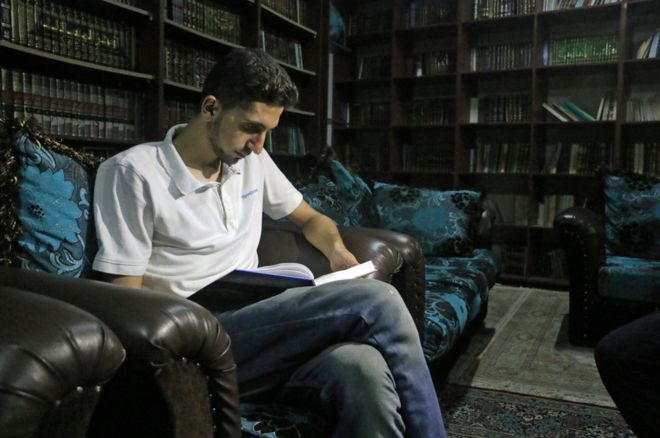
beneath a bomb-damaged building, it's home to a secret library that
provides learning, hope and inspiration to many in the besieged Damascus
suburb of Darayya.
"We saw that it was vital to create a new library so that we could continue our education. We put it in the basement to help stop it being destroyed by shells and bombs like so many other buildings here," says Anas Ahmad, a former civil engineering student who was one of the founders. Read more...
 | ||
| MALEK |
When a place has been besieged for
years and hunger stalks the streets, you might have thought people would
have little interest in books. But enthusiasts have stocked an
underground library in Syria with volumes rescued from bombed buildings -
and users dodge shells and bullets to reach it.
"We saw that it was vital to create a new library so that we could continue our education. We put it in the basement to help stop it being destroyed by shells and bombs like so many other buildings here," says Anas Ahmad, a former civil engineering student who was one of the founders. Read more...
Wednesday, July 27, 2016
Rikers Island gets unofficial New York Public Library branch by Alison Fox
July 27, 2016
 |
The library at the Rikers Island correction facility has a wide range of books, including "The Hunger Games" series and "To Kill a Mockingbird." (Credit: Craig Ruttle)
The (unofficial) 93rd branch of the New York Public Library is now
open for business — and you can’t take the subway to visit it.
That’s because the small-but-well-stocked collection is the first permanent public library on Rikers Island.
And
the collection, which is housed in the women’s Rose M. Singer Center
and sits below a poster of Beyoncé as Rosie the Riveter, is as varied as
the people who will be reading from it: “The Hunger Games” books share
space with “To Kill a Mockingbird,” “Les Misérables,” and an extensive
James Patterson collection.
“It’s
amazing the city services that are available in the community; many of
those we want here on the island,” said Department of Correction
Commissioner Joseph Ponte. “This is a good step to introduce inmates to
the value of education, the value of reading.”
The
library holds 1,200 books — spanning everything from comics to sci-fi,
from Spanish language works to nonfiction classics — and it will be open
every Tuesday for about six hours each day. Read more...
|
Tuesday, July 19, 2016
Library on wheels serve Gazans

GAZA
Published
July 12, 2016
The German-French Cultural Center brought a traveling library vehicle to
Gaza from the West Bank on May 16, which aims to instill a love of
reading in children by enabling them to read books at colorful chairs
and tables. The traveling library which remain in Gaza until August, and
made its first stop in the Huzaa town of Khan Yunis province, one of
the main targets of Israel's attack on Palestine in July 2014. Children
living in Huzaa previously had no access to a library. Thanks to the
traveling library, children are able to enter the magical world of
books, drawings and enchanting stories, as well as spending time with
the staff of the library enjoying entertaining activities.
Mahmud al-Askalani, the coordinator of the traveling library, told Anadolu Agency (AA) how the library works: "The traveling library offers its services in Gaza three months a year. Then we will head to West Bank and open the doors of the magical world of the books to children living there."
Mahmud al-Askalani, the coordinator of the traveling library, told Anadolu Agency (AA) how the library works: "The traveling library offers its services in Gaza three months a year. Then we will head to West Bank and open the doors of the magical world of the books to children living there."
Thursday, June 16, 2016
The Freedom to Read: The history of ALA's vital statement on intellectual freedom
March 15, 2016
Eisenhower’s words shocked many because they constituted his first
public challenge to McCarthyism—an ethos enveloping the country at the
time and fed by Senator Joseph McCarthy (R-Wis.), who inferred communist
conspiracies everywhere in American culture, including books on the
shelves of 194 information libraries that the US State Department
operated in 61 foreign countries.
Like-minded individuals also saw communist threats in the images on the covers of magazines, paperbacks, and comics that were stacked face-out on newsstand racks across the country. The US House of Representatives even set up a Select Committee on Current Pornographic Materials to investigate the publishers. Outside Washington, the National Organization for Decent Literature (NODL) sponsored by the Roman Catholic Church issued monthly lists of condemned titles that local parishioners used to police newsstands (and, on occasion, local public library shelves). Owners who passed muster received NODL seals of approval to display in their windows; sales at newsstands that did not display a seal invariably suffered. Read more...
 | |||
| US President Dwight D. Eisenhower (left) and Dartmouth President John Sloan Dickey at the Dartmouth College commencement, June 14, 1953. Courtesy of Dartmouth College Library |
“Don’t join the book burners,” President Dwight D.
Eisenhower implored Dartmouth College graduates on June 14, 1953. “Don’t
be afraid to go to your library and read every book as long as any
document does not offend your own ideas of decency.”
Like-minded individuals also saw communist threats in the images on the covers of magazines, paperbacks, and comics that were stacked face-out on newsstand racks across the country. The US House of Representatives even set up a Select Committee on Current Pornographic Materials to investigate the publishers. Outside Washington, the National Organization for Decent Literature (NODL) sponsored by the Roman Catholic Church issued monthly lists of condemned titles that local parishioners used to police newsstands (and, on occasion, local public library shelves). Owners who passed muster received NODL seals of approval to display in their windows; sales at newsstands that did not display a seal invariably suffered. Read more...
Tuesday, May 10, 2016
5 Famous British TV Writers On How Libraries Influenced Their Lives
Following the closure of 10 libraries in Lambeth in London, Russell T Davies, Mark Gatiss, Peter Bowker, Sarah Phelps, and Jack Thorne spoke to BuzzFeed News about why they need to protected across the rest of the UK.
posted on Apr. 30, 2016, at 3:27 a.m.
Moving “south of the river” after spending 15 years as a Hackney resident was tumult enough, so you can imagine my irritation when, upon my arrival in Lambeth, south London, I discovered that the council in its wisdom was closing 10 libraries – including my local one, the Carnegie Library.
The Carnegie Library was closed at the end of April, with the council promising that it will reopen in 2017 as “a healthy living centre with a self-service neighbourhood library”. For 10 days the library was occupied by protestors upset at the move. They left the building peacefully, and the gates of the Carnegie Library are now locked shut. Behind those gates, books lie unread and stories go untold.
The closure is a tragedy and it’s one that got me thinking what the world – individuals and communities – would be without libraries and what libraries mean to people. So I asked five of the best TV writers in Britain to lend their voices to the anti-closure campaign (#DefendTheTen) and write about what libraries meant and mean to them.
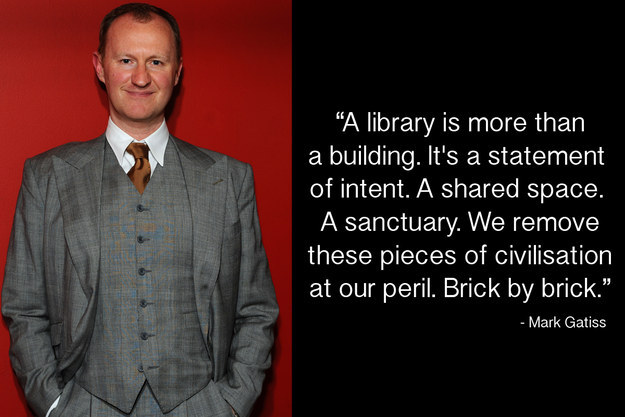
Mark Gatiss (Sherlock, Doctor Who, An Adventure in Space and Time, The League of Gentlemen)
Anthony Harvey / Getty Images and Scott Bryan / BuzzFeed
Tuesday, April 5, 2016
8 Librarians Who Lend Out More Than Books by Michele Debszak

Libraries would be nothing without the librarians who run them. Most of us know them as the people who check out our books or help us navigate the Dewey Decimal System, but not all librarians are limited to working with the printed word. Whether they’re lending out ties or larger-than-life puppets, these are the heroic men and women behind some of the world’s most unique library collections.
1. LAUREN COMITO // THE TIE-BRARY
Libraries offer tremendous resources to people searching for employment, but that could all be for nothing without a proper interview outfit to wear. In Queens, New York, library members can check out a tie with interview tips and tie-tying instructions printed inside the box it comes in. Queens librarian Lauren Comito launched the “tie-brary” as one of her many initiatives dedicated to providing services to the borough’s homeless population. After foundingWhereinQueens.org, a website that directs users to career services and other resources in the area, she realized that some of her patrons didn’t own a tie or even know they should be wearing one to interviews. She met this need by building the racks to hold a library of ties herself. read more...
IMAGE CREDIT:
ISTOCK
Monday, March 28, 2016
A Day in the Life of a Bookmobile Librarian
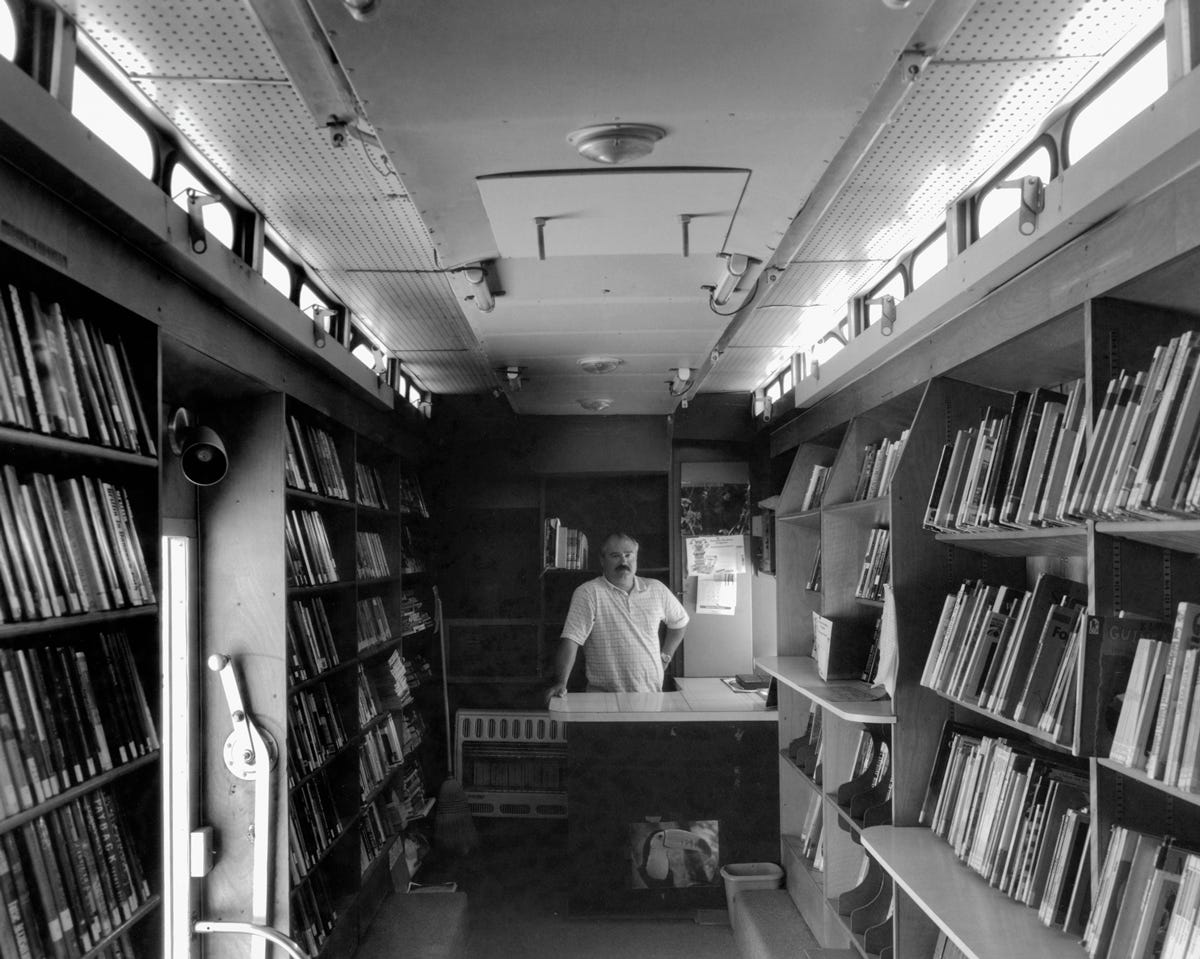 |
| Northeastern Nevada Regional Bookmobile Librarian, Elko County Library, Baker, Nevada, 2000, photo Robert Dawson |
Wednesday, February 24, 2016
Introducing Open eBooks

"Today, the White House announced that the Open eBooks app to put ebooks in the hands of lower-income children and young adults aged 4-18, is up and running. The Open eBooks service to provide age appropriate reading materials, was developed in partnership with the Digital Public Library of America, the New York Public Library, FirstBook, and Baker & Taylor. With the app, the Open eBooks service can begin."
First Lady Michelle Obama released a video (1:02) explaining the initiative.
Thursday, February 4, 2016
The loss of libraries is another surefire way to entrench inequality Mary O'Hara Mary O'Hara
 |
| ‘Having a library within walking distance of home was a way for a young girl from a poor background to access the same breadth of reading material as anyone else.’ Photograph: Getty Images |
Having a library within walking distance of home was a way for a young girl from a poor background to access the same breadth of reading material as anyone else – at no expense. It stripped away at least some of the disadvantage that came with being from a low-income family. So every time I hear of another library closure – and there were more than 100 last year alone in Scotland, Wales and England, according to official figures – it hits a nerve. The loss of libraries is simply another surefire way to entrench inequality.
From providing books for people of all ages and backgrounds, to kids clubs and hubs for older people, to computer terminals that those with no access to the internet can use to find job vacancies, libraries are about as democratic and diverse as is possible to imagine. When properly funded and resourced they are educational and social anchors in communities everywhere. Yet, despite knowing all this, in the past five years the relentless funding constraints placed on local authorities have seen library budgets slashed by an astounding amount. Read more...
Thursday, December 31, 2015
10 Ways Mobile Devices Have Changed Education By Karen A. Frenkel
 |
Carry Along Your School
Because of mobile devices, students no longer need to be in school to learn and ask questions. They can work from anywhere at any time with their smartphone or tablet and connect with teachers and fellow students, check assignments and work on shared content.
- See more at: http://www.cioinsight.com/it-strategy/mobile-wireless/slideshows/10-ways-mobile-devices-have-changed-education.html#sthash.Poj1Dkg7.dpuf |
Computers have been used in schools and colleges for decades, with most connected to the Internet, yet they’ve fallen short in making a profound impact on education and learning pedagogies, according to Krish Kupathil, CEO of Mobiliya Technologies, which makes a digital classroom platform. Enter mobile devices. "Clunky desktops gave way to cool laptops, tablets and the ubiquitous smartphone, the real turning point in the modern education system," he said. "Gen Z loves carrying them, browsing endlessly and tapping them to complete their assignments." Mobile learning is the new face of education, he says. The Speak Up 2012 National Research Project found that 80% of students in grades 9-12 use smartphones and are connected to their schools 24/7. And by 2020, the mobile learning market is expected to reach $32 billion, according to Apollo Matrix, a prediction that "clearly shows that mobile learning is here to stay and dominate the education sphere." Kupathil describes 10 ways mobile devices are changing education.
Subscribe to:
Posts (Atom)