Pages

Showing posts with label tolerance. Show all posts

Tuesday, May 16, 2017

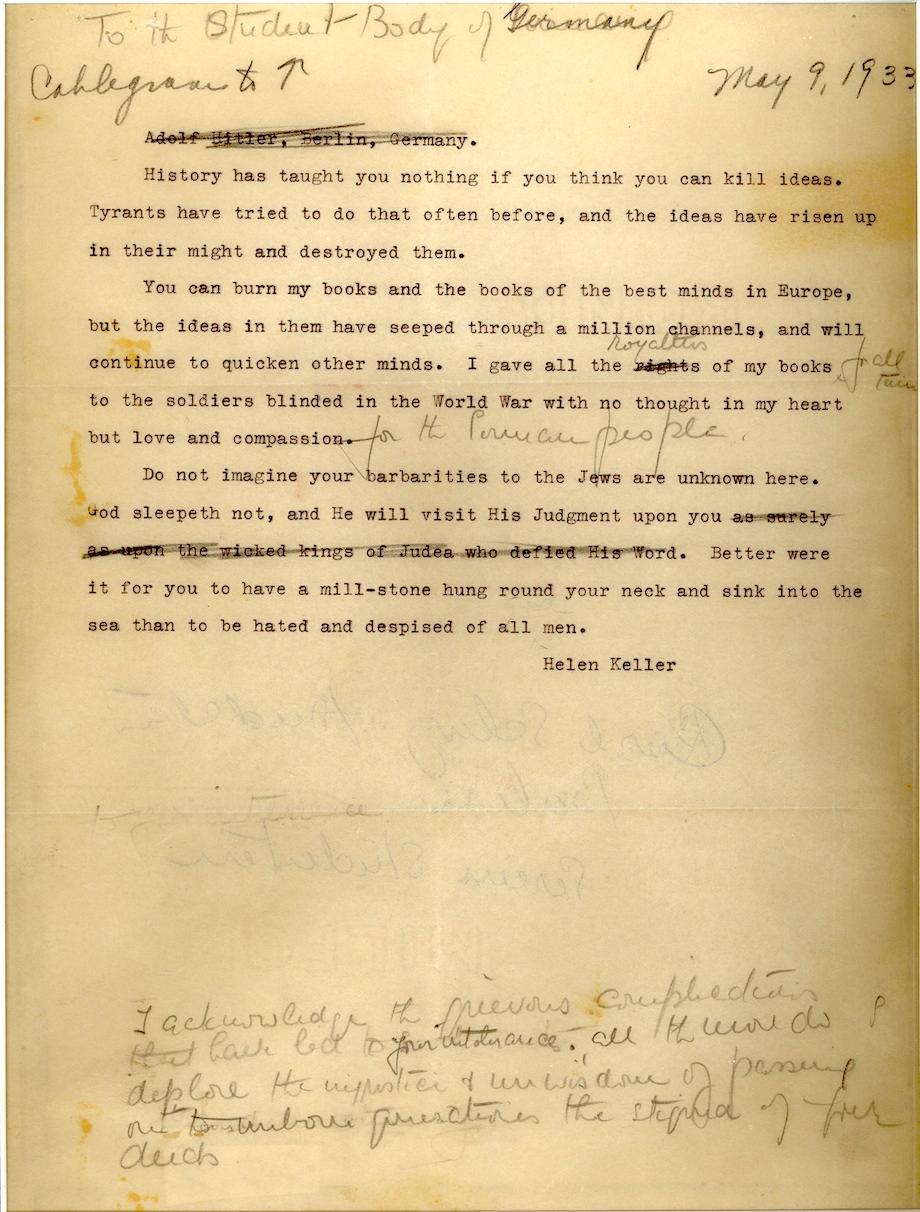
Helen Keller Writes a Letter to Nazi Students Before They Burn Her Book: “History Has Taught You Nothing If You Think You Can Kill Ideas” (1933)

Book burning | Holocaust | Diversity
Open culture  | History May 16, 2017

Helen Keller achieved notoriety not only as an individual success story, but also as 
 prolific essayist, activist, and fierce advocate for poor and marginalized people. She “was a lifelong radical,” writes Peter Dreier at Yes! magazine, whose “investigation into the causes of blindness” eventually led her to “embrace socialism, feminism, and pacifism.” Keller supported the NAACP and ACLU, and protested strongly against patronizing calls for her to “confine my activities to social service and the blind.” Her critics, she wrote, mischaracterized her ideas as “a Utopian dream, and one who seriously contemplates its realization indeed must be deaf, dumb, and blind.”

Twenty years later she found a different set of readers treating her ideas with contempt. This time, however, the critics were in Nazi Germany, and instead of simply disagreeing with her, they added her collection of essays, How I Became a Socialist, to a list of “degenerate” books to be burned on May 10, 1933. Such was the date chosen by Hitler for “a nationwide ‘Action Against the Un-German Spirit,’” writes Rafael Medoff, to take place at German Universities—“a series of public burnings of the banned books” that “differed from the Nazis’ perspective on political, social, or cultural matters, as well as all books by Jewish authors.”  Read more...

Thursday, February 2, 2017

How Video Games Can Save The World | Jordan Shapiro | Jan 31, 2017

Video games | Diversity | Tolerance | Book Review


The new book, Power Play: How Video Games Can Save The World, by Asi Burak and Laura Parker, was just released. Asi is well known in the game world as the creator of PeaceMaker and the former executive director of Games For Change. For quite a while now, he has been the go-to source for understanding the social impact gaming movement.

In this important book, along with coauthor Laura Parker, Asi maps out the landscape of games with a purpose. But what really struck me is how clearly the book expresses the possibilities that still lie ahead for digital play. When I finished reading it, I was clearly reminded that the video game industry is still in it’s infancy. And I felt a kind of enthusiastic anticipation to see what direction it will go.

I also wanted to talk to Asi about it. So I reached out to him to ask about PeaceMaker, Games For Change, the future of the industry, and how games can make a difference in politically tumultuous times.


Wednesday, February 1, 2017

[IFLA-L] Open Societies are Healthy Societies: IFLA rejects unjustified barriers to the free movement of persons | 1st February 2017


Open Societies are Healthy Societies

Libraries are at the heart of healthy societies. By bringing people together – students, researchers, creators, citizens – they support learning, sharing, and the creation of new ideas.

They also support the delivery of key human rights, as set out both in national constitutions and international conventions, most importantly the Universal Declaration of Human Rights: freedom of expression and access to information, as well as the right to participate in cultural life and enjoy the benefits of scientific progress.

Libraries have long supported the flow of ideas and information across borders. IFLA has called for reforms to laws that hold this back. Evidence shows that such flows promote innovation and creativity, which in turn drives growth, jobs and equality everywhere.

However, arbitrary and unjustified barriers to the movement of people jeopardise this situation. Such policies run contrary to states’ obligations under international law, which prohibit discrimination of any kind on the basis of race, colour, sex, language, religion, political or other opinion, national or social origin, property, birth or other status, as set out in the UN’s New York Declaration for Refugees and Migrants.

The International Migration Convention also provides the right to temporary absence from the country of residence, a right which can be undermined by barriers to re-entry.

IFLA condemns such policies, wherever they take place in the world.  The recent Executive Order issued by US President Trump temporarily barring entry into the United States by individuals from seven countries is one such policy.

This policy will affect students, workers and academics, families and children. All use libraries to generate new ideas and perspectives which will benefit social, economic and cultural life.  

The policy also adversely affects refugees fleeing extreme poverty, persecution and conflict. Libraries’ doors are open to help them find support and encouragement to learn the language and develop the skills needed to find their place. Focusing on successful integration, rather than rejection, will produce the scholars, artists, workers and engaged citizens of tomorrow.

History has demonstrated that openness and exchange make countries great. We call on governments, for the sake of the future, to protect these principles.  

Thursday, January 26, 2017

16 Books About Race That Every White Person Should Read | Zeba Blay

Diversity | Reader's Advisory


The Huffington Post


Earlier this week, actor Matt McGorry gave a shout out to Michelle Alexander’s powerful book on mass incarceration, The New Jim Crow. “I’m embarrassed that I didn’t come across the information in this book sooner,” McGorry wrote on Facebook. “But that’s white privilege for ya... Burning crosses and racial slurs are not the only types of racism affecting people of color. And we owe it to our black and brown brothers and sisters to understand this.”

The “Orange is the New Black” star’s post has gained him plenty of praise for actively trying to educate himself on issues regarding race, but it also serves as a powerful example to other white people and allies on how, sometimes, one of the best ways to better understand racism is to just pick up a book.
In the spirit of this, we’ve compiled a list of books that every white person and ally should read right now, and have included some of each book’s most powerful passages: Read more...

Tuesday, July 19, 2016

Libraries across the country look to Hennepin County Library for response to Black Lives Matter

Tuesday, September 1, 2015

Why We Need Diverse Libraries By Rachel Smalter Hall Sep 1, 2015

www.nationofchange.org


Public librarians fight the good fight: we’re champions of literacy and intellectual freedom, we oppose book bannings, and we’re pro-education and public service. We’ve had a bit of a public image problem what with our shushing and our late fees, but we’ve been hard at work reinventing our image as welcoming, affirming professionals who are here to spread the love of books and information. We even have literary tattoos and bookish roller derby names.

All of this makes it harder to say this next thing: Public librarians need to do better with race.
When I recently read about the Napa Valley Wine Train that apologized for wrongfully escorting a book club of 11 black women off the train for being “too boisterous” (i.e. #laughingwhileblack), my first thought was of how many times I’ve seen the same thing happen in public libraries — I’ve witnessed many similar microaggressions against people of color throughout my time in libraries.

The nature of microaggressions makes them tricky to define, especially since they’re often so specific and personal, but I’ll do my best to describe a few of the instances I’ve seen.