Pages

Showing posts with label fake news. Show all posts

Thursday, February 16, 2017

Fake news is real

Fake news | Information literacy |Panel discussion


Fake news is real: Fake news. You’ve heard about it, consumed it, probably even believed it — at least on occasion. But what is it? Why does it exist? How do we combat it and why can’t it just go away? USC Times invited two faculty members and an alumnus who serves as the attorney for the South Carolina Press Association to discuss one of the most vexing of 21st century media problems — the rampant spread of fake news, clickbait profiteering and outright propaganda.


Read more...

Wednesday, February 15, 2017

Real News/Fake News: About Fake News: Finding Real News/Detecting Fake News | LibGuide

Fake news | Information literacy | Journalism | Social media

What is fake news?


Wikipedia defines fake news as:  “Fake news is a type of hoax or deliberate spread of misinformation in social media or traditional news media with the intent to mislead in order to gain financially or politically.”  

Fake news websites ... deliberately publish hoaxes, propaganda, and disinformation — using social media to drive web traffic and amplify their effect.”
Fake news takes all forms - print, online, podcasts, YouTube videos, radio shows, images - any format that can convey information can convey disinformation. Read more...

Tuesday, February 14, 2017

Why these librarians are protesting Trump’s executive orders | Elizabeth Flock

Activism | Access | Fake news | Immigration Ban

February 13, 2017

A “Libraries Are For Everyone” poster in Arabic. Credit: Rebecca McCorkindale

“Libraries Are For Everyone.” That’s the message of a series of images created by Rebecca McCorkindale in the days after President Donald Trump announced the temporary travel ban on seven Muslim-majority countries. She never expected her signs of inclusion to go further than a handful of libraries. 

But by the time she’d woken up the following day, she had received messages from librarians across the world wanting their languages represented. And libraries across the country — in Illinois, Minnesota, California, Virginia — had begun putting up the images as posters, along with displays about books on Islam, empathy and being a good neighbor. 

McCorkindale, who is assistant library director and creative director at the Gretna, Nebraska, public library, said she created the images because she believes librarians can and should be activists.
“Libraries are the heart of a community, for anyone and everyone that lives there, regardless of their background,” she said. “And so we strongly believe that libraries are not neutral. We stand up for human rights.”

She is not the only one. Since Mr. Trump took office a little more than three weeks ago, a vocal and growing number of librarians across the country have begun to take a more politically active stance.
Read more...

Monday, February 6, 2017

Librarians take up arms against fake news | Jerry Large February 6, 2017

Fact checking | Literacy | Critical reading | Journalism

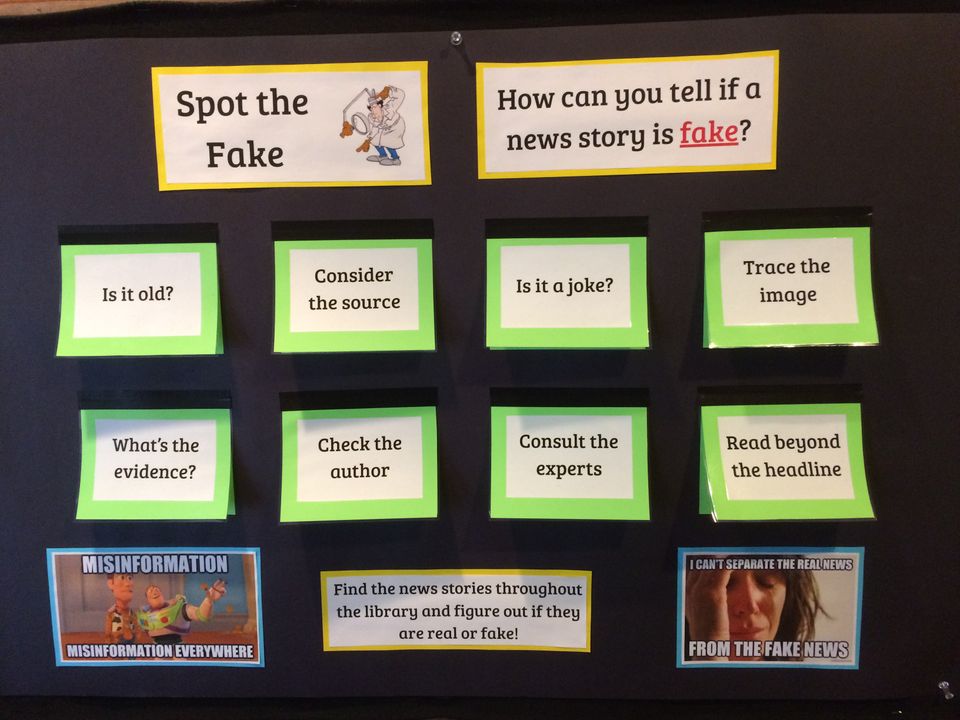
Tips for spotting fake news in the Upper School library at Lakeside School in north Seattle. (Jerry Large/The Seattle Times)  

Librarians are stepping into the breach to help students become smarter evaluators of the information that floods into their lives. That’s increasingly necessary in an era in which fake news is a constant.


Janelle Hagen is a school librarian whose job goes far beyond checking out books. She and many other librarians are equipping students to fight through lies, distortion and trickery to find their way to truth.

Helping students become smarter evaluators of the information that floods into their lives has become increasingly necessary in an era in which fake news is a constant.

Two University of Washington professors recently announced a new class that will focus on the ways data are misused to mislead the public. Younger students may need guidance even more.

Hagen, the middle-school librarian at Lakeside School in Seattle, said the students she serves are online every day, and they need to be able to figure out what’s trustworthy and what isn’t. Read more...

Tuesday, January 10, 2017

Internet Truth Debunked: INTERNET LISTS DEBUNKED - Surprising Book Facts | Saturday, 25 October 2014

Reading habits | Infographics | Literacy

Internet Truth Debunked: INTERNET LISTS DEBUNKED - Surprising Book Facts:A pretty infographic showing with statistics to remind you how society is just getting stupider will always get a lot of reshares.  Maybe people are getting stupider, because they accept statistics on pretty infographics as true...


The infographic was created by Rob Brewer in in 2012, later realising the errors in the original he created a new one:


Since the new one are far less surprising and far less emotive than the original, guess which one still gets shared around?

Rob Brewer notes where the original statistics come from and why he now thinks they're dubious on the page above.  Here's an more detailed look at it from a link on his page.

The stats come from a speech given by Jenkins in 2003, so wherever possible, 2002 statistics are used below.  It's important to note that however accurate the statistics in the speech, the speech was to industry people about the industry. Read more...

Tuesday, December 13, 2016

Donald Trump Is Gaslighting America by Lauren Duca

 Advocacy & Activism

In this scorched-earth op-ed, Lauren Duca takes on Trump's systematic attempts to destabilize the truth and weaken the foundation of American freedom.

Dec 10, 2016 


The CIA officially determined that Russia intervened in our election, and President-elect Donald Trump dismissed the story as if it were a piece of fake news. "These are the same people that said Saddam Hussein had weapons of mass destruction," his transition team wrote in a statement. "The election ended a long time ago in one of the biggest Electoral College victories in history. It’s now time to move on and ‘Make America Great Again'."

It wasn't one of the biggest Electoral College victories in history, so presumably that's another red-herring lie to distract from Trump treating the Central Intelligence Agency of the United States like it is some rogue blogger to be cast to the trolls. A foreign government's interference in our election is a threat to our freedom, and the President-elect's attempt to undermine the American people's access to that information undermines the very foundation upon which this country was built. It's also nothing new.

Trump won the Presidency by gas light. His rise to power has awakened a force of bigotry by condoning and encouraging hatred, but also by normalizing deception. Civil rights are now on trial, though before we can fight to reassert the march toward equality, we must regain control of the truth. If that seems melodramatic, I would encourage you to dump a bucket of ice over your head while listening to “Duel of the Fates." Donald Trump is our President now; it’s time to wake up.
Read more...


Monday, December 12, 2016

Google is not ‘just’ a platform. It frames, shapes and distorts how we see the world

 Internet & Literacy

by Carole Cadwalladr. | Sunday 11 December 2016

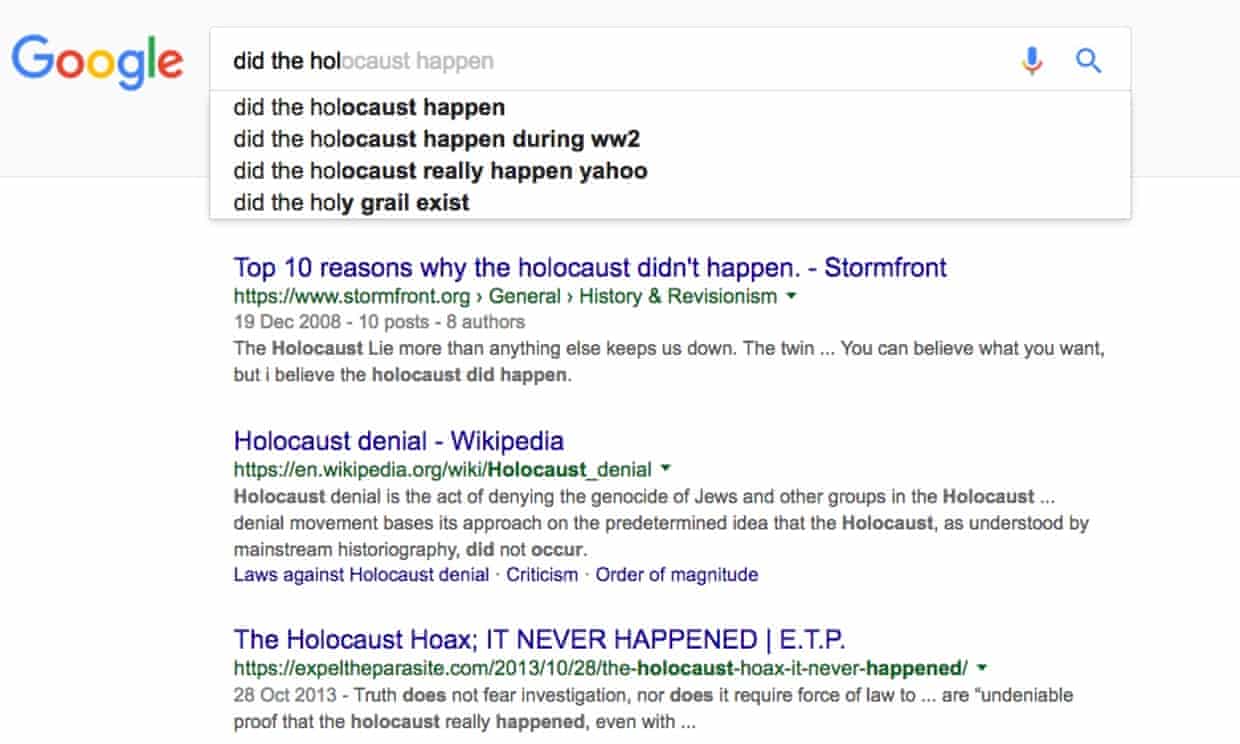
Did the holocaust happen? Google search for Carole Cadwalladr Photograph: Google 
Did the Holocaust really happen? No. The Holocaust did not really happen. Six million Jews did not die. It is a Jewish conspiracy theory spread by vested interests to obscure the truth. The truth is that there is no evidence any people were gassed in any camp. The Holocaust did not happen.

Are you happy with that answer? Happy that if you have children, this is what they’re being exposed to? That all across America and France and Hungary and Holland and Britain, when people ask that question, this is what they are clicking on and reading and absorbing? No? Well, then, we really, really need to talk about Google. Right now. Because these are the “facts” of what happened according to the number one source of information to the entire planet. Type this into your Google search bar: “did the hol”. And Google suggests you search for this: “Did the Holocaust happen?” Read more...

Thursday, December 8, 2016

Fake News Brings Life-Threatening Consequences in National Capital

by Wayne Rash | Posted 20106-12-07


NEWS ANALYSIS: Enraged by fake news story, a man fires a rifle three time into a pizza restaurant in the U.S. capital, bringing urgency to efforts to find ways to rein in false rumor stories circulating on the internet.

WASHINGTON—It was an event that many of us in the news business have feared would happen: A deranged gunman, fueled by passion based on a series of fake news stories, came to the nation's capital with an assault rifle, entered a place of business and fired.

The gunman, Edgar Maddison Welch of Salisbury, North Carolina, was quickly arrested after shooting into the Comet Ping Pong pizzeria three times. He told police after he was arrested that he came to Washington to investigate reports of a child sex-trafficking ring being run out of the pizzeria by Hillary Clinton and her campaign manager John Podesta.

The fake news about Comet Ping Pong had been circulating on social media since before the election, with increasingly shrill stories seemingly attributed to reliable media sources. The stories got so far out of control that one site, Reddit, banned any discussion of what had become known as "pizzagate" from its forums.

But that wasn't the only incident based on this fake news story. Read more...
Thursday, December 1, 2016

Here's how to outsmart fake news in your Facebook feed


(CNN)Just because it's on the internet doesn't make it true. It seems so simple, but if everyone knew that, Facebook and Google wouldn't have to pull bogus news sites from their advertising algorithms and people wouldn't breathlessly share stories that claim Donald Trump is a secret lizard person or Hillary Clinton is an android in a pantsuit.
It doesn't have to be this way. Fake news is actually really easy to spot -- if you know how. Consider this your New Media Literacy Guide.
NOTE: As we put this together, we sought the input of two communications experts: Dr. Melissa Zimdars, an associate professor at Merrimack College in Massachusetts whose dynamic list of unreliable news sites has gone viral, and Alexios Mantzarlis, the head of the International Fact-Checking Network at the Poynter Institute.
First, know the different types of misleading and false news
1. Fake news
These are the easiest to debunk and often come from known sham sites that are designed to look like real news outlets. They may include misleading photographs and headlines that, at first read, sound like they could be real.
2. Misleading news
These are the hardest to debunk, because they often contain a kernel of truth: A fact, event or quote that has been taken out of context. Look for sensational headlines that aren't supported by the information in the article.
3. Highly partisan news
A type of misleading news, this may be an interpretation of a real news event where the facts are manipulated to fit an agenda.
4. Clickbait
The shocking or teasing headlines of these stories trick you into clicking for more information -- which may or may not live up to what was promised.
5. Satire
This one is tough, because satire doesn't pretend to be real and serves a purpose as commentary or entertainment. But if people are not familiar with a satire site, they can share the news as if it is legitimate. Read more...