Pages

Showing posts with label Publishing. Show all posts

Tuesday, July 11, 2017

Want to Raise Your Child to Love Reading? Read These Secrets

Children's books | Literacy | Reading


A class at Public School 682, the Academy of Talented Scholars, in Brooklyn. Credit Joshua Bright for The New York Times

“You’re the children’s books editor?” Someone has said this to me, usually with a smile, at least once a week in the almost three years I’ve been at The New York Times. “What a cool job!” is the subtext. But lurking in the background are almost always other questions, sometimes more pressing ones about kids’ reading in general. “What should my second grader be reading?” a colleague asked the other day, adding, “She’s obsessed with the books in that series with the different flower fairies, and I can’t get her interested in anything else.” A neighbor recently approached me with a worried look and said, “My 10-year-old will only read graphic novels. What should I do?”
Clearly, there’s a lot of uncertainty out there among parents when it comes to children’s books, and also an earnest desire to make the right choices and do the right thing. Parents realize the stakes are high, and childhood passes quickly.

So when the Guides team approached Pamela Paul, the editor of the Book Review, about writing a guide to raising readers, and she asked if I was interested, I jumped at the chance. (Find it here.)

Much of what I do every day is sift through new books, deciding which ones we should assign for review, or which ones might make for a good feature story. I try to balance for different ages, different genres and books by authors from a variety of backgrounds. There’s always the thrill of discovering a book I can’t wait to tell our readers about. Read more...

Tuesday, January 10, 2017

Rumors of the Demise of Books Greatly Exaggerated | Gallup

Reading habits | Literacy

January 6, 2017

Rumors of the Demise of Books Greatly Exaggerated

by Art Swift and Steve Ander

Story Highlights

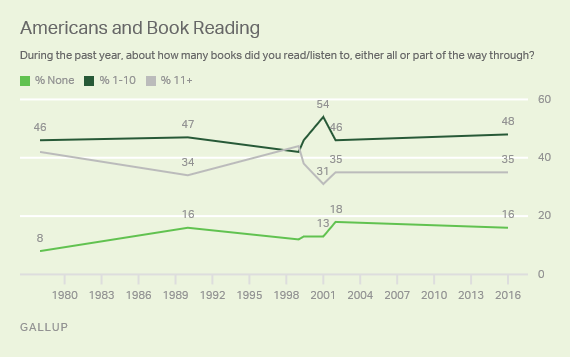
35% say they read more than 11 books in the past year
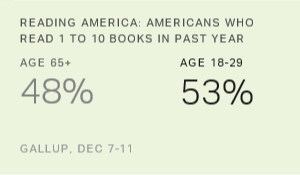
53% of young adults read between one and 10 books in the past year
73% prefer printed books to e-readers or audio books

WASHINGTON, D.C. -- Despite the abundance of digital diversions vying for their time and attention, most Americans are still reading books. In fact, they are consuming books at nearly the same rate that they were when Gallup last asked this question in 2002 -- before smartphones, Facebook or Twitter became ubiquitous. More than one in three (35%) appear to be heavy readers, reading 11 or more books in the past year, while close to half (48%) read between one and 10 and just 16% read none.


Rumors of the Demise of Books Greatly Exaggerated | Gallup: Rumors of the Demise of Books Greatly Exaggerated

Internet Truth Debunked: INTERNET LISTS DEBUNKED - Surprising Book Facts | Saturday, 25 October 2014

Reading habits | Infographics | Literacy

Internet Truth Debunked: INTERNET LISTS DEBUNKED - Surprising Book Facts:A pretty infographic showing with statistics to remind you how society is just getting stupider will always get a lot of reshares.  Maybe people are getting stupider, because they accept statistics on pretty infographics as true...


The infographic was created by Rob Brewer in in 2012, later realising the errors in the original he created a new one:


Since the new one are far less surprising and far less emotive than the original, guess which one still gets shared around?

Rob Brewer notes where the original statistics come from and why he now thinks they're dubious on the page above.  Here's an more detailed look at it from a link on his page.

The stats come from a speech given by Jenkins in 2003, so wherever possible, 2002 statistics are used below.  It's important to note that however accurate the statistics in the speech, the speech was to industry people about the industry. Read more...

Thursday, August 25, 2016

The mysterious ancient origins of the book By Keith Houston 22 August 2016

 History of the Book


The book is changing. Electronic books, or ebooks, are more portable than their paper counterparts, capable of being carried in their hundreds on a single reader or tablet. Thousands more are just a click away. It can be argued that ebooks are more robust than paper ones: an ebook reader can be stolen or dropped in the bath, but the books on it are stored safely in the cloud, waiting to be downloaded onto a new device. It is not too much to say that books and reading are in the throes of a revolution.
Books and reading are in the throes of a revolution
Not everyone is happy about this. Book lovers, publishers and booksellers alike are watching the book-v-ebook sales battle with great interest, and when Tom Tivnan of The Bookseller reported recently that ebook sales had dipped for the first time, he sounded almost relieved: “For those who predicted the death of the physical book and digital dominating the market by the end of this decade, the print and digital sales figures […] for 2015 might force a reassessment.” Physical books may have the upper hand for now, but the debate is a long way from being settled.

Book lovers, publishers and booksellers alike are watching the book-v-ebook sales battle with great interest (Credit: Getty Images)

Wednesday, March 9, 2016

The Custodian of Forgotten Books by Daniel. A. Gross


In Brussels, Brad Bigelow, a former I.T. adviser for the U.S. Air Force, has made a hobby of rescuing neglected books and writers from obscurity.CREDITILLUSTRATION BY BOYOUN KIM

A little over a decade ago, a forgotten book was suddenly remembered. Its second life began when a fiction writer referenced it in a book of her own. A blogger read the new book, then tracked down a copy of the old one, and wrote about all this on his Web site. An archivist read the blog post and e-mailed it to a small publisher. By 2009, Jetta Carleton’s “The Moonflower Vine,” first published in 1962, was back in print. 
Most novels are forgotten. Glance at the names of writers who were famous in the nineteenth century, or who won the Nobel Prize at the beginning of the twentieth, or who were on best-seller lists just a few decades ago, and chances are that most of them won’t even ring a bell. When “The Moonflower Vine” resurfaced and ricocheted around the publishing world, it became an unlikely exception.
What’s strange about the journey of that bookand about our moment in the history of publishing—is that its rediscovery was made possible by an independent blogger, named Brad Bigelow. Bigelow, fifty-eight, is not a professional publisher, author, or critic. He’s a self-appointed custodian of obscurity. For much of his career, he worked as an I.T. adviser for the United States Air Force. At his home, in Brussels, Belgium, he spends nights and weekends scouring old books and magazines for writers worthy of resurrection.

Wednesday, September 23, 2015

The Plot Twist: E-Book Sales Slip, and Print Is Far From Dead By ALEXANDRA ALTER SEPT. 22, 2015

Penguin Random House last year doubled the size of its distribution center in Crawfordsville, Ind., to speed up book distribution. CreditA J Mast for The New York Times
Five years ago, the book world was seized by collective panic over the uncertain future of print.
As readers migrated to new digital devices, e-book sales soared, up 1,260 percent between 2008 and 2010, alarming booksellers that watched consumers use their stores to find titles they would later buy online. Print sales dwindled, bookstores struggled to stay open, and publishers and authors feared that cheaper e-books would cannibalize their business.
Then in 2011, the industry’s fears were realized when Borders declared bankruptcy.
“E-books were this rocket ship going straight up,” said Len Vlahos, a former executive director of the Book Industry Study Group, a nonprofit research group that tracks the publishing industry. “Just about everybody you talked to thought we were going the way of digital music.”

Read more....

Tuesday, February 24, 2015

Why digital natives prefer reading in print. Yes, you read that right. - The Washington Post

Although American University student Cooper
Nordquist, 21, uses his laptop most of the day, he still likes to read
from the printed word for enjoyment. Despite that fact that most college
students do a majority of their socializing and school work
electronically, many still like to read from actual hard copy printed
books. (Michael S. Williamson/The Washington Post)
Frank Schembari loves books — printed books. He loves how
they smell. He loves scribbling in the margins, underlining interesting
sentences, folding a page corner to mark his place.


Schembari
is not a retiree who sips tea at Politics and Prose or some other
bookstore. He is 20, a junior at American University, and paging through
a thick history of Israel between classes, he is evidence of a peculiar
irony of the Internet age: Digital natives prefer reading in print.


“I like the feeling of it,” Schembari said, reading under natural light in
a campus atrium, his smartphone next to him. “I like holding it. It’s
not going off. It’s not making sounds.”


Textbook makers,
bookstore owners and college student surveys all say millennials still
strongly prefer print for pleasure and learning, a bias that surprises
reading experts given the same group’s proclivity to consume most other
content digitally. A University of Washington pilot study of digital
textbooks found that a quarter of students still bought print versions
of e-textbooks that they were given for free.

Read more...

Wednesday, February 13, 2013

Goodreads.com Is Growing as a Popular Book Site - NYTimes.com

Goodreads.com Is Growing as a Popular Book Site - NYTimes.com


Goodreads.com has grown to 15 million members. 
 Lori Hettler is a passionate reader, tearing through about 80 books a year. But as a resident of a Pennsylvania town and with a preference for fiction from small publishers, she can have trouble finding new books to feed her habit.

She tried to start a book club, but there weren’t enough takers. For years she made a weekly trip to browse a bookstore 40 minutes away in a Scranton suburb.

But then she found a solution to her problem: Goodreads.com, a social media site for finding and sharing titles that has 15 million members, is exploding in popularity and rivaling Amazon.com as a platform for promoting new books. Read more...
Enhanced by Zemanta

Thursday, October 18, 2012

Ditch the Monograph - College, Reinvented - The Chronicle of Higher Education

Ditch the Monograph - College, Reinvented - The Chronicle of Higher Education
By Jennifer Howard
October 14, 2012
David Schwen for The Chronicle
 
A historian or anthropologist spends years working on a monograph, bulking up an argument. A scholarly publisher takes more years to shepherd that argument into print. Meanwhile, academic libraries have ever-smaller amounts of money and space to lavish on such books, which often have more pages than they have readers.

What if scholars, publishers, and tenure-and-promotion committees embraced short-form e-books as a respectable way to deliver serious scholarship? A Kindle Singles model could help academics and publishers pick up the pace of production. It could be priced low enough to appeal to library budgets. It wouldn't devour precious shelf space. It would suit libraries' current desire to build up their e-book collections. And it might pull in new readers for serious scholarship. Read more...
Enhanced by Zemanta

Tuesday, August 14, 2012

Predatory Publishing | The Scientist

Predatory Publishing | The Scientist

KeraFAST

Predatory Publishing

Overzealous open-access advocates are creating an exploitative environment, threatening the credibility of scholarly publishing.

By Jeffrey Beall | August 1, 2012

Illustration by Dusan Petricic
 A great upheaval is occurring in scholarly publishing. Over the past 10 years, researchers, academics, and academic librarians have been promoting open-access publishing, and we are just now beginning to see the results of their advocacy, which unfortunately are way below expectations.

One result is that the open-access movement is producing an almost boomtown-like increase in the number of scholarly open-access publishers, fostered by a very low barrier to entrance into the learned publishing industry. To become a scholarly publisher, all you need now is a computer, a website, and the ability to create unique journal titles.

Bolstering this trend is the so-called “gold open-access” model, in which publishing is supported not by subscription fees but by author fees. An example of a gold open-access journal is The Scientific World Journal, currently published by Cairo-based Hindawi Publishing Corporation. This megajournal covers virtually all scientific fields and imposes an article processing charge of $1,000 for each accepted article. Similarly, the better-known Public Library of Science (PLoS) journals charge authors anywhere from $1,350 to $2,900 to publish, with a discount if the researcher is affiliated with a university that is an institutional member. [Read more...]
Enhanced by Zemanta