Showing posts with label #OpenAccess. Show all posts
Showing posts with label #OpenAccess. Show all posts
Monday, March 2, 2020
Wednesday, November 6, 2019
Weaving Books into the Web—Starting with Wikipedia
Wikipedia | Internet Archive | Open Access
Weaving Books into the Web—Starting with Wikipedia
The Internet Archive has transformed 130,000 references to books in Wikipedia into live links to 50,000 digitized Internet Archive books in several Wikipedia language editions including English, Greek, and Arabic. And we are just getting started. By working with Wikipedia communities and scanning more books, both users and robots will link many more book references directly into Internet Archive books. In these cases, diving deeper into a subject will be a single click. Read more...
 |
| —Moriel Schottlender, Senior Software Engineer, Wikimedia Foundation, speech announcing this program |


Thursday, February 21, 2019
Paywall: The Business of Scholarship (CC BY 4.0)
Open Access | Paywall |Scholarly Communication | Publishing | Academic Libraries
Paywall: The Business of Scholarship, produced by Jason Schmitt, provides focus on the need for open access to research and science, questions the rationale behind the $25.2 billion a year that flows into for-profit academic publishers, examines the 35-40% profit margin associated with the top academic publisher Elsevier and looks at how that profit margin is often greater than some of the most profitable tech companies like Apple, Facebook and Google. This film is free to view both in personal and public venues. For more information please visit: Paywallthemovie.comPaywallthemovie.com
Thursday, February 14, 2019
Internet Archive's ebook loans face UK copyright challenge
Internet Archive | E-books | Copyright | Open Access
The Society of Authors has called on the website’s Open Library to stop making scanned books ‘unlawfully’ available to British readersby Alison Flood | Tue 22 Jan 2019
 |
| The Society of Authors has called on the Internet Archive ‘to cease making available to UK users the unauthorised lending of scanned books’. Photograph: Model-la/Getty Images/iStockphoto |
Set up in San Francisco 1996 to preserve pages published on the internet, the Internet Archive also collects digital books, offering borrowers access to hundreds of thousands of titles through its Open Library arm. Some are out of copyright, but the collection includes books from authors including AS Byatt, Kate Atkinson, Hilary Mantel, William Boyd, Philip Pullman and Iain Banks that are still in copyright and currently available to be borrowed in the UK.
According to its website, the organisation began digitising books in 2005, because “not everyone has access to a public or academic library with a good collection, so to provide universal access we need to provide digital versions of books”. Today the archive scans 1,000 books a day in 28 locations around the world, through its book scanning and book drive programmes – with the “ultimate goal of [making] all the published works of humankind available to everyone in the world”. Users can borrow up to five books at a time, with each loan expiring after two weeks. Read more...
Thursday, May 31, 2018
Tuesday, February 6, 2018
You’re a Researcher Without a Library: What Do You Do? | Medium
Research | Access | Libraries | Open Access
by Jake Orlowitz | Nov 15, 2017Investigating solutions for frustrated scholars, nonprofits, independent learners, and the rest of us.
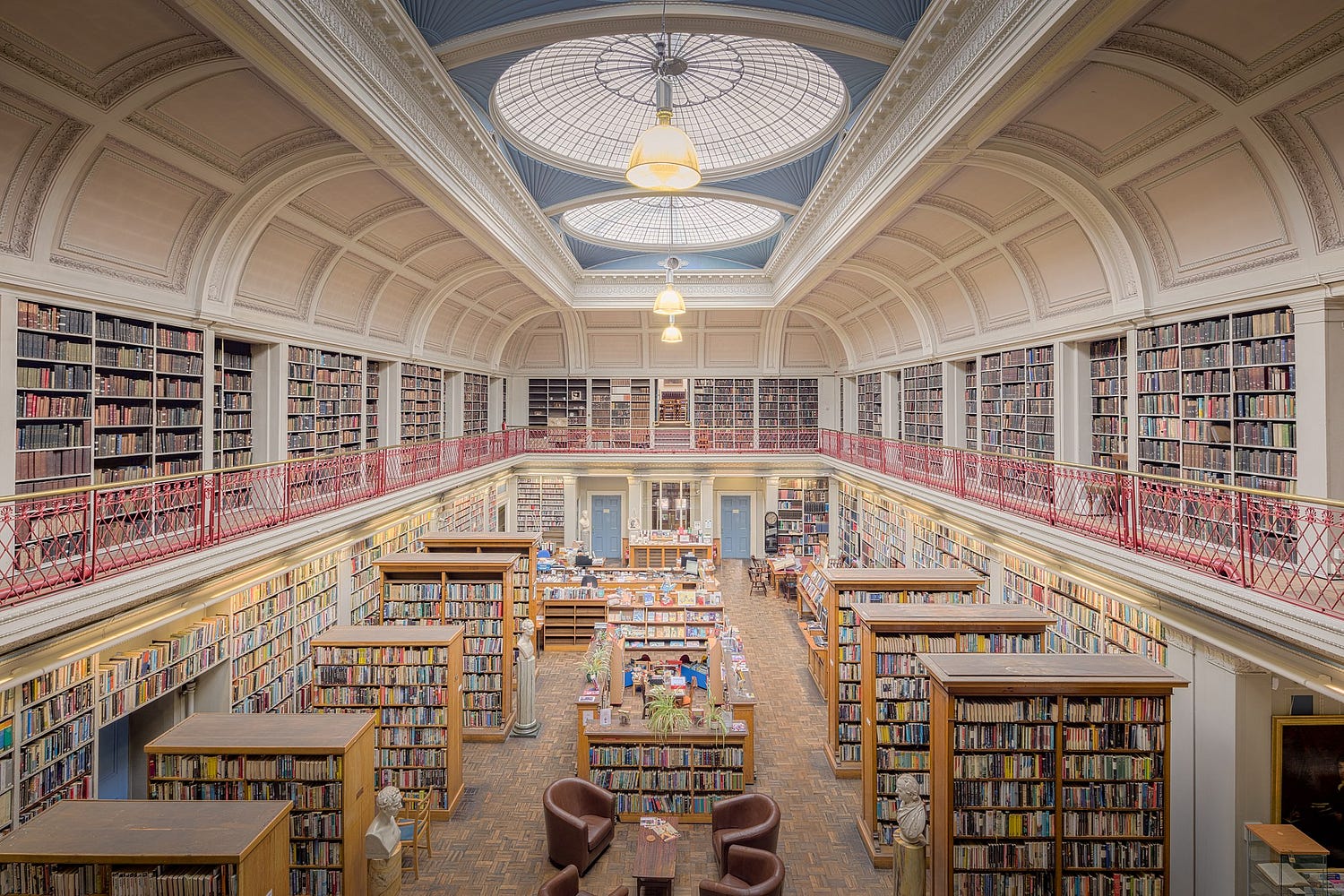 |
| Wikimedia Commons |
The world of publishing is evolving frantically, while it remains
frustratingly fragmented and prohibitively expensive for many. If you’re
a student who just left your academic library behind only to discover
you are now locked out of the stacks; a startup researching water usage
in Africa and keep hitting paywalls; a local nonprofit that studies
social change activism, but all the latest papers cost $30 per read…
This article is for you.
Local Library
Citizens, taxpayers, cities, states, and nations pay a lot of money to provide free services. Use them!
Public libraries often subscribe to costly databases; the annual
investments for these licenses are only worth it if they are of use to
the libraries’ constituency. The good news is that most people have a
library nearby, many of the resources are fully available online
(especially the databases), and a library card is often free or
inexpensive. Also, libraries have librarians, who are pros at finding what you want (or something even better).
Bad
news is that your local library may not be that local, and you may need
to jump through some hoops to get your library card. Not all local
libraries can afford masses of scholarly journals either, although many
have at least some access. Read more...
Subscribe to:
Posts (Atom)