Pages

Showing posts with label #copyright. Show all posts

Monday, March 16, 2020

Public Statement: Fair Use & Emergency Remote Teaching & Research

Copyright | Fair Use | Online instruction | Remote learning | Covid-19


Public Statement of Library Copyright Specialists: Fair Use & Emergency Remote Teaching & Research
Share this page: https://tinyurl.com/tvnty3a
March 13, 2020
This Statement is meant to provide clarity for U.S. colleges and universities about how copyright law applies to the many facets of remote teaching and research in the wake of the COVID-19 outbreak. We write this as copyright specialists at colleges, universities, and other organizations supporting higher education in the U.S. and Canada who work every day with faculty, staff, and librarians to enable them to make ethical and legal choices about copyright issues in online teaching.  
The United States is in a time of crisis. As of this writing, more than 200 universities and colleges have moved to remote teaching. These moves aim to promote public health by slowing the spread of the disease, while maintaining at least some of the important functions higher education plays in teaching, learning, and research. We have heard concerns that copyright may pose impediments to a rapid shift to remote instruction, or conversely, that copyright is not relevant. While legal obligations do not automatically dissolve in the face of a public health crisis, U.S. copyright law is, thankfully, well equipped to provide the flexibility necessary for the vast majority of remote learning needed at this time.

Fair Use

Copyright law in the United States is made to support teaching, research, and learning. This stems from its Constitutional purpose, which is “to promote the Progress of Science and the useful Arts.”[1] One critical feature of copyright law is fair use,[2] a flexible users’ right that allows the use of copyrighted works without permission. It accommodates a wide variety of circumstances, including new and rapidly evolving situations. In the words of one of our colleagues, April Hathcock, “fair use is made for just these kinds of contingencies.”
To analyze whether a particular use is fair, courts balance four factors. The “heart of the fair use inquiry” lies in the first factor – the purpose and character of the use.[3] Courts favor uses where the purpose is to benefit the public, even when that benefit is not “direct or tangible.”[4]
Even under normal circumstances, courts favor educational uses because of their broad public benefits.[5] While there are no fair use cases squarely addressing copying to help minimize a public health crisis, the other wide variety of public benefits cited by courts leads us to believe that this purpose would weigh extremely heavily in favor of fair use. For example, in the Authors Guild v. HathiTrust case,[6] the court made it clear that providing access to persons with disabilities was a strong public interest that weighed heavily in the fair use assessment. Similarly, other courts have found that allowing reproduction of the Zapruder film documenting Kennedy's assassination was in the public interest,[7] and allowing redistribution of leaked internal memos about problems with electronic voting machines also favored fair use.[8] 
The benefit to the public in providing remote coursework is obvious when it enables teaching to continue in the face of social distancing measures or quarantine, or when access to physical library materials is impossible. The public benefit of these measures is without a doubt of at least equal importance as in these cases.
The second factor examines the nature of the work used—is it more factual or creative, published or not? In cases like this, the second factor “has rarely played a significant role in the determination of a fair use dispute.”[9] For remote teaching in the COVID-19 situation, the analysis should be the same. Read more....

Thursday, February 14, 2019

Internet Archive's ebook loans face UK copyright challenge

Internet Archive | E-books | Copyright | Open Access

The Society of Authors has called on the website’s Open Library to stop making scanned books ‘unlawfully’ available to British readers

by Alison Flood | Tue 22 Jan 2019

The Society of Authors has called on the Internet Archive ‘to cease making available to UK users the unauthorised lending of scanned books’. Photograph: Model-la/Getty Images/iStockphoto
The Society of Authors (SoA) is threatening legal action against the Internet Archive unless it stops what the writers’ body claimed is the unauthorised lending of books unlawfully scanned for its Open Library.

Set up in San Francisco 1996 to preserve pages published on the internet, the Internet Archive also collects digital books, offering borrowers access to hundreds of thousands of titles through its Open Library arm. Some are out of copyright, but the collection includes books from authors including AS Byatt, Kate Atkinson, Hilary Mantel, William Boyd, Philip Pullman and Iain Banks that are still in copyright and currently available to be borrowed in the UK.

According to its website, the organisation began digitising books in 2005, because “not everyone has access to a public or academic library with a good collection, so to provide universal access we need to provide digital versions of books”. Today the archive scans 1,000 books a day in 28 locations around the world, through its book scanning and book drive programmes – with the “ultimate goal of [making] all the published works of humankind available to everyone in the world”. Users can borrow up to five books at a time, with each loan expiring after two weeks. Read more...

Wednesday, October 11, 2017

Books from 1923 to 1941 Now Liberated!

Copyright | Open Access | Internet Archives

[press: boingboing]


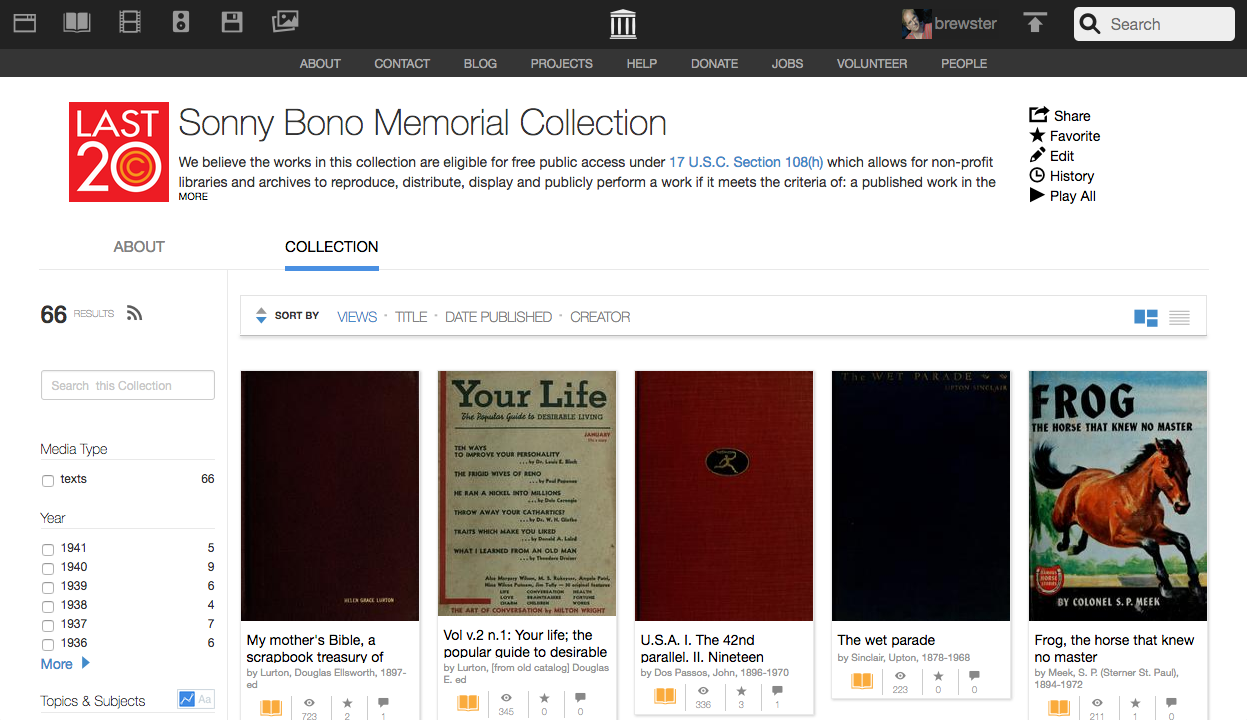
The Internet Archive is now leveraging a little known, and perhaps never used, provision of US copyright law, Section 108h, which allows libraries to scan and make available materials published 1923 to 1941 if they are not being actively sold. Elizabeth Townsend Gard, a copyright scholar at Tulane University calls this “Library Public Domain.”  She and her students helped bring the first scanned books of this era available online in a collection named for the author of the bill making this necessary: The Sonny Bono Memorial Collection. Thousands more books will be added in the near future as we automate. We hope this will encourage libraries that have been reticent to scan beyond 1923 to start mass scanning their books and other works, at least up to 1942.


Wednesday, August 16, 2017

BiblioTech: Why Libraries Matter More Than Ever in the Age of Google by John Palfrey [review]

Library advocacy | Digitization | Libraries | User experience | Book review

BiblioTech: Why Libraries Matter More Than Ever in the Age of GoogleBiblioTech: Why Libraries Matter More Than Ever in the Age of Google by John Palfrey

Reviewer: Stephanie L. Gross, MSLIS, MATESOL
August 16, 2017
 
My rating: 4 of 5 stars


Reviewer bio:
I am an academic librarian whose main responsibility has been to establish and maintain a large database for electronic reserves. I have a solid background in public service, and have mentored library school students and recent graduates for over 10 years. I am conversant in issues relating to access and technology relating to digitization of materials as well as those born-digitally. Since I follow library news on a daily basis, I read this book more as a review of the known, while noting sources for future use. Most of those concerned digitization of material and aspects relating to institutional repositories. A second focus was based on a new work responsibility, that of personal librarian to undergraduate honors students.

Review:
This volume was written by a "feral" librarian with a law degree. It included the major areas where and how libraries are ever-relevant today: users, spaces, platforms, hacking, networks, preservation, education and copyright. Noteworthy highlights for me were the discussions of how some librarians and advocates are reinventing libraries while acknowledging their tradition roles in democratic society. Public, academic, school and special libraries were included. The ‘hybrid-ness’ of libraries is emphasized, along with the innovative factor of digitization of a variety of materials. Risks are involved when print is not saved to backup data. “Data rot” happens when technology fails, but also when newer forms outpace older, obsolete ones. Budgets are stretched to accommodate both digital and analog materials. The author calls for the ‘collaboration’ among librarians, the establishment of library networks, consortia, and private as well as public funding. The conundrum of copyright, data rights and collection policies was briefly examined.

Additional Subject headings might include:

Digital libraries
Web archiving
Digital preservation
Archival materials – Digitization
Library materials -- Digitization


View all my reviews