Archives | Women's studies | Research
 |
Dwayne Desaulniers, AP Images
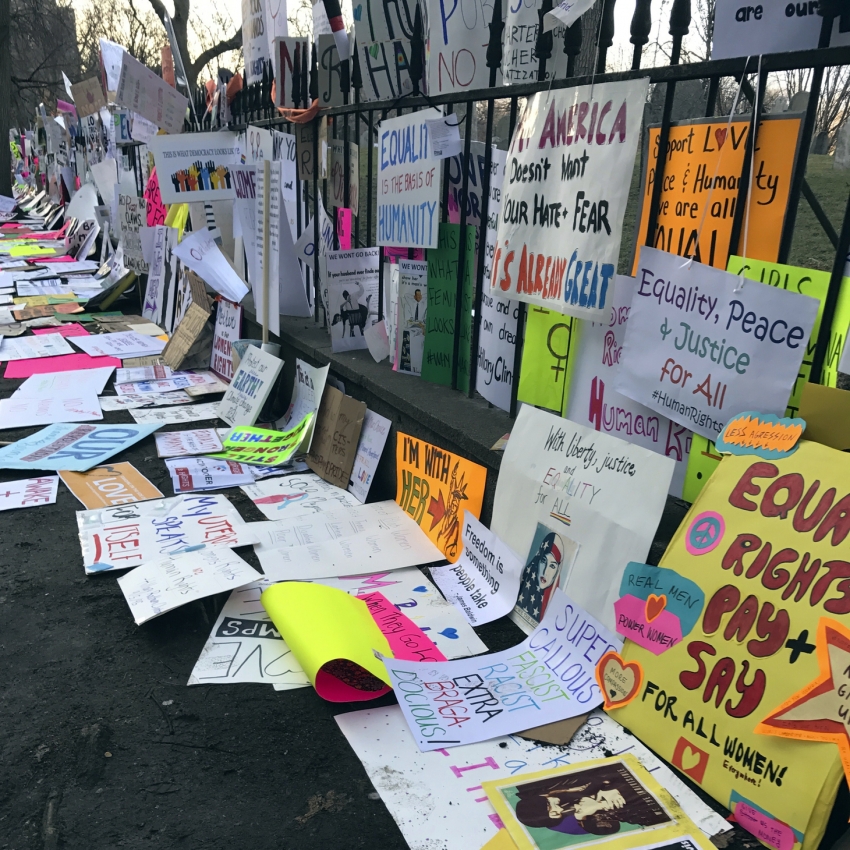
Signs line the fence surrounding Boston Common after the
Boston Women's March for America on Saturday. Some of those signs could
end up in an archive at Northeastern U.
|
The signs were pink, blue, black, white.
Some were hoisted with wooden sticks, and others were held in
protesters’ hands. A few sparkled with glitter, and some had original
designs, created on computers with the help of a few internet memes.
Still, at the Boston Women’s March for America on Saturday, hundreds
of the signs criticizing President Trump’s campaign promises and
administrative agenda ended up wrapped around the fence near Boston
Common, laid down like a carpet covering the sidewalk.
After leaving a late lunch with some colleagues, Nathan Felde, a
design professor at Northeastern University, stopped to admire the
signs. He was struck by their originality, and how most had come from
amateur artists. Parks employees told him they had been instructed to
dispose of the signs that evening, he said.
"There was that moment where, in looking at that work, it was almost
instinctual to say, ‘This all has to be saved,’ and then acting on it
before we knew what we were going to do next," Mr. Felde said.
The workers said Mr. Felde and his group were free to take signs. So
he rented a van, his colleagues and a few onlookers loaded them up, and
off to a newly rented storage unit they went. Dietmar Offenhuber, an
assistant professor of art and design and public policy, said the
collected signs filled a 40-square-foot storage unit.
Now the group wants to archive the collection, physically and online, with the help of Northeastern University’s library.
Read more...