Pages

Showing posts with label women's movement. Show all posts

Tuesday, January 24, 2017

In Discarded Women’s March Signs, Professors Saw a Chance to Save History | By Fernanda Zamudio-Suaréz January 24, 2017


Archives | Women's studies | Research
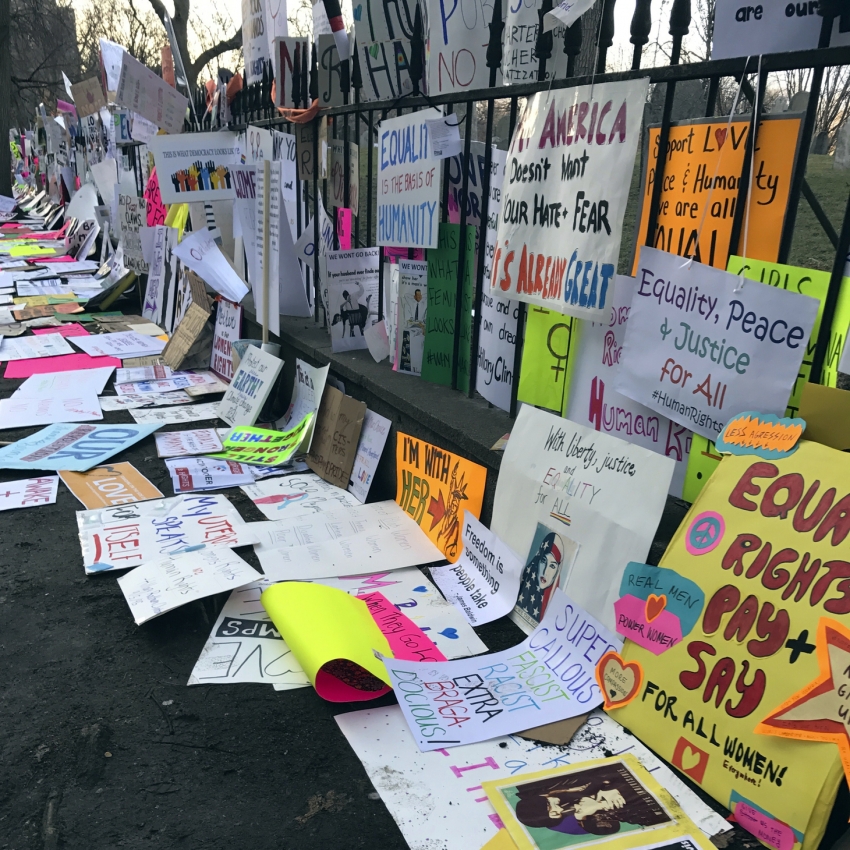
Dwayne Desaulniers, AP Images
Signs line the fence surrounding Boston Common after the Boston Women's March for America on Saturday. Some of those signs could end up in an archive at Northeastern U. 


The signs were pink, blue, black, white. Some were hoisted with wooden sticks, and others were held in protesters’ hands. A few sparkled with glitter, and some had original designs, created on computers with the help of a few internet memes.

Still, at the Boston Women’s March for America on Saturday, hundreds of the signs criticizing President Trump’s campaign promises and administrative agenda ended up wrapped around the fence near Boston Common, laid down like a carpet covering the sidewalk.

After leaving a late lunch with some colleagues, Nathan Felde, a design professor at Northeastern University, stopped to admire the signs. He was struck by their originality, and how most had come from amateur artists. Parks employees told him they had been instructed to dispose of the signs that evening, he said.

"There was that moment where, in looking at that work, it was almost instinctual to say, ‘This all has to be saved,’ and then acting on it before we knew what we were going to do next," Mr. Felde said.
The workers said Mr. Felde and his group were free to take signs. So he rented a van, his colleagues and a few onlookers loaded them up, and off to a newly rented storage unit they went. Dietmar Offenhuber, an assistant professor of art and design and public policy, said the collected signs filled a 40-square-foot storage unit.

Now the group wants to archive the collection, physically and online, with the help of Northeastern University’s library. Read more...

Friday, October 9, 2015

Suffragette Movie: 3 Alternative Books to Read BY NICOLE FROIO

The movie Suffragette, featuring Helena Bonham Carter, Meryl Streep and Carey Mulligan, premiered in the UK on Wednesday, October 7. In true feminist fashion, the movie was welcomed by feminists who stormed the red carpet to protest against UK government cuts that have been harming British women.
It was a badass show of activism by SistersUncut and I absolutely loved it.
However, I am the feminist killjoy who pops your suffragette-admiring bubble to say that Emmeline Pankhurst (and other suffragettes) was kind of racist (and very pro-colonisation in her later years). As much as the suffragettes were absolutely essential to the fight for equality, they often compared (white) women’s lack of rights to slavery – effectively excluding black women from their fight for women’s suffrage. This was extensively pointed out in social media after Suffragette actresses were picturedwearing shirts with one of Pankhurst’s most famous (and offensive) quotes: “I’d rather be a rebel than a slave.” (As if slavery was a choice but OK EMMELINE, WELL DONE). (ALSO, can we talk about why these actresses thought wearing this quote across their chest was OK?!!? Meryl, I thought you were cool.)
There’s a lot to be said about whether it’s right or wrong to admire the suffragettes if we look at the movement with an intersectional feminist lens, but I believe the best way to make that decision is to educate yourself. All of our idols will be problematic in one way or another and while I will definitely be watching the movie, I will also be reading some additional materials to make sure I understand the full picture of the suffragette movement in terms of intersectionality (or lack thereof). Below are the books I will be reading to seek this knowledge.
On a quick side note, it’s important to say that the racism in the British and American suffragette movements were very different (it was definitely more overt in the US, with suffragettes arguing against black men having the right to vote) but that it existed in both countries.