Pages

Showing posts with label Research. Show all posts

Tuesday, January 24, 2017

In Discarded Women’s March Signs, Professors Saw a Chance to Save History | By Fernanda Zamudio-Suaréz January 24, 2017


Archives | Women's studies | Research
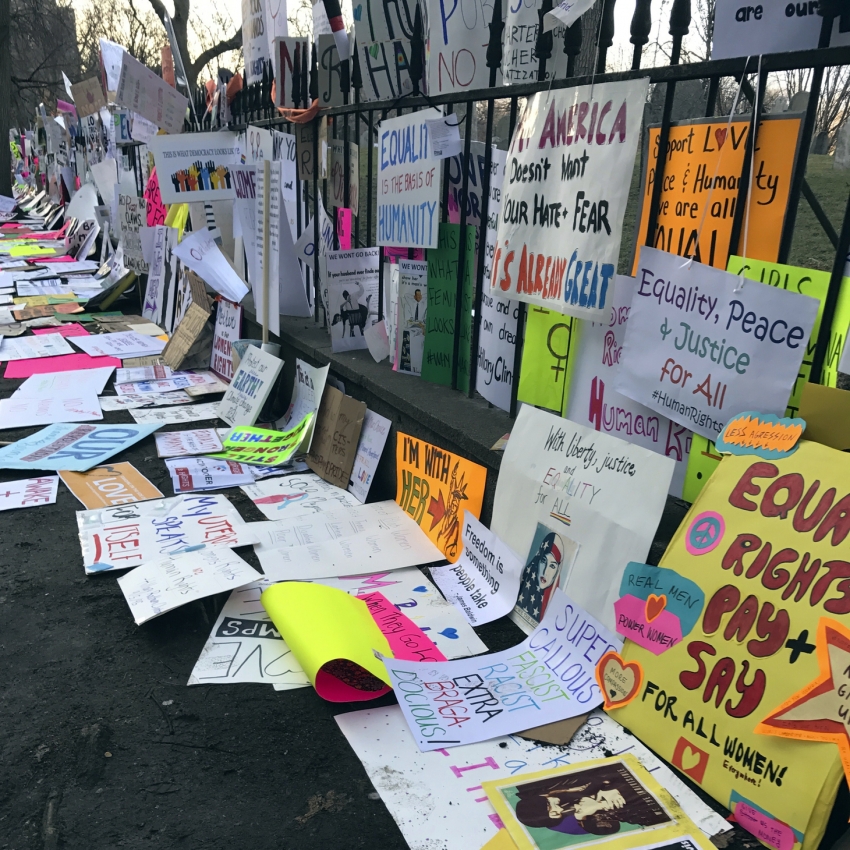
Dwayne Desaulniers, AP Images
Signs line the fence surrounding Boston Common after the Boston Women's March for America on Saturday. Some of those signs could end up in an archive at Northeastern U. 


The signs were pink, blue, black, white. Some were hoisted with wooden sticks, and others were held in protesters’ hands. A few sparkled with glitter, and some had original designs, created on computers with the help of a few internet memes.

Still, at the Boston Women’s March for America on Saturday, hundreds of the signs criticizing President Trump’s campaign promises and administrative agenda ended up wrapped around the fence near Boston Common, laid down like a carpet covering the sidewalk.

After leaving a late lunch with some colleagues, Nathan Felde, a design professor at Northeastern University, stopped to admire the signs. He was struck by their originality, and how most had come from amateur artists. Parks employees told him they had been instructed to dispose of the signs that evening, he said.

"There was that moment where, in looking at that work, it was almost instinctual to say, ‘This all has to be saved,’ and then acting on it before we knew what we were going to do next," Mr. Felde said.
The workers said Mr. Felde and his group were free to take signs. So he rented a van, his colleagues and a few onlookers loaded them up, and off to a newly rented storage unit they went. Dietmar Offenhuber, an assistant professor of art and design and public policy, said the collected signs filled a 40-square-foot storage unit.

Now the group wants to archive the collection, physically and online, with the help of Northeastern University’s library. Read more...

Monday, October 13, 2014

Harvard University says it can't afford journal publishers' prices | Science | The Guardian

Harvard University says it can't afford journal publishers' prices | Science | The Guardian: Harvard University says it can't afford journal publishers' prices
University wants scientists to make their research open access and resign from publications that keep articles behind paywalls


A graduation ceremony at Harvard University
A memo from Harvard's
faculty advisory council said major scientific publishers had made
scholarly communication 'fiscally unsustainable'. Photograph: Corbis
Exasperated by rising subscription costs charged by academic publishers, Harvard University
has encouraged its faculty members to make their research freely
available through open access journals and to resign from publications
that keep articles behind paywalls.


A memo from Harvard Library
to the university's 2,100 teaching and research staff called for action
after warning it could no longer afford the price hikes imposed by many
large journal publishers, which bill the library around $3.5m a year.


The
extraordinary move thrusts one of the world's wealthiest and most
prestigious institutions into the centre of an increasingly fraught
debate over access to the results of academic research, much of which is
funded by the taxpayer.


The outcome of Harvard's decision to take
on the publishers will be watched closely by major universities around
the world and is likely to prompt others to follow suit. Read more...

Wednesday, November 20, 2013

Research Like a Librarian: Using "Big6 Skills" for Better Grades! | The New York Public Library


PSSSTT! Let me let you in on a little librarian research secret: finding information at branches and online isn't hard (anyone can do it). In fact, in this digital age of big databases, Google and Wikipedia we are on information overload. We are surrounded by too much information actually. So how do librarians research? What do we know that you don't?

Well, we know how to evaluate information, dissect it, analyze it, reassemble it and put it to use effectively. One way to do this is through the "Big6 Skills"—a research and problem solving process, which was developed by two educators as a way to teach information and technology skills. I learned them while getting my Masters in Library Science and they BLEW MY MIND! Suddenly researching and organizing information for a paper or essay was a breeze. If only I'd learned them when I was in high school or middle school my life would've been totally different. I might've been Hillary Clinton or Simon Cowell. Read more...
Enhanced by Zemanta

Thursday, October 25, 2012

Enabling the Research ‘Flow’ and Serendipity in Today’s Digital Library Environment – Library Hat

Enabling the Research ‘Flow’ and Serendipity in Today’s Digital Library Environment – Library Hat


Can you resist walking between these stacks? Our desire doesn’t always correspond to its practical utility?
 Today’s library users do not carry pencils and notebooks to a library. They do no longer want to be isolated to concentrate on deep study or contemplative reading when they are at a library. Rather, they have the dire need to be connected to the biggest library the human race ever had, the World Wide Web, always and even more so when they are at a library walking through the forest of fascinating knowledge and information. The traditional library space packed with stacks and carrels does not serve today’s library users well whether they are scholars, students, or the public visiting a library for research, study, or leisure reading. As more and more library resources are moved to the fast and convenient realm of the World Wide Web, libraries have been focusing on re-defining the library space. Now, many libraries boast attractive space almost comparable to trendy, comfortable, and vibrant coffee shops. The goal of these new library spaces are fostering communication, the exchange of ideas, and social learning. Read more.http://www.bohyunkim.net/blog/archives/2287
Enhanced by Zemanta