Pages

Showing posts with label digital humanities. Show all posts

Tuesday, June 20, 2017

Brooklyn Academy of Music Puts 70,000 Archive Materials Online

Arts | Archives | Digital Humanities

The musician and performance artist Laurie Anderson in another archival image, from the production “Empty Places” during the Next Wave Festival in 1989. Credit Linda Alaniz/Martha Swope Associates
Merce Cunningham onstage, with the composer John Cage to the right, in “How to Pass, Kick, Fall and Run” in 1970. The image is part of the Brooklyn Academy of Music’s new digital archives. Credit James Klosty 
 
More than 70,000 playbills, posters and ephemera from the history of the Brooklyn Academy of Music — from as far back as the Civil War era — are now available through the Leon Levy BAM Digital Archive, which opened to the public on Tuesday.

The archive has been in development for several years, paid for by a $1 million grant from the Leon Levy Foundation, the same organization that funded the New York Philharmonic’s digital collection.
 
 
Read more... 

Wednesday, February 8, 2017

New York’s Metropolitan Museum of Art releases 375,000 digital works for remix and re-use online via CC0

Open Access |  Digital Humanities | Art

Jennie Rose Halperin | Feburary 7, 2017

Today, the Metropolitan Museum of Art in New York announces that all public domain images in its collection will be shared under CC0, expanding their digital collection by over 375,000 images as well as providing data on over 420,000 museum objects spanning more than 5,000 years. CC0 allows anyone to use, re-use, and remix a work without restriction. This announcement will shape the future of public domain images online and underscores the Met’s leadership role as one of the most important open museum collections in the world.

Creative Commons CEO Ryan Merkley joined the Met to announce the release. The Met collection of CC0 images can be browsed on the new CC Search beta, also announced this morning.

“Sharing is fundamental to how we promote discovery, innovation, and collaboration in the digital age,” said Merkley. “Today, The Met has given the world a profound gift in service of its mission: the largest museum in the United States has eliminated the barriers that would otherwise prohibit access to its content, and invited the world to use, remix, and share their public domain collections widely and without restriction.” Read more...

Wednesday, January 6, 2016

New York Public Library Invites a Deep Digital Dive By JENNIFER SCHUESSLERJAN. 6, 2016

Part of one of the “Tale of Genji” scrolls available for easy exploration now that the New York Public Library has released nearly 200,000 public-domain items from its special collections. CreditSpencer Collection, The New York Public Library

Mansion Maniac, a whimsical online toy created by the New York Public Library, may seem like envy bait for the real-estate have-nots. With the help of a Pac-Man-like icon, users can explore the floor plans of some of the city’s most extravagant early-20th-century residences, culled from the library’s archives.
But the game is what you might call a marketing teaser for a major redistribution of property, digitally speaking: the release of more than 180,000 photographs, postcards, maps and other public-domain items from the library’s special collections in downloadable high-resolution files — along with an invitation to users to grab them and do with them whatever they please.
Digitization has been all the rage over the past decade, as libraries, museums and other institutions have scanned millions of items and posted them online. But the library’s initiative (nypl.org/publicdomain), which goes live on Wednesday, goes beyond the practical questions of how and what to digitize to the deeper one of what happens next.  Read more...

Wednesday, September 2, 2015

Introducing the Archive Corps Meet the man behind a new effort to save documents and other artifacts before they disappear.


Jason Scott / Flickr

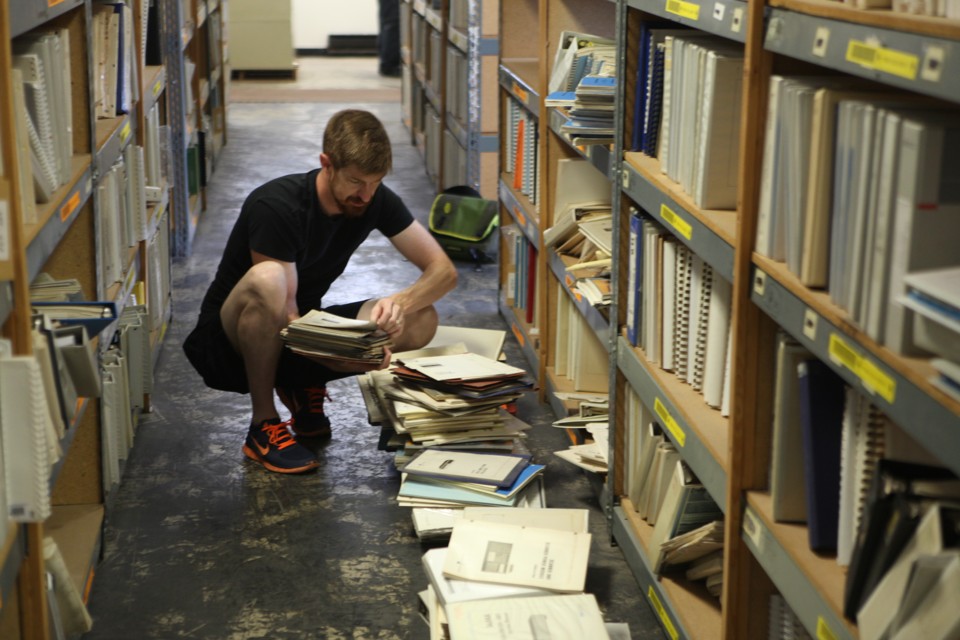
Jason Scott has something of a reputation. He’s a historian who works for the Internet Archive, and he’s known in some circles as the guy who can save bits of history right before they disappear.
So when he found out that a small store in Maryland that sold manuals for machinery was going out of business, and was going to get rid of its collection of nearly 200,000 obscure booklets in just a few days, Scott got to work. 

He got to Maryland on a Friday to check out the stockpile at Manuals Plus. By Wednesday of the next week he had rallied over 70 volunteers to put together 1,600 boxes of manuals (nobody counted exactly how many booklets fill those boxes, but the guess is between 50,000 and 75,000) that now sit in three storage containers. The whole endeavor cost about $9,000, most of which was donated to the project.

Read more: http://www.theatlantic.com/technology/archive/2015/09/introducing-the-archive-corps/403135/?utm_source=SFTwitter

Wednesday, July 8, 2015

1.5 Million Slavery-Era Records to be Released for Free Online Access


1.5 million digitized images contain an estimated four million names of formerly enslaved people. The names were originally collected by the Freedmen's Bureau, a program established by Congress to help newly freed Black people transition into citizenship post-Civil War. Because the bureau was a government agency, the records were kept by the National Archives until now.

A partnership with National Archives and the Church of Jesus Christ of Latter-day Saints will allow the handwritten records to be digitized and archived for public access. The effort to make these records available to the public online free of charge will coincide with the opening of the Smithsonian National Museum of African-American History and Culture at the National Mall in the fall of 2016. Access to these records appropriately coincides with the 150 year anniversary of the abolition of slavery.

Approximately four million names of formerly enslaved people will be released in hopes of helping Black Americans trace their ancestry
These records will allow Black Americans to trace their ancestry further back than previously possible.

Paul Nauta, a spokesman for FamilySearch says, “African Americans who tried to research their family history before 1870 hit a brick wall because before 1870 their ancestors who were slaves and showed up as tics or hash marks on paper. They didn’t have a name. The slave master would just have tick marks.”

Photo: theGrio.com

Joneka Percentie is a junior studying Communications, Africana Studies, and Women's and Gender Studies. When she is not working as an editorial assistant with For Harriet, she enjoys blogging for SPARK, singing, dancing, tweeting @jpercentie, eating, and sleeping. E-mail her at joneka.percentie@forharriet.com