Pages

Showing posts with label WWII. Show all posts

Thursday, December 8, 2016

Dorothea Lange’s Censored Photographs of FDR’s Japanese Concentration Camps

 Archives & Special Collections | Digital Humanities

December 7, 2016 | Tim Chambers

The military seized her photographs, quietly depositing them in the National Archives, where they remained mostly unseen and unpublished until 2006
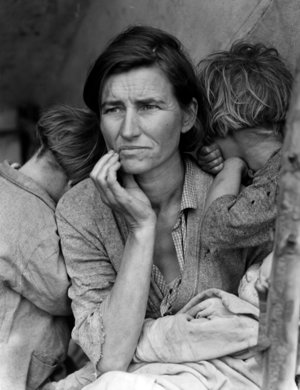
 

Dorothea Lange—well-known for her FSA photographs like Migrant Mother—was hired by the U.S. government to make a photographic record of the “evacuation” and “relocation” of Japanese-Americans in 1942. She was eager to take the commission, despite being opposed to the effort, as she believed “a true record of the evacuation would be valuable in the future.”

The military commanders that reviewed her work realized that Lange’s contrary point of view was evident through her photographs, and seized them for the duration of World War II, even writing “Impounded” across some of the prints. The photos were quietly deposited into the National Archives, where they remained largely unseen until 2006.

I wrote more about the history of Lange’s photos and President Roosevelt’s Executive Order 9066 initiating the Japanese Internment in another post on the Anchor Editions Blog.
Below, I've selected some of Lange’s photos from the National Archives—including the captions she wrote—pairing them with quotes from people who were imprisoned in the camps, as quoted in the excellent book, Impounded: Dorothea Lange and the Censored Images of Japanese American Internment.

I’ve also made a limted number of prints of her photos available for sale at Anchor Editions, and I’m donating 50% of the proceeds to the ACLU—they were there during WWII handling the two principle Supreme Court cases, fighting against the government’s mass incarceration of Japanese-Americans—and they have pledged to continue to fight against further unconstitutional civil rights violations. Their fight seems especially important today given the current tide of anti-Muslim rhetoric, and talk of national registries and reactionary immigration policies.

“A photographic record could protect against false allegations of mistreatment and violations of international law, but it carried the risk, of course, of documenting actual mistreatment.”
— Linda Gordon, Impounded: Dorothea Lange and the Censored Images of Japanese American Internment
Read more... 

Wednesday, November 11, 2015

VHP at 15: Collections over the Years (Experiences War: Stories from the Veterans History Project(Library of Congress: loc.gov)

The Library of Congress' Veterans History Project is a great project and a wonderful way to honor those who have served. This Veterans Day, take some time to read their stories or consider helping to record the story of the veteran in your life.
Jump to Page Content The Library of CongressVeterans History Project Home  
VHP at 15: Collections Over the Years
In 2015, the Veterans History Project celebrates fifteen years of collecting the stories of America's war veterans. To commemorate the occasion, here we highlight 15 different collections, donated to us during the first five, ten, and fifteen years of VHP's existence. While these collections vary widely in scope, each fulfills VHP's mission of capturing the stories of veterans in their own words. Whether they were submitted to us in the early days of the project, or later on, these fifteen collections represent a mere fraction of the over 99,000 collections in the Veterans History Project archive--all of which communicate the experience of war.
Five Years (montage image)Five Years
2000-2005
Image: Robert E. CassidyRobert E. Cassidy 
ARMY
Korean War

Audio Interview
Image: Thomas J. Hudner, Jr.Thomas J. Hudner, Jr.
NAVY
Korean War
Vietnam War 


Video and Audio Interviews, Photos
Image: Herman F. MonoscheinHerman F. Monoschein
AIR FORCE
World War II
Korean War 


Video Interview
Image: Martha Settle PutneyMartha Settle Putney
WAAC
World War II

Video Interview
Image: Gary L. VillerealGary L. Villereal
ARMY
Vietnam War

Video Interview
Ten Years (montage image)Ten Years
2005-2010
Image: Felmers O. ChaneyFelmers O. Chaney
ARMY
World War II

Video Interviews
Image: James E. FrolkingJames E. Frolking
ARMY AIR CORPS
World War II

Audio Interview, Memoir, Photos, Personal Correspondence
Image: James Noburu MihoJames Noboru Miho
ARMY
Korean War

Video Interviews
Image: Bernadette P. MillerBernadette P. Miller
ARMY
Vietnam War

Video Interview, Photos
Image: Lucius Byron NashLucius Byron Nash
NAVY
World War I

Photos, Official Documents, Personal Correspondence
Fifteen Years (montage image)Fifteen Years
2010-2015
Image: Rollins EdwardsRollins Edwards
ARMY
World War II

Audio Interview
Image: Adam Jordan HoltAdam Jordan Holt 
ARMY
Iraq War

Audio Interview
Image: Kurt Chew-Een LeeKurt Chew-Een Lee 
MARINE CORPS
World War II, Korean War, Vietnam War

Video Interview, Official Documents
Image: Elisa RaneyElisa Raney
NAVY
Iraq War

Video Interview, Photos
Image: Edwin TrawczynskiEdwin Trawczynski
ARMY
Vietnam War

Memoir, Photos, Personal Corredspondence
More Stories...

  Other Collections of Interest:

  Search the Veterans Database:

  View ALL Stories:

 The Library of Congress            Legal | External Link Disclaimer
  October 28, 2015
Veterans History Project Home
Contact Us

http://www.loc.gov/vets/stories/ex-war-15years.html?loclr=twloc

Thursday, September 10, 2015

My Grandfather Built a House of 20,000 Books From the Ashes of War By Sasha Abramsky

n July 1920, when my grandfather Chimen was nearly four years old, the town of Smalyavichy, in which his father Yehezkel was the rabbi, was besieged. It had changed hands several times during the civil war that had broken out following Lenin’s October Revolution. This time, it was a triumphant Red Army that readied itself to push Polish nationalist soldiers, allied with the pro-Tsarist White Armies, out of the town and the broader region. As the Polish soldiers retreated, they set fire to large parts of the town, especially in the Jewish quarters, indulging in a last frenzied bout of pogrom-like brutality.
Yehezkel was not present as the flames rose skyward—he had an appointment in the nearby city of Minsk. But his wife Raizl was at home, and so were his four young sons. The flames caught hold of their house, and Raizl barely had time to grab her children, rush them out into the street, and run for safety before the fire began reducing their home to ash. Inside, Yehezkel’s books, as well as his large personal correspondence with the leading rabbis of Byelorussia and Lithuania, went up in smoke.
Yehezkel, who had lived on bread and water during the Russian-Japanese war, was no stranger to deprivation and loss. Yet even with such a training and a history, and even knowing that in rabbinic lore the words from burned holy books and scrolls find their way up to Heaven, losing the bulk of his library must have been a bitter blow. Perhaps it was the story of the fire, repeated in subsequent years around the family dinner table, which triggered in Chimen his life-long obsession with collecting books.


Read more...http://www.newrepublic.com/article/122753/my-grandfather-built-house-20000-books-ashes-war

Monday, August 27, 2012

The Morgan Library & Museum - Current Exhibitions - Churchill: The Power of Words

The Morgan Library & Museum - Current Exhibitions - Churchill: The Power of Words

Winston Churchill, 1941
© Estate of Yousuf Karsh

Sir Winston Churchill's impact upon the twentieth century is difficult to overestimate. A master orator and writer, Churchill's use of spoken and written words will be explored in this exhibition that covers more than a half century of his life—from Victorian childhood letters to his parents, to Cold War correspondence with President Eisenhower, and featuring some of his most famous wartime oratory. Drawn from the Churchill Archives Centre, Cambridge, the presentation uses drafts, speaking notes, personal and official correspondence, public statements, and recordings from some of his most compelling speeches and broadcasts as lenses to examine the main events in Churchill's life. Of particular focus will be Churchill's lifelong relationship with the United States, homeland of his Brooklyn-born mother, from first visit in 1895 to award of Honorary Citizenship in 1963; and the ways in which he used the written and spoken word to develop, complement and advance his political career.

In conjunction with the exhibition, the Morgan and the Churchill Archives Centre have also launched DiscoverChurchill.org. The site, created to generate interest in Churchill among a younger audience and educators, features fun facts, videos, quotes, and links to Churchill-related content. Special gallery discussions for teens, designed and led by high school student Isaac Norwich, will be offered on Wednesdays throughout July and August. See the complete schedule and purchase tickets here.

Read more....more
Enhanced by Zemanta