Pages

Showing posts with label Holocaust. Show all posts

Thursday, April 20, 2017

Opening of UN files on Holocaust will 'rewrite chapters of history' | Monday 17 April 2017

Holocaust | Archives | Jewish history | War crimes

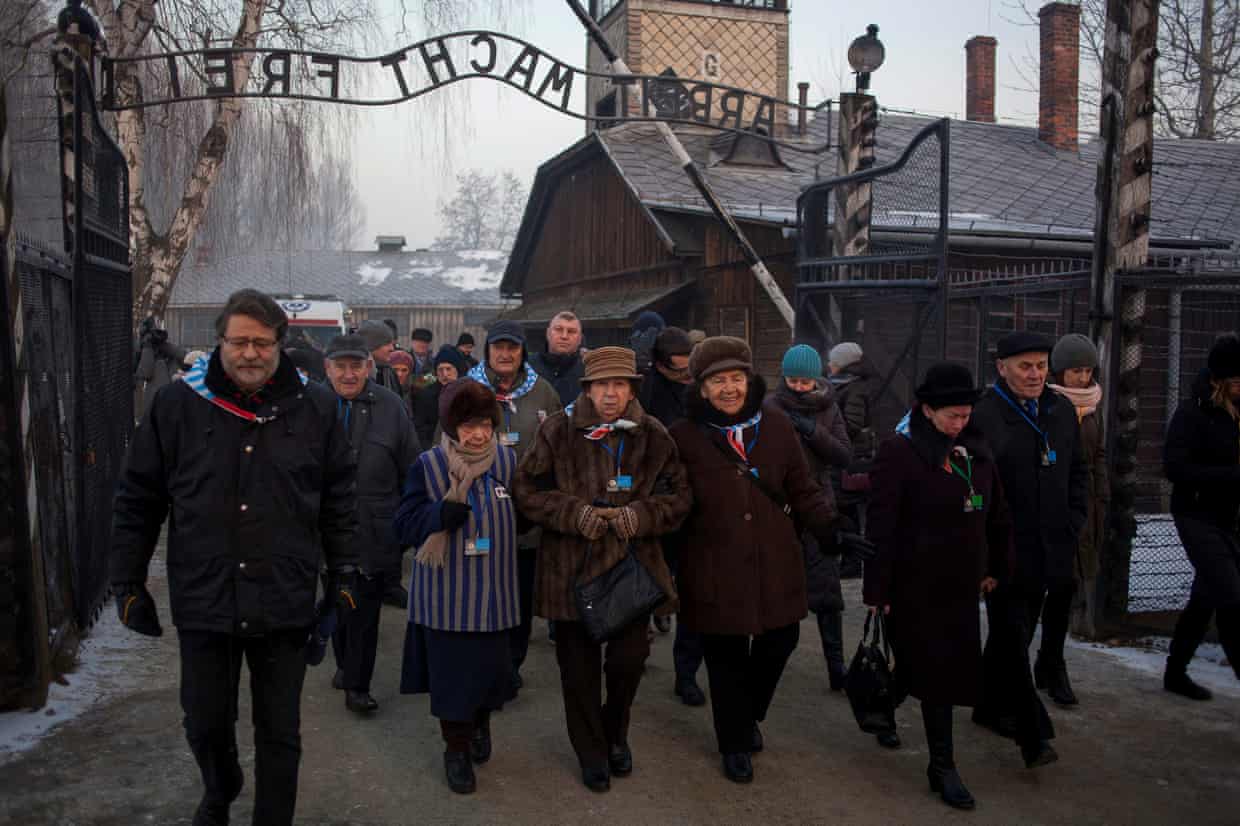
Survivors visit the former Auschwitz-Birkenau camp in Poland on the anniversary of its liberation. Photograph: Kuba Ociepa/Agencja Gazeta/Reuters

 Archive used in prosecution of Nazis reveals detailed evidence of death camps and genocide previously unseen by public

by Owen Bowcott

War crimes files revealing early evidence of Holocaust death camps that was smuggled out of eastern Europe are among tens of thousands of files to be made public for the first time this week.

The once-inaccessible archive of the UN war crimes commission, dating back to 1943, is being opened by the Wiener Library in London with a catalogue that can be searched online.


Anne Frank Who? Museums Combat Ignorance About the Holocaust | MARCH 21, 2017

Museums | Holocaust | Exhibitions

By NINA SIEGAL

Anne Frank in 1939, six years before her death. Credit Agence France-Presse — Getty Images 
 
 
AMSTERDAM — “She hid Jews?”

Aleatha Hinds, 17, ventured a guess about Anne Frank’s identity as she waited in line for two hours recently to enter the museum devoted to that world-famous diarist, who hid with her family in a secret annex for 25 months during World War II.

“No, no, no!” replied several friends, all 11th and 12th graders from the St. Charles College high school in Ontario. “She was Jewish!” they corrected her, in unison.
“She was hiding in her father’s factory,” said Eric LeBreton, 16. “The Nazis were looking for all the Jewish people because Hitler was trying to do genocide.”

With attendance swelling to 1.3 million annually, from one million in 2010, the Anne Frank House has begun reckoning with a striking dimension of its popularity: Many of the younger and foreign visitors who flock here nonetheless have little knowledge of the Holocaust — and sometimes none about Frank. The museum and some others dedicated to Jewish life are seeking new ways to address a declining understanding of World War II and the genocide that took the lives of six million Jews in Europe, efforts that have increasing relevance as anti-Semitic incidents intensify across parts of Europe and the United States. Read more...


Thursday, September 10, 2015

My Grandfather Built a House of 20,000 Books From the Ashes of War By Sasha Abramsky

n July 1920, when my grandfather Chimen was nearly four years old, the town of Smalyavichy, in which his father Yehezkel was the rabbi, was besieged. It had changed hands several times during the civil war that had broken out following Lenin’s October Revolution. This time, it was a triumphant Red Army that readied itself to push Polish nationalist soldiers, allied with the pro-Tsarist White Armies, out of the town and the broader region. As the Polish soldiers retreated, they set fire to large parts of the town, especially in the Jewish quarters, indulging in a last frenzied bout of pogrom-like brutality.
Yehezkel was not present as the flames rose skyward—he had an appointment in the nearby city of Minsk. But his wife Raizl was at home, and so were his four young sons. The flames caught hold of their house, and Raizl barely had time to grab her children, rush them out into the street, and run for safety before the fire began reducing their home to ash. Inside, Yehezkel’s books, as well as his large personal correspondence with the leading rabbis of Byelorussia and Lithuania, went up in smoke.
Yehezkel, who had lived on bread and water during the Russian-Japanese war, was no stranger to deprivation and loss. Yet even with such a training and a history, and even knowing that in rabbinic lore the words from burned holy books and scrolls find their way up to Heaven, losing the bulk of his library must have been a bitter blow. Perhaps it was the story of the fire, repeated in subsequent years around the family dinner table, which triggered in Chimen his life-long obsession with collecting books.


Read more...http://www.newrepublic.com/article/122753/my-grandfather-built-house-20000-books-ashes-war
Monday, June 15, 2015

Turning a Long Lost Cookbook Into a Bestseller By Joy Bean | Jun 12, 2015

A cookbook published in 1938 in Yiddish doesn’t sound like a slam dunk to be a bestseller in 2015, and yet that’s precisely what happened with The Vilna Vegetarian Cookbook: Garden-Fresh Recipes Rediscovered and Adapted for Today’s Kitchen by Fania Lewando, translated by Eve Jochnowitz (Schocken). The book, released on May 26, debuted at #8 on PW's cookbook bestseller list.

With only about 1,000 copies printed and sold throughout Europe before WWII broke out, the cookbook would have been lost to history if it had not been for two women, Wendy Waxman and Barbara Mazur, who found a copy of the long out-of-print book in the rare book room at the YIVO Institute for Jewish Research in New York City. The women found a champion of the book in Jewish cookbook author Joan Nathan who, in turn, brought the book to the attention of Schocken editorial director Altie Karper.

Bringing new life to a long-forgotten gem is one challenge, but promoting a book in which the author is deceased (Lewando died in 1941 while fleeing from the Nazis), and therefore doesn’t have a current platform, is even trickier. In order to do the book and its history justice, Schocken went back to the cookbook's roots, which are surprisingly current. “With all of Fania Lewando’s excellent advice about using the freshest, best quality fruit and vegetables you can get, and about using every part of the fruit or vegetable, and about not discarding even the cooking water, it seemed as though the book was written last week, and not 70 years ago,” said Karper. “I was particularly intrigued by the vegetable juice and fruit juice recipes. How much more 21st century can you get?”  Read more...

Thursday, July 26, 2012

Nazi Persecution of Homosexuals Subject of Traveling Exhibit | At Your Library

Nazi Persecution of Homosexuals Subject of Traveling Exhibit | At Your Library

Thousands of homosexuals, primarily gay men, perished at the hands of the Nazis in concentration camps by the Nazis along with millions of Jews and other victims including, Roma (Gypsies), Poles, Soviet prisoners of war, Jehovah’s Witnesses, and the handicapped during World War II and the Holocaust.
The story of what happened to homosexuals in Nazi Germany is the subject of the United States Holocaust Memorial Museum’s exhibition, “Nazi Persecution of Homosexuals 1933-1945.” The exhibition has been circulating to cities across the country. More than two years in development, it is the first major exhibition on the subject for English-speaking audiences and draws on materials from more than 40 archives and other repositories in eight countries. Read more...
Enhanced by Zemanta