Academic cybrarian, bibliophile & culturista. Mentor to library school (LIS) students and graduates. Advocate for all libraries and their users. [Fmr. Organizer, NY Librarians Meetup]
Holocaust | Archives | Jewish history | War crimes
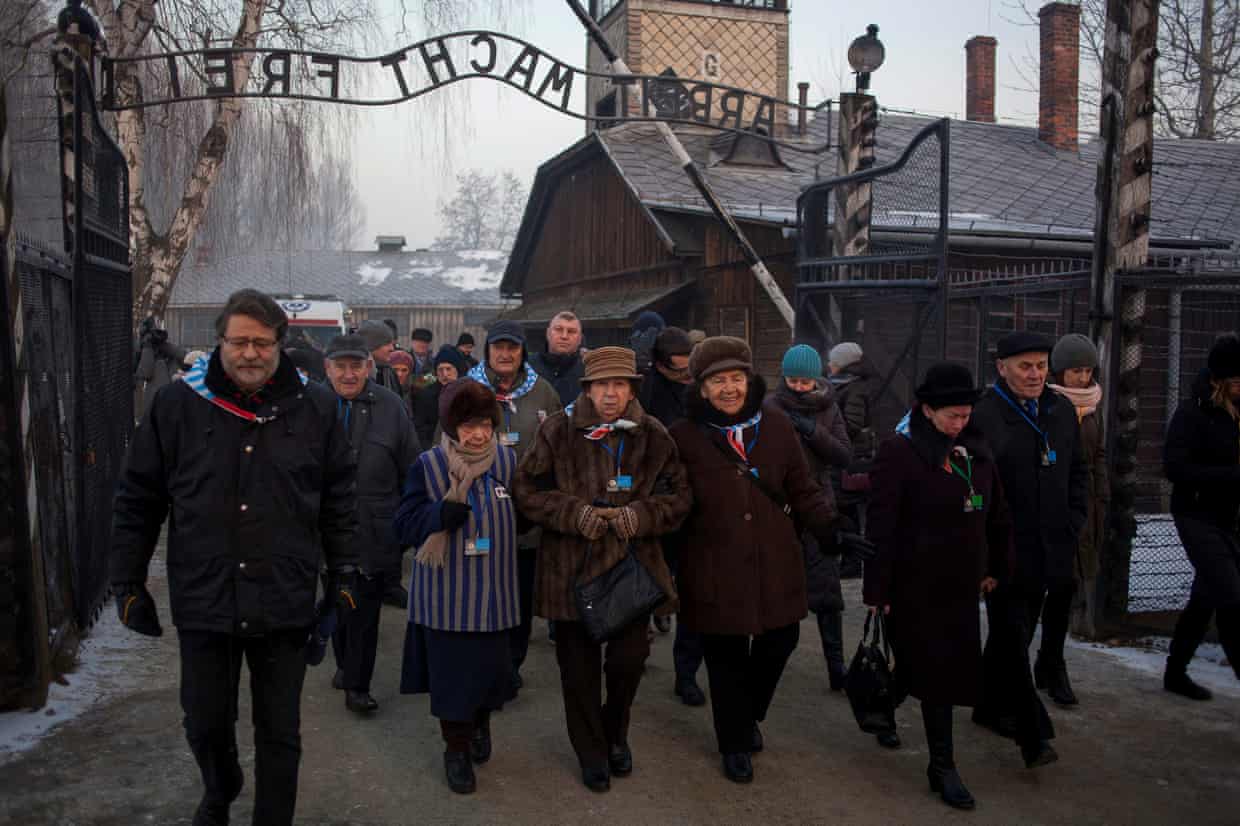
Survivors visit the former Auschwitz-Birkenau camp in Poland on the anniversary of its liberation.
Photograph: Kuba Ociepa/Agencja Gazeta/Reuters
Archive used in prosecution of Nazis reveals detailed evidence of death camps and genocide previously unseen by public
by Owen Bowcott
War crimes
files revealing early evidence of Holocaust death camps that was
smuggled out of eastern Europe are among tens of thousands of files to
be made public for the first time this week.
The once-inaccessible archive of the UN war crimes commission, dating back to 1943, is being opened by the Wiener Library in London with a catalogue that can be searched online.
A page from “The Amen
Corner,” a three-act play by James Baldwin, part of his personal papers
that are now at the Schomburg Center for Research in Black Culture.Credit
Emon Hassan for The New York Times
James Baldwin
died in 1987, but his moment is now. His books are flying off the
shelves. He has inspired homages like Raoul Peck’s documentary “I Am Not Your Negro” and Ta-Nehisi Coates’s memoir “Between the World and Me.” Baldwin’s prophetic essays on race read like today’s news.
And
yet a full understanding of this pioneering gay African-American artist
remains elusive. While Baldwin’s books are in print, there’s one
revealing work that admirers long to read but have mostly been unable
to: his letters.
The
Baldwin estate has held tight to hundreds in its possession, letting
only a few scholars see them. It has almost never allowed any of
Baldwin’s correspondence to be published, or given biographers permission to quote a single word. Read more...
Black History Month | Women's History Month | Library of Congress | Archives
by Wendi Maloney (The following guest post was written by Beverly W. Brannan, curator of photography in the Prints and Photographs Division.)
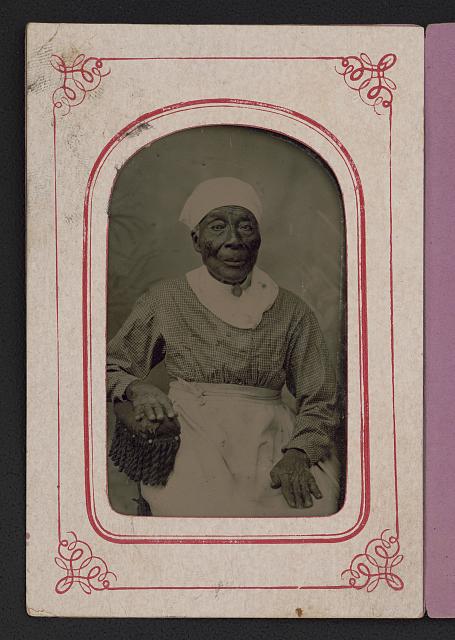
Tintype of Hannah Richards from the William Henry Richards Collection
The Library purchased the collection of William Henry Richards (1856–1941),
a law professor at Howard University, in 2013. The collection includes
manuscript and visual materials, including a tintype of Hannah Richards,
William’s grandmother, who was born in captivity but later freed. Research into her life—a story of determination and resilience—suggests
she may have motivated William’s successful career. Besides being a law
professor, he was a civil rights activist and a supporter of temperance
and women’s right to vote and own property in the District of Columbia.
The library edition of Ancestry.com shows that Hannah Richards was
born in Virginia, probably near Danville, around 1800. She belonged to
Gabriel Richards (1739–1826), who moved to Roane County, Tennessee, in
about 1805. He later relocated to McMinn County, Tennessee, where he
died in 1826, freeing Hannah in his will. But there is more to the
story.
Freed slaves were always at risk of being re-enslaved after being
kidnapped or jailed for trivial offenses. Hannah almost lost her freedom
for keeping company with a man. She was arrested in 1828, according to
databases, and charged with harboring “a certain Negro slave Sandy
without either written or verbal authority from . . . the said boy’s
master” for two years. Papers filed in McMinn County court stated that
Sandy had been “with her at her place of living on Sunday nights.”
Hannah was fined $2.20 for “harboring and entertaining” Sandy, $2.00 for
her jail fee and $0.75 for the justice of the peace. She was warned
that if she did not pay all the costs as well as an additional $2.00,
she could be sold into slavery for nonpayment of debt.