Pages

Showing posts with label #WomensHistoryMonth. Show all posts

Tuesday, March 6, 2018

The New Vanguard

Women's history month | Women writers | Fiction


Our critics chose 15 remarkable books by women that are shaping the way we read and write fiction in the 21st century.

Corey Olsen
In 2016, the feminist press Emily Books held a panel in Brooklyn titled, a bit cheekily, “What Is Women’s Writing?” There was no consensus, much laughter and a warm, rowdy vibe. Eileen Myles read from a memoir in progress and Ariana Reines read a poem, wearing a dress with a pattern of a city on fire. All of this felt exactly right.

But even if it puts your teeth on edge to see “women’s writing” cordoned off in quotes, you can’t deny the particular power of today’s women writers — their intensity of style and innovation. The books steering literature in new directions — to new forms, new concerns — almost invariably have a woman at the helm, an Elena Ferrante, a Rachel Cusk, a Zadie Smith. 

For Women’s History Month, The Times’s staff book critics — Dwight Garner, Jennifer Szalai and myself, Parul Sehgal — sat down together to think about these writers who are opening new realms to us, whose books suggest and embody unexplored possibilities in form, feeling and knowledge.

As we put together a reading list, we introduced a few parameters, for sanity’s sake. We confined ourselves to books written by women and published in the 21st century. And we limited our focus to fiction, but not without some grief. Memoir has emerged as a potent political and literary force in recent years (see the terrain-shifting work of Maggie Nelson, for example). And poets like Claudia Rankine, Solmaz Sharif and Tracy K. Smith are some of the most distinctive voices working today.

Tuesday, February 6, 2018

Rosa Parks Was My Aunt. Here's What You Don't Know About Her.

Civil Rights | Black Heistory Month | Women's History

by Urana McCauley as told to Liz Dwyer | February 2, 2018

Urana McCauley  
After that NAACP event, that’s when I started asking her questions about what she witnessed, what she endured, and what life was like for black people back then. That led to her telling me a lot of stories. She’d tell me what her life was like when she was a little girl growing up in Alabama. One of the things that people don’t understand about my aunt is that she was an activist her whole life and she started questioning things at a young age. I think part of it was her upbringing with her grandfather, Sylvester Edwards. He would sit up at night with a shotgun — in case the KKK might come by and try to kill them — and talk to her about black resistance and the key figures in it: Crispus Attucks, Harriet Tubman, Marcus Garvey. That laid the foundation for my aunt to feel like, "This isn’t right. I should be doing something and becoming an activist." Her whole life became dedicated to change.

When she was 10, a white boy pushed Auntie Rosa, and she pushed him back. Auntie Rosa’s grandmother told her, "You need to be quiet, you need to stop being so vocal." She was told, as black people, we’re not allowed to do those things to whites. Her grandmother was concerned that she’d get hurt, that she could even get lynched. But Auntie Rosa told her grandmother, "Let them try to lynch me." She was that bold, even when she was young. Read article...

Saturday, April 1, 2017

The first woman travel writer in America met every president from Washington to Lincoln | March 30, 2017

Women's history | Travel | US History


Anne Newport Royall was a spitfire journalist and publisher in the early days of the republic.

When Anne Newport Royall first visited Washington D.C., it was to petition Congress for a federal pension. She was recently widowed, and believed she was entitled to compensation as the wife of a veteran. At the time, Pension Law did not guarantee funds for widows; each woman had to plead her individual case. Royall thought that was ridiculous, so she found then President John Quincy Adams taking his morning swim in the Potomac River and, according to legend, sat on top of his clothing on the bank of the river until he was willing to speak to her. (It surely wasn’t long.) Though this story is widely seen as apocryphal, it is true that Adams met Royall and took a reluctant liking to her, even inviting her to visit with his wife, Louisa Adams, who gave Anne a shawl to take on her travels. Read more...

Thursday, March 9, 2017

Women’s History Month: The Legacy of Hannah Richards | March 8, 2017

Black History Month | Women's History Month | Library of Congress | Archives


(The following guest post was written by Beverly W. Brannan, curator of photography in the Prints and Photographs Division.)

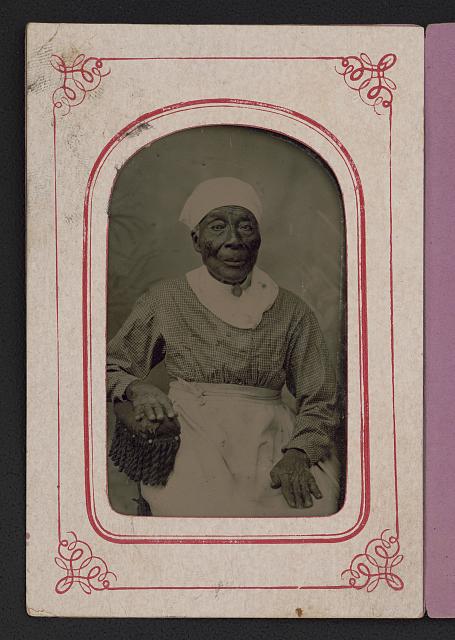
Tintype of Hannah Richards from the William Henry Richards Collection

The Library purchased the collection of William Henry Richards (1856–1941), a law professor at Howard University, in 2013. The collection includes manuscript and visual materials, including a tintype of Hannah Richards, William’s grandmother, who was born in captivity but later freed. Research into her life—a story of determination and resilience—suggests she may have motivated William’s successful career. Besides being a law professor, he was a civil rights activist and a supporter of temperance and women’s right to vote and own property in the District of Columbia.

The library edition of Ancestry.com shows that Hannah Richards was born in Virginia, probably near Danville, around 1800. She belonged to Gabriel Richards (1739–1826), who moved to Roane County, Tennessee, in about 1805. He later relocated to McMinn County, Tennessee, where he died in 1826, freeing Hannah in his will. But there is more to the story.

Freed slaves were always at risk of being re-enslaved after being kidnapped or jailed for trivial offenses. Hannah almost lost her freedom for keeping company with a man. She was arrested in 1828, according to databases, and charged with harboring “a certain Negro slave Sandy without either written or verbal authority from . . . the said boy’s master” for two years. Papers filed in McMinn County court stated that Sandy had been “with her at her place of living on Sunday nights.” Hannah was fined $2.20 for “harboring and entertaining” Sandy, $2.00 for her jail fee and $0.75 for the justice of the peace. She was warned that if she did not pay all the costs as well as an additional $2.00, she could be sold into slavery for nonpayment of debt.

Read more...