Pages

Showing posts with label news. Show all posts

Tuesday, May 9, 2017

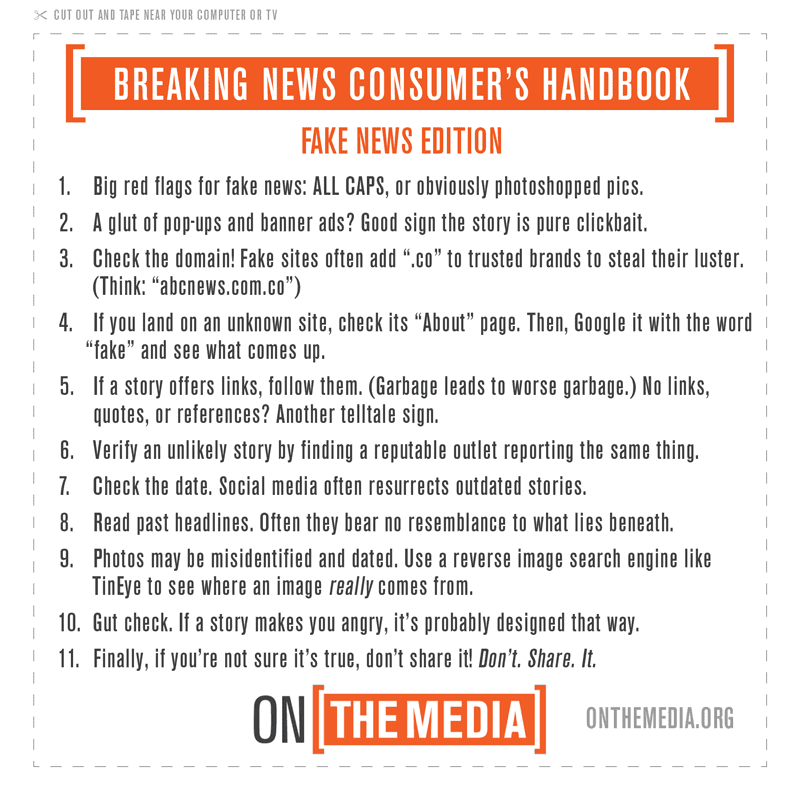
Breaking News Consumer's Handbook: Fake News Edition | WNYC

Fake news | Media | Podcast

November 18, 2016

Monday, February 6, 2017

Librarians take up arms against fake news | Jerry Large February 6, 2017

Fact checking | Literacy | Critical reading | Journalism

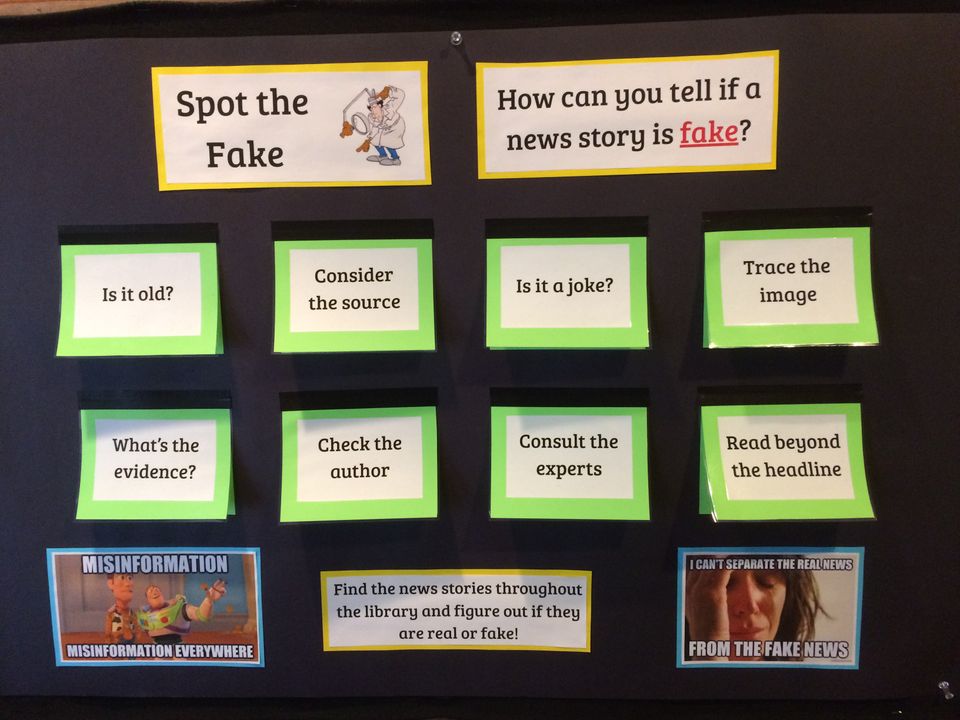
Tips for spotting fake news in the Upper School library at Lakeside School in north Seattle. (Jerry Large/The Seattle Times)  

Librarians are stepping into the breach to help students become smarter evaluators of the information that floods into their lives. That’s increasingly necessary in an era in which fake news is a constant.


Janelle Hagen is a school librarian whose job goes far beyond checking out books. She and many other librarians are equipping students to fight through lies, distortion and trickery to find their way to truth.

Helping students become smarter evaluators of the information that floods into their lives has become increasingly necessary in an era in which fake news is a constant.

Two University of Washington professors recently announced a new class that will focus on the ways data are misused to mislead the public. Younger students may need guidance even more.

Hagen, the middle-school librarian at Lakeside School in Seattle, said the students she serves are online every day, and they need to be able to figure out what’s trustworthy and what isn’t. Read more...

Thursday, December 1, 2016

Here's how to outsmart fake news in your Facebook feed


(CNN)Just because it's on the internet doesn't make it true. It seems so simple, but if everyone knew that, Facebook and Google wouldn't have to pull bogus news sites from their advertising algorithms and people wouldn't breathlessly share stories that claim Donald Trump is a secret lizard person or Hillary Clinton is an android in a pantsuit.
It doesn't have to be this way. Fake news is actually really easy to spot -- if you know how. Consider this your New Media Literacy Guide.
NOTE: As we put this together, we sought the input of two communications experts: Dr. Melissa Zimdars, an associate professor at Merrimack College in Massachusetts whose dynamic list of unreliable news sites has gone viral, and Alexios Mantzarlis, the head of the International Fact-Checking Network at the Poynter Institute.
First, know the different types of misleading and false news
1. Fake news
These are the easiest to debunk and often come from known sham sites that are designed to look like real news outlets. They may include misleading photographs and headlines that, at first read, sound like they could be real.
2. Misleading news
These are the hardest to debunk, because they often contain a kernel of truth: A fact, event or quote that has been taken out of context. Look for sensational headlines that aren't supported by the information in the article.
3. Highly partisan news
A type of misleading news, this may be an interpretation of a real news event where the facts are manipulated to fit an agenda.
4. Clickbait
The shocking or teasing headlines of these stories trick you into clicking for more information -- which may or may not live up to what was promised.
5. Satire
This one is tough, because satire doesn't pretend to be real and serves a purpose as commentary or entertainment. But if people are not familiar with a satire site, they can share the news as if it is legitimate. Read more...