Pages

Showing posts with label library programs. Show all posts

Monday, May 15, 2017

Argentina's page turner: How a Canadian author became the leader of a library revolution

Libraries | Alberto Manguel | Culture

The National Library of Argentina sits at the epicentre of the country's cultural life. So when government officials appointed Alberto Manguel – native son and longtime Canadian anthologist – to radically rethink the institution, pushback from the intellectual elite was all but certain. Stephanie Nolen reports on an irascible scribe's rocky tenure
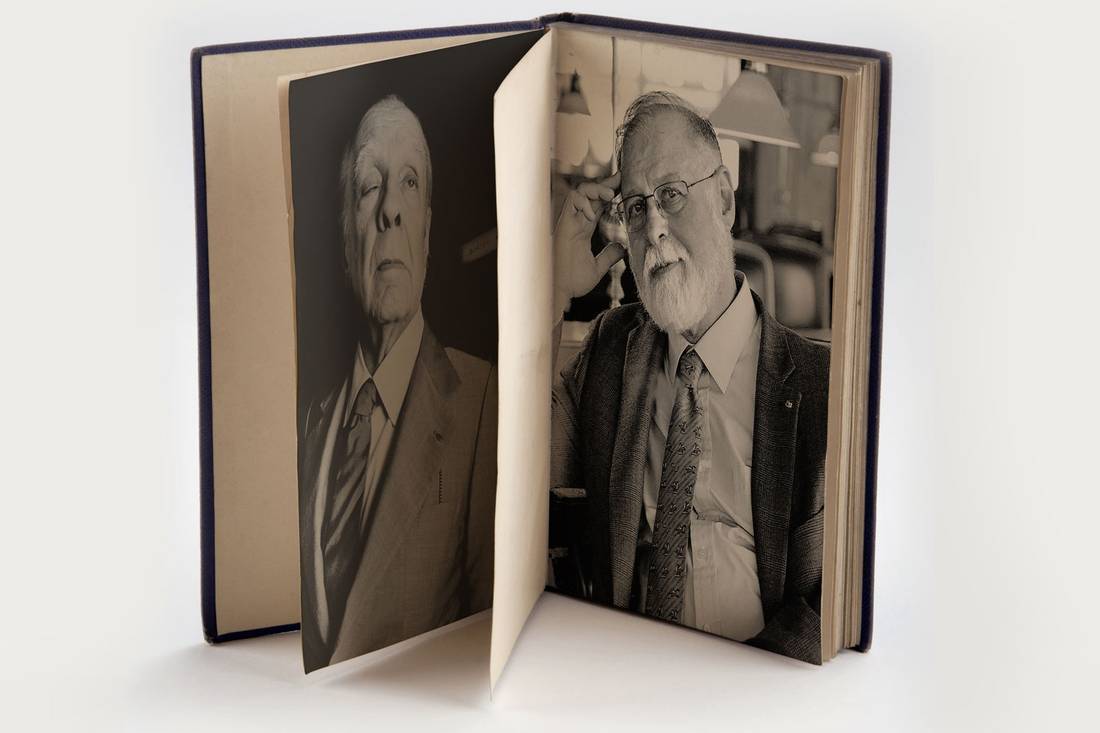
A few years after Jorge Luis Borges, left, ended his tenure as head of Argentina’s National Library, he began a friendship with Alberto Manguel, right, then a teenager in Buenos Aires. Argentina’s greatest writer was, by that time, blind, and invited the young Mr. Manguel to come home and read aloud to him, which Mr. Manguel went on to do many times over the next few years. Now, Mr. Manguel has taken Mr. Borges’s former role at the library.


Alberto Manguel is harried. A stream of wealthy Argentines, all stiletto heels and elegant umbrellas, is leaving his office in the National Library; he hopes to cultivate them as donors, and ushers them to the door with awkward pleasantries. A line of employees with requests waits in the hall, hoping to catch him. An assistant brandishes a clipboard thick with demands: There is a committee, but there is also a meeting, he is expected imminently at a luncheon, and there's this journalist, and – "I've abandoned my previous persona: I detested nothing more than lunches and cocktails and meetings and groups of more than three people," Mr. Manguel says with a sigh and a valiant attempt at a smile, when he has retreated back behind the office door. "And I'm spending my life doing this."

Back in December of 2015, Mr. Manguel was living in New York and teaching at Columbia and Princeton; he opened his e-mail one day to find a startling request from a stranger. The newly appointed Minister of Culture for Argentina was wondering if Mr. Manguel would consider returning to the country where he was born – and which he left 50 years ago – to serve as director of the storied National Library. Mr. Manguel says he assumed at first it was a joke – "What next, being Pope?"Read more...

Wednesday, June 29, 2016

Prisons Want to Use Tech to End In-Person Visits — These Librarians Have a Different Plan

Across the country, jails are replacing in-person visits with a glitchy, expensive system called "video visitation" — think of it like Skyping in to see your incarcerated loved one, if Skype was low-resolution, difficult to install and cost as much as $1.50 a minute.

But the librarians of Brooklyn are racing to roll out a more humane solution.
The Brooklyn Public Library is planning to build its own video visitations in 12 of its locations in neighborhoods with high rates of incarceration. Unlike visitation centers at country jails, the libraries will build visitation centers that are comfortable, humane and don't charge families exorbitant fees for connecting with loved ones.

"It's an intentionally human experience," Nick Higgins, Director of Outreach Services at Brooklyn Public Library, said in a phone call. "Anything that we do in jails or marginalized communities, we want to create a sense of belonging and inclusion. How life should be."

Friday, June 10, 2016

France’s libraries discovering a new lease of life beyond just books

Seminars, events and cafes are helping some formerly staid institutions reinvent themselves as social ‘third spaces’ beyond work and the home

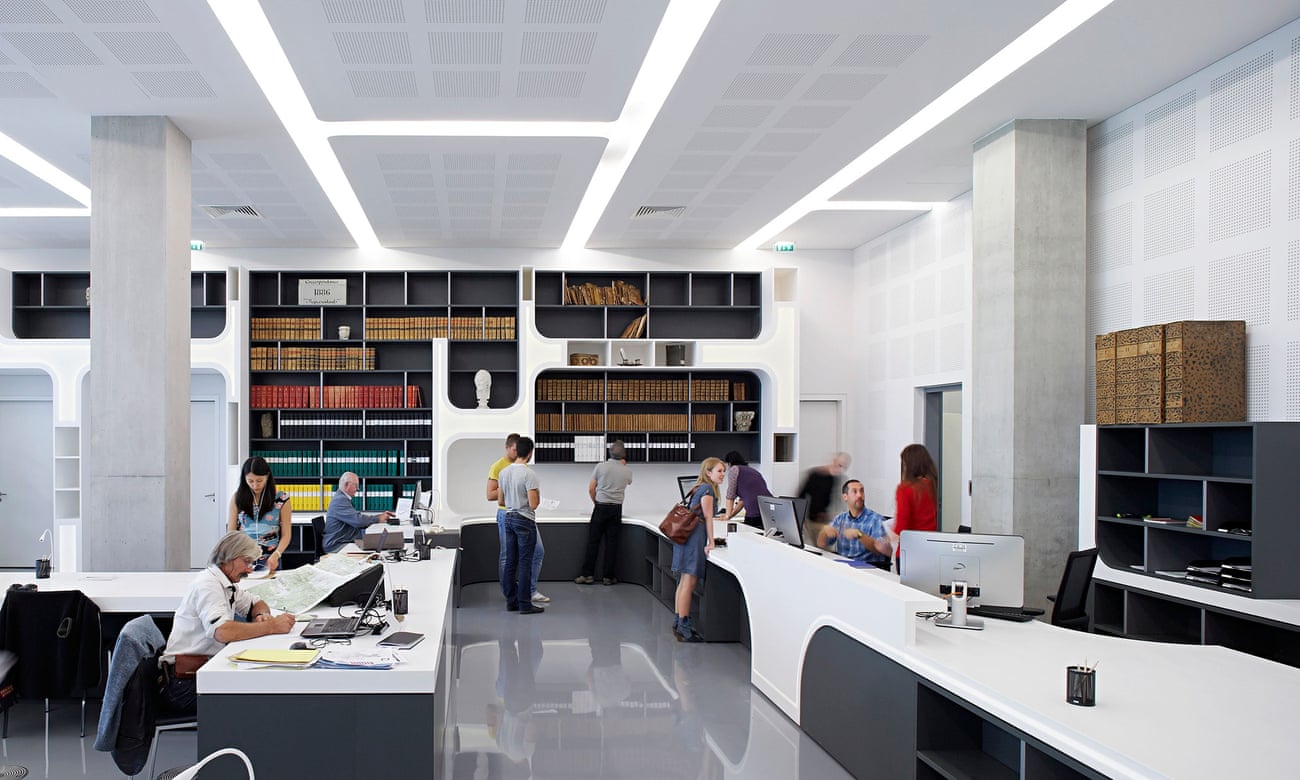
 Turning a page: the new, Zaha Hadid-designed library in the Pierres Vives Building, Montpellier. Photograph: View/Alamy


Back in the 1950s Juliette Gréco sang Je hais les dimanches (I hate Sundays), but would she have found them quite so dull if public libraries had been open? It is still an open question in France, where museums and cinemas welcome the public on this day of rest, but not yet libraries.
Things may finally be changing, thanks to a bill originally more concerned with shopping than the arts. An amendment, put forward by former arts minister Aurélie Filipetti, to the “growth, business and equal economic opportunities” bill currently grinding through the French parliament, seeks to oblige local councils to organise a debate before introducing Sunday opening for libraries and shops. Her successor, Fleur Pellerin, has endorsed this proposal and asked a member of the upper house to look at how library opening hours could be adapted.
Although it may be some time before it becomes law, a vote in favour of the bill could have symbolic impact. It would certainly draw attention to the role now played by libraries, institutions that have taken on other missions than simply providing books.
Workshops, events, exhibitions, training courses and encouraging public participation in their management have become part of libraries’ roles. In some you may talk without whispering, use a phone, eat and even play computer games. Reading has become a source of sociability and the books on offer are supposed to encourage “social cohesion”. This trend towards greater openness, which started a few years ago, has only taken hold in a few of France’s 3,000 public libraries. But, it seems, it’s spreading. Read more...


Thursday, May 19, 2016

Host a silent reading party in 7 easy steps

 by Jeff O'Neal
05-18-16


If you are a reader, you know the special pleasure of going out to read in public. But for most of us, reading in public has meant reading in public alone.

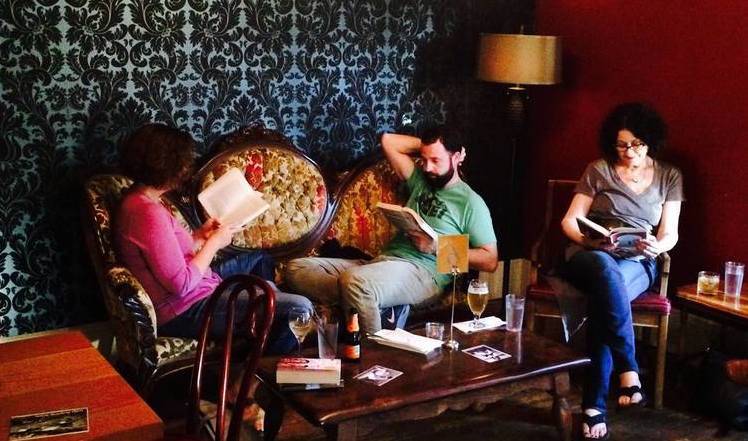
But recently, a few recurring Silent Reading Parties have sprung up, giving readers a chance to read alone in public, but together. That’s right: a bunch of people get together and read. And that’s it. Doesn’t it sound great?

I spoke with Karen Munro and Amanda Morgan, organizers of Silent Reading Party Portland, about the best ways (and why) to host a Silent Reading Party of your own. Here is their advice.
  1. Pick a Place You Love
    Seattle’s Silent Reading Party founder, Christopher Frizzelle, told us to choose a place that we absolutely loved. For us that meant a place with comfortable seating, good lighting, some patina, some ambience, some comfort, some dignity… The kind of place that makes you want to read. We love our home at Beech Street Parlor. It’s a Victorian house with gorgeous flocked wallpaper, period couches, and wood floors. And of course it has a full bar–that’s important too. We’re also constantly dreaming up other locations for special pop-up parties. It would be so cool to do silent reading parties in public parks, at the art museum, at Powell’s bookstore… We don’t know how well those will work yet, but we’re hoping we get to try. Read more...

Thursday, February 4, 2016

The loss of libraries is another surefire way to entrench inequality Mary O'Hara Mary O'Hara

 ‘Having a library within walking distance of home was a way for a young girl from a poor background to access the same breadth of reading material as anyone else.’ Photograph: Getty Images

As someone who grew up in a home without books, no spare cash to buy them and no tradition of reading bedtime stories, my local library offered something unique and indispensable. It’s hard to think of anything that brought me more joy as a primary school-aged child than walking back from the Falls Road library in west Belfast with a bundle of books.

Having a library within walking distance of home was a way for a young girl from a poor background to access the same breadth of reading material as anyone else – at no expense. It stripped away at least some of the disadvantage that came with being from a low-income family. So every time I hear of another library closure – and there were more than 100 last year alone in Scotland, Wales and England, according to official figures – it hits a nerve. The loss of libraries is simply another surefire way to entrench inequality.
From providing books for people of all ages and backgrounds, to kids clubs and hubs for older people, to computer terminals that those with no access to the internet can use to find job vacancies, libraries are about as democratic and diverse as is possible to imagine. When properly funded and resourced they are educational and social anchors in communities everywhere. Yet, despite knowing all this, in the past five years the relentless funding constraints placed on local authorities have seen library budgets slashed by an astounding amount.  Read more...


Thursday, December 31, 2015

Public Libraries Support Refugees You are here: Home / Public Services / Public Libraries Support Refugees Public Libraries Support Refugees By April Witteveen


LFPL welcomes Syrian refugees Photo credit: Michelle Wong

Louisville Free Public Library (LFPL), KY, welcomes Syrian refugees
Photo credit: Michelle Wong


n the midst of the ongoing international migration crisis, libraries worldwide are finding ways to support newly arriving refugees. Libraries across Europe are assisting the wave of newly arriving Syrian refugees, as illustrated by recent articles from Public Libraries Online and the International Federation of Library Associations and Institutions (IFLA). And they’re not alone: as cities in the US and Canada receive an influx of Middle Eastern refugees seeking asylum, libraries are using both traditional and innovative services to reach out and connect with these populations in crisis.
COLLABORATION IN SALT LAKE
Salt Lake City is a designated refugee relocation city. “Utah has resettled just 12 Syrian refugees, comprising two families, though the state is expected to receive a few hundred more between March and September,” according to a recent article in the Salt Lake Tribune. The International Rescue Committee (IRC) is one agency working to resettle refugees in Salt Lake City, and it counts the library as a resource. The IRC offers guided tours of the Downtown Salt Lake City Public Library (SLCPL) in order to connect refugees with services. Brooke Young, manager at the Glendale Branch of SLCPL, told Library Journal about a community partnership with the University of Utah’s University Neighborhood Partners program (UNP) which works collaboratively with a wide variety of university departments and community agencies to “offer resources such as English language instruction, mental health support, citizenship classes, employment workshops, after school and summer programs, and educational resources to the community.” Young presented to UNP leadership on resources for new immigrants, and noted that “since talking to the leadership group, our meeting room demand has tripled and we have had people [from the immigrant/refugee community] come in and use our computers for resume help and job hunting.” Young shared that as SLCPL’s partnership with UNP grows, the institutions plan “to do a year of citizenship workshops, with an emphasis on voting in the next year.”


“We do have some really great partnerships happening,” Young told LJ. “Making sure that we are going to all the meetings of all the different partners can take up a lot of staff time, but it is really worth it. I also try and make sure that my teen librarian and children’s librarian are involved in the meetings so that we can help tailor our programs to the needs of the community. We also try and be really flexible. And I do mean flexible. I came into the library after hours on a Saturday to ensure that a Sudanese baby shower could happen. And we try and let as many meetings as possible happen in our space, even when if it means opening early or staying late. It can be time consuming, but we have won a lot of community support by opening the space.”


Public Libraries Support Refugees Read more...