Pages

Showing posts with label Alberto Manguel. Show all posts

Monday, May 15, 2017

Argentina's page turner: How a Canadian author became the leader of a library revolution

Libraries | Alberto Manguel | Culture

The National Library of Argentina sits at the epicentre of the country's cultural life. So when government officials appointed Alberto Manguel – native son and longtime Canadian anthologist – to radically rethink the institution, pushback from the intellectual elite was all but certain. Stephanie Nolen reports on an irascible scribe's rocky tenure
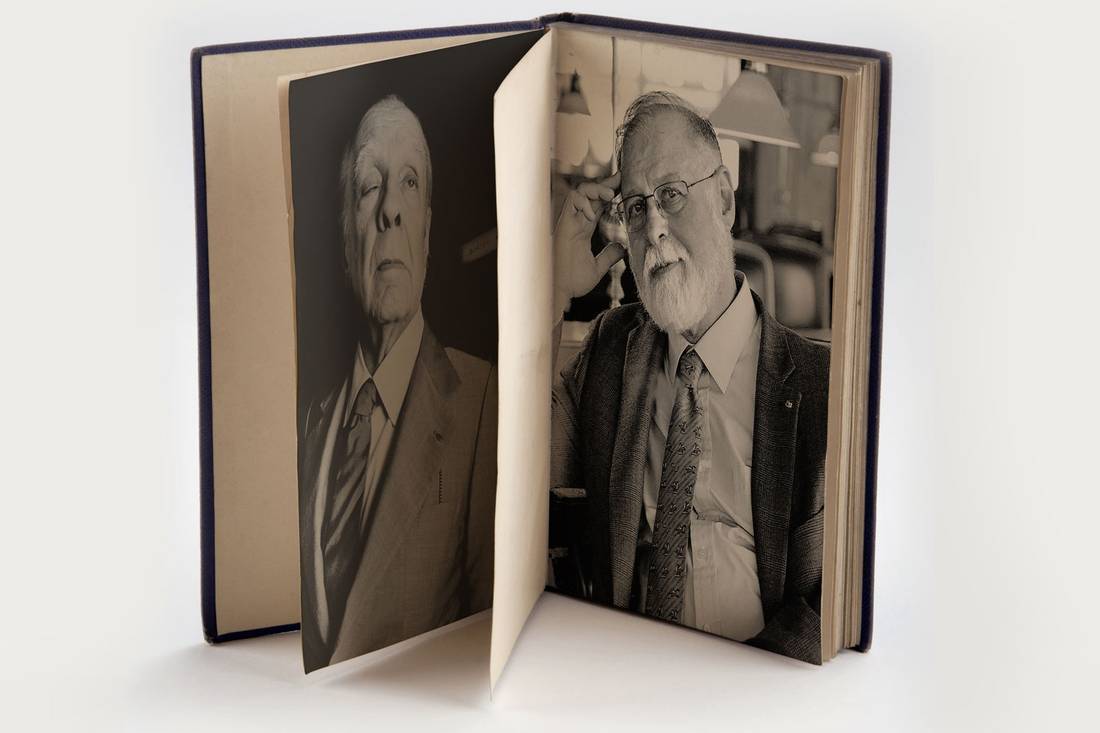
A few years after Jorge Luis Borges, left, ended his tenure as head of Argentina’s National Library, he began a friendship with Alberto Manguel, right, then a teenager in Buenos Aires. Argentina’s greatest writer was, by that time, blind, and invited the young Mr. Manguel to come home and read aloud to him, which Mr. Manguel went on to do many times over the next few years. Now, Mr. Manguel has taken Mr. Borges’s former role at the library.


Alberto Manguel is harried. A stream of wealthy Argentines, all stiletto heels and elegant umbrellas, is leaving his office in the National Library; he hopes to cultivate them as donors, and ushers them to the door with awkward pleasantries. A line of employees with requests waits in the hall, hoping to catch him. An assistant brandishes a clipboard thick with demands: There is a committee, but there is also a meeting, he is expected imminently at a luncheon, and there's this journalist, and – "I've abandoned my previous persona: I detested nothing more than lunches and cocktails and meetings and groups of more than three people," Mr. Manguel says with a sigh and a valiant attempt at a smile, when he has retreated back behind the office door. "And I'm spending my life doing this."

Back in December of 2015, Mr. Manguel was living in New York and teaching at Columbia and Princeton; he opened his e-mail one day to find a startling request from a stranger. The newly appointed Minister of Culture for Argentina was wondering if Mr. Manguel would consider returning to the country where he was born – and which he left 50 years ago – to serve as director of the storied National Library. Mr. Manguel says he assumed at first it was a joke – "What next, being Pope?"Read more...

Friday, October 23, 2015

Reinventing the library by Alberto Manguel

The Oberlausitzische Library of Sciences in Gorlitz, Germany. CreditFlorian Monheim/Arcaid via Corbis
Plato, in the “Timaeus,” says that when one of the wisest men of Greece, the statesman Solon, visited Egypt, he was told by an old priest that the Greeks were like mere children because they possessed no truly ancient traditions or notions “gray with time.” In Egypt, the priest continued proudly, “there is nothing great or beautiful or remarkable that is done here, or in your country, or in any other land that has not been long since put into writing and preserved in our temples.”
Such colossal ambition coalesced under the Ptolemaic dynasty. In the third century B.C., more than half a century after Plato wrote his dialogues, the kings ordered that every book in the known world be collected and placed in the great library they had founded in Alexandria. Hardly anything is known of it except its fame: neither its site (it was perhaps a section of the House of the Muses) nor how it was used, nor even how it came to its end. Yet, as one of history’s most distinguished ghosts, the Library of Alexandria became the archetype of all libraries.
Libraries come in countless shapes and sizes. They can be like the Library of Congress or as modest as that of the children’s concentration camp in Auschwitz-Birkenau, where the older girls were in charge of eight volumes that had to be hidden every night so that the Nazi guards wouldn’t confiscate them. They can be built from books found in the garbage, like the Yiddish Book Center in Amherst, Mass., set up in 1980 by the 24-year-old Aaron Lansky from volumes discarded by the younger generations who no longer spoke the tongue of their elders, or they can be catalogued in the mind of their exiled readers, in the hope of resurrection, like the libraries plundered by the Israeli soldiers in the occupied territories of Palestine. It is in the nature of libraries to adapt to changing circumstances and threats, and all libraries exist in constant danger of being destroyed by war, vermin, fire, water or the idiocies of bureaucracy.
Read more: http://nyti.ms/1R0E2G8

Tuesday, April 7, 2015

Book Discussion History Reading | Video | C-SPAN.org


Book Discussion on A History of Reading

Mr. Manguel spoke about his recent book, A History of Reading. It
traces the history of written communication from 4000 B.C. to the
present through stylistic, material and other changes. He also took
questions from the audience.