Pages

Showing posts with label #InformationLiteracy. Show all posts

Thursday, July 19, 2018

Teaching with Primary Sources: How can we do research with political cartoons? | Brooklyn Public Library

Politics | Cartoons | Information literacy | Research Skills

by Jen Hoyer | Jun 20, 2018 
 
 
 Brooklyn Connections is the education outreach program in the Brooklyn Collection. It focuses on cultivating 21st Century learning skills in students and supporting teachers on the incorporation of archives materials into curricula. This blog post is part of a series from the Brooklyn Connections team, sharing skills and ideas for using archives primary source material in the classroom. Using primary sources in the classroom shows us that we can access history through many different formats as long as we are grounded in historical thinking. 

The Brooklyn Connections team loves engaging with teachers for regular Professional Learning events, and our recent workshop at Plymouth Church gave us an opportunity to learn about the role that this institution played in Abolition and Civil War-era Brooklyn. While exploring the Brooklyn Collection for primary sources that we could share, we were excited to find political cartoons about our subject. We wanted to share some of our ideas on how students can learn to work with political cartoons. We think that using political cartoons in the classroom is an engaging and exciting starting point that shifts away from textbooks and classroom lectures while still scaffolding the same historical information. Read more...

Wednesday, October 18, 2017

In Italian Schools, Reading, Writing and Recognizing Fake News

Europe | Fake news | Social media | Italy

Laura Boldrini, president of Italy’s Chamber of Deputies, spearheaded a project to educate high-school students on how to recognize fake news and conspiracy theories online.
Andreas Solaro / Agence France-Presse — Getty Images
 
 
ROME — After reading the horrors in Dante’s “Inferno,” Italian students will soon turn to the dangers of the digital age. While juggling math assignments, they’ll also tackle worksheets prepared by reporters from the national broadcaster RAI. And separate from the weekly hour of religion, they will receive a list of what amounts to a new set of Ten Commandments for the digital age.

Among them: Thou shalt not share unverified news; thou shall ask for sources and evidence; thou shall remember that the internet and social networks can be manipulated.
The lessons are part of an extraordinary experiment by the Italian government, in cooperation with leading digital companies including Facebook, to train a generation of students steeped in social media how to recognize fake news and conspiracy theories online.

“Fake news drips drops of poison into our daily web diet and we end up infected without even realizing it,” said Laura Boldrini, the president of the Italian lower house of Parliament, who has spearheaded the project with the Italian Ministry of Education. Read more...

Thursday, March 2, 2017

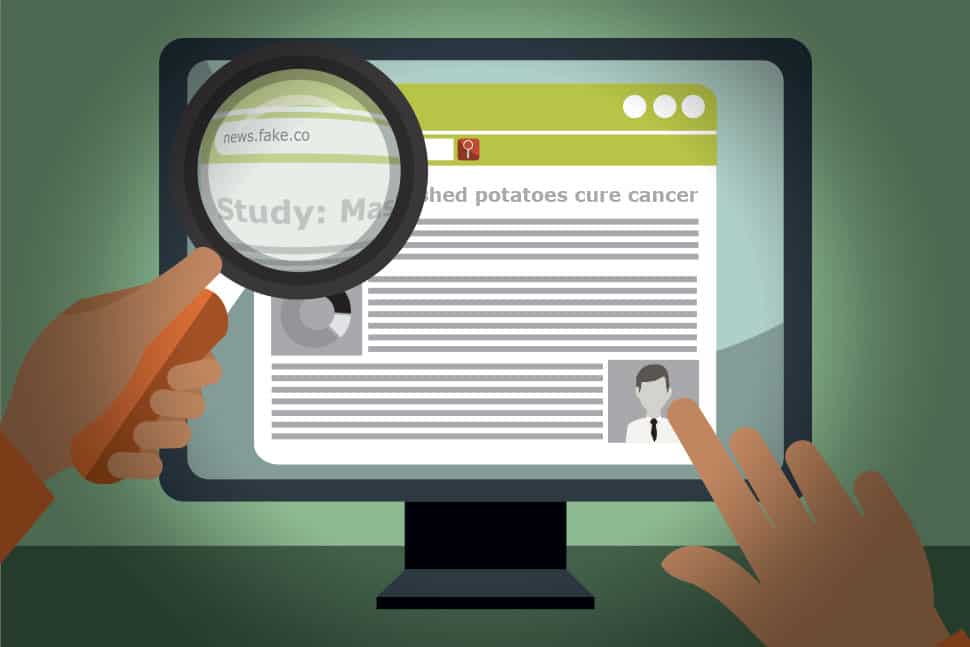
Fighting Fake News: How libraries can lead the way on media literacy | December 27, 2016

Fake news | Information literacy | Journalism

by Marcus Banks

Illustration: Rebecca Lomax/American Libraries  
Librarians—whether public, school, academic, or special—all seek to ensure that patrons who ask for help get accurate information.


Given the care that librarians bring to this task, the recent explosion in unverified, unsourced, and sometimes completely untrue news has been discouraging, to say the least. According to the Pew Research Center, a majority of US adults are getting their news in real time from their social media feeds. These are often uncurated spaces in which falsehoods thrive, as revealed during the 2016 election. To take just one example, Pope Francis did not endorse Donald Trump, but thousands of people shared the “news” that he had done so.

Completely fake news is at the extreme end of a continuum. Less blatant falsehoods involve only sharing the data that puts a proposal in its best light, a practice of which most politicians and interest group spokespeople are guilty.

The news-savvy consumer is able to distinguish fact from opinion and to discern the hallmarks of evasive language and half-truths. But growing evidence suggests that these skills are becoming rarer. A November 2016 study by the Stanford History Education Group (SHEG) showed that students have difficulty separating paid advertising from news reporting, and they are apt to overlook clear evidence of bias in the claims they encounter. These challenges persist from middle school to college.

According to SHEG Director Sam Wineburg, professor at Stanford Graduate School of Education, “nothing less than our capacity for online civic reasoning is at risk.”

Librarians and journalists: natural allies

Read more...

Monday, February 27, 2017

We Need Librarians More Than Ever Before Need Librarians More Than Ever Before | Feb. 11, 2017

Librarians | Library Services | Information Literacy

 by John Spencer


Why Librarians Are Vital to our Students

I often hear people ask, “If we have the internet, why do we still need librarians?”

This is something I’ve heard since the days of dial-up and continue to hear right now. It misses the vital role that librarians play in our students’ lives. It’s true that the information landscape has changed. It is easier than ever to create a work and publish it to the world and with a tap of a button, we access information from anywhere at any time.

But actually, that’s why librarians are more vital than ever. Here are some of the things librarians do:
  1. Guide Students through Media Literacy: In an age of instant information, librarians help students learn to ask better questions, find valid sources, and deconstruct the information. Take a quick glance at Facebook and you’ll see people falling for fake news and failing to understand media bias. We are in desperate need of media literacy and librarians are the ones best poised to make this a reality. Read more...