Pages

Showing posts with label #librarians. Show all posts

Thursday, January 14, 2021

David Lankes on the way forward : Rebuilding the civic and educational structures that bring communities together


David Lankes
l

January 9, 2021
(from Facebook)


On January 6th insurrectionists invade the Capital in Washington DC to attempt to subvert the will of the American people by attempting to overturn the presidential election. They did so after a morning, and indeed, months of instigation founded on misinformation, false grievance, and a climate that increasingly defines politics as a pursuit of power over the judicious use of power at the behest of the people.

It has taken me several days to begin to make sense of this, to get over my anger, and to affirm for myself a way forward. For me, as an information scientist; as a director of an academic program that prepares librarians and information professionals; as an author and speaker, the way forward is clear: we must rebuild the civic and educational structures that bring communities together.

This is not a shocking conclusion. One could even rightly say it is a self-serving one. After all, as a scholar, educator, and author I am invested in the success of these institutions. However, I am invested because I continue to see their value and positive transformational potential.

I am invested because I have seen when libraries break out of the artificial bounds of collections and neutrality, they become instruments of community cohesion. I have seen libraries host difficult conversations on race. I have seen libraries bring together a people on issues of immigration. I have seen libraries fight for the poor, and the incarcerated, and the all too forgotten in attempts to remove the alien nature of neighbors. From drag queen story hours, to human libraries, to simply providing a collection that captures the value and richness of the human experience, our public libraries must continue to weave together a fragmented social fabric one person, one neighborhood, one nation at a time.


Read full post

Thursday, October 11, 2018

Open Invitation: Fall Reception of the New York Library Club, Inc. Thursday, 18th October 2018

Library event  | Networking | Professional Library Organizations

Are you a librarian? Library Student? Writer? Publisher? Looking to network with other like professionals?

The New York Library Club, Inc. invites you to their annual Fall kick-off reception:

John Ashbery: The Construction of Fiction

UPCOMING EVENTS
October 18, 2018, 6PM-8PM

  • Fall Social at the Pratt Manhattan Gallery (144 West 14th Street, New York, NY 10011).
  • We would Love to meet you and hear your thoughts and concerns on Librarianship as a career! Learn about the club including its social events, members, history and its vision.
  • Take advantage of Networking/Mentoring and Leadership Opportunities
  • Explore the details regarding our available yearly Scholarship Award
  • Light refreshments will be served
Please RSVP to membership@nylibraryclub.org with your name and affiliation by October 17th so we can get a list to Security and assure your entry.

Wednesday, October 4, 2017

The Radical Reference Librarians Who Use Info to Challenge Authority

Activism | Advocacy | Librarians

An unshushable social movement is afoot.

by Natalie Zarrelli | October 03, 2017

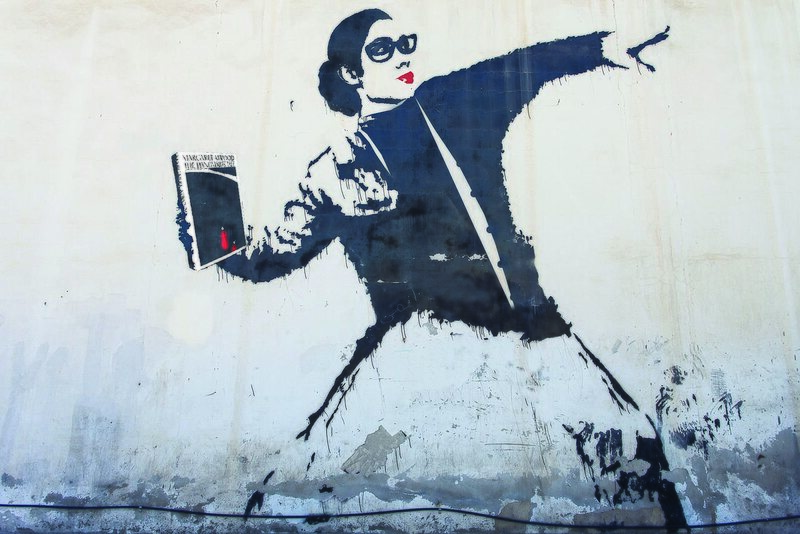
An adaptation of Banksy’s “Flower Bomber,” this depicts a librarian in protest, throwing Margaret Atwood’s A Handmaid’s Tale. Hafuboti/ CC BY-SA 4.0  

From August 29 through September 2, 2004, a series of protests erupted in New York in response to the 2004 Republican National Convention and the nomination of George W. Bush for the impending election. Nearly 1,800 protesters were arrested during the convention, and later filed a civil rights suit, citing violation of their constitutional rights.

During the protests, a steady team provided support to anyone who needed information amid the confusion: a modest group of socially conscious librarians from around the United States, armed with folders of facts ranging from legal rights in dealing with police to the locations of open bathrooms.

“We wanted to operate as if we were bringing a reference desk to the streets,” explains Lia Friedman, Director of Learning Services at University of California San Diego, who was at one of the protest marches in 2004. At the time, fewer people had smartphones, making this service both new and important. When someone asked a question that wasn’t included in their traveling reference desk folders, other librarians waiting at their home computers were poised to research and deliver information by phone. Read more...

Wednesday, September 20, 2017

Using Our Words : Getting it right on neutrality and libraries | American Libraries

Intellectual freedom |Libraries and neutrality

by Joseph Hanes | 09-01-17

I’ve always been a wordy sort of person. Yes, that too, but I mean word-y. I was the sort of kid who spent time with a thesaurus and dictionary as well as Tinkertoys and Matchbox cars. I was fascinated by words, their uses, and shades of meaning.

Even my amateur lexicographic interest ill prepared me for a world in which one of the more trenchant voices of political observation belongs to the Merriam-Webster Twitter feed (@MerriamWebster). If you don’t follow it yet, do so immediately, for its largely straightforward Word of the Day feature as well as its often wry and acerbic commentary on trending lookups based on “conversations” of the moment, not to mention words that aren’t really words (“covfefe”).

So the Webster’s dictionary has taken a side, or at least a perspective. Based on what I know of Noah Webster’s own colorful history and antipopulist views, I think he might approve. All of which puts an intriguing gloss on an emerging discussion within our own profession on what some may think a bedrock principle of librarianship: neutrality. This discussion includes my fellow AL columnist Meredith Farkas’s excellent piece on the critical librarianship movement (Jan./Feb., p. 70).

In one important sense, we aren’t neutral and never can be—nor should we be. Naturally, each of us has his or her own biases, prejudices, and preferences; we represent a sample of the breadth of society, so this is inevitable and necessary to avoid homogeneity of thought and action. Together, though, we advocate strongly on matters critical to our success. We fight in public for the rights of our patrons to read and think freely without fear of exposure, surveillance, or censure, as well as for open and equal access to a range of materials. We stand for the principle that government and public information shouldn’t depend on the whims of the moment. We are engaged with, represent, and fight for our communities and strive to improve them through our institutions and our work. Read more...
I want to be sure that we’re fighting the right fights on the right terms and, yes, using the right words.

Radical restructuring: Library renovations lead to personnel and process reorganization | American Libraries

Library design | Human resources | Academic libraries

by Catherine Murray-Rust | September 1, 2017

As librarians, we’ve all felt, at some point or another, like one of the great loves of our lives has been judged hopelessly irrelevant. In an era when information is digital and abundant, demonstrating the value of libraries and librarians is more urgent—and can be more difficult—than ever.

At Georgia Tech, we knew that using words to explain and defend would not accurately demonstrate the impact we have on inspiring and accelerating the intellectual achievements of faculty and students. So we set out on a library renewal project.

When we started four years ago, the project largely centered on building renovations. Over time we realized that renovations are the easy part of a transformation. We are fortunate to have creative architects, designers, engineers, and construction experts. We have the financial and political support of the administration and the University System of Georgia. And we benefit every day from the advice of consultants and subject-matter experts.

The biggest challenge to our transformation was organizational. We soon saw that we had to change the culture of the library from passive to active, and we had to retire models that focused narrowly on the library rather than those that supported the larger institution. We had to commit to organizing in a way that envisions a future that is digital.

How? We are adapting techniques used in disciplines such as supply chain thinking and portfolio management to radically restructure the way we operate. Our goal is to make the transactional parts of the library’s work as efficient as possible in order to free up resources to sustain new services such as intelligent agents, visualization, and data science.

Read more...

Thursday, September 7, 2017

Famed Documentarian Frederick Wiseman Turns His Camera on NYPL in Ex Libris | NYPL

Advocacy | Documentary | Public Libraries | Films

And check out early reviews for the film, which is screening at the Venice Film Festival:
Additionally, Wiseman himself is coming to LIVE from the NYPL to discuss the film at the Stephen A. Schwarzman Building on September 14. He will be joined by fellow master of documentary Errol Morris. Get your ticket to this unique meeting of minds today.

Frederick Wiseman
Photo by wowe

Monday, August 14, 2017

On Racism, Ignorance, and Librarianship | RD Lankes

Librarianship | Racism | Activism | Advocacy

RD Lankes August 13, 2017


On Racism, Ignorance, and Librarianship

I begin this post by condemning the racists, white supremacist, and Nazi actions in Charlottesville.

The past few days have been extremely troubling, and left me wondering what I can do. I then remembered I was asked that exact question after the Charlie Hebdo attack in France. I put together this post: https://davidlankes.org/charlie-hebdo/

This morning I re-read it and while I stand by it, I don’t think it went nearly far enough, and I need to amend it.

Read more...


Thursday, March 2, 2017

Our Futures in Times of Change: How values guide our understanding of trends and transition | March 1, 2017

Library Trends | Library Activism | Library Values

by Miguel Figueroa


For many futurists and trend spotters, “futuring” is fundamentally about the study of change.

“We can learn a great deal about what may happen in the future by looking systematically at what is actually happening now,” wrote Edward Cornish, one of the founders of the World Future Society.
We study change so we can prepare for the many futures that might happen. We start seeing what’s coming next. We study so that we won’t be surprised. And we study so that we’ll be better prepared to start creating the future.

That’s good news for library and information professionals. We are expert in finding, organizing, processing, and prioritizing information. From wherever we are in our organizations, we all have opportunities to observe changes in our communities and consider the implications over the long term.

But observation is simply not enough. One of the biggest lessons my colleagues and I have learned while developing the Center for the Future of Libraries is that studying change is useless without considering values. We need to look at trends and changes with consideration of our own professional values (confidentiality and privacy, diversity, equitable access, intellectual freedom and expression, preservation) and the values that we seek to provide to our communities (a civic commons, democracy, discovery, education and literacy, public discourse).  And so, looking at changes, we need to ask ourselves what they might mean for intellectual freedom, for education, for equitable access, or for any of the other values that drive our work. Read more...

Monday, February 27, 2017

We Need Librarians More Than Ever Before Need Librarians More Than Ever Before | Feb. 11, 2017

Librarians | Library Services | Information Literacy

 by John Spencer


Why Librarians Are Vital to our Students

I often hear people ask, “If we have the internet, why do we still need librarians?”

This is something I’ve heard since the days of dial-up and continue to hear right now. It misses the vital role that librarians play in our students’ lives. It’s true that the information landscape has changed. It is easier than ever to create a work and publish it to the world and with a tap of a button, we access information from anywhere at any time.

But actually, that’s why librarians are more vital than ever. Here are some of the things librarians do:
  1. Guide Students through Media Literacy: In an age of instant information, librarians help students learn to ask better questions, find valid sources, and deconstruct the information. Take a quick glance at Facebook and you’ll see people falling for fake news and failing to understand media bias. We are in desperate need of media literacy and librarians are the ones best poised to make this a reality. Read more...