Pages

Showing posts with label #publiclibraries. Show all posts

Thursday, October 11, 2018

Reclaiming Reference at the Library

Reference | Public libraries | Information seeking

For librarians, reference work today is increasingly about community service

Wednesday, September 12, 2018

To Restore Civil Society, Start With the Library | Opinion

Louie Chin

Libraries | Society | Public service

This crucial institution is being neglected just when we need it the most.

By Eric Klinenberg
Mr. Klinenberg is a sociologist.
Is the public library obsolete? 

A lot of powerful forces in society seem to think so. In recent years, declines in the circulation of bound books in some parts of the country have led prominent critics to argue that libraries are no longer serving their historical function. Countless elected officials insist that in the 21st century — when so many books are digitized, so much public culture exists online and so often people interact virtually — libraries no longer need the support they once commanded.

Libraries are already starved for resources. In some cities, even affluent ones like Atlanta, entire branches are being shut down. In San Jose, Calif., just down the road from Facebook, Google and Apple, the public library budget is so tight that users with overdue fees above $20 aren’t allowed to borrow books or use computers. 

But the problem that libraries face today isn’t irrelevance. Indeed, in New York and many other cities, library circulation, program attendance and average hours spent visiting are up. The real problem that libraries face is that so many people are using them, and for such a wide variety of purposes, that library systems and their employees are overwhelmed. According to a 2016 survey conducted by the Pew Research Center, about half of all Americans ages 16 and over used a public library in the past year, and two-thirds say that closing their local branch would have a “major impact on their community.”

Libraries are being disparaged and neglected at precisely the moment when they are most valued and necessary. Why the disconnect? In part it’s because the founding principle of the public library — that all people deserve free, open access to our shared culture and heritage — is out of sync with the market logic that dominates our world. But it’s also because so few influential people understand the expansive role that libraries play in modern communities. Read more...

Monday, July 23, 2018

Twitter rips awful Forbes take about replacing libraries with Amazon

Amazon | Bookstores Public Libraries

Libraries are amazing and bad takes in Forbes are not.

UPDATE: July 23, 2018, 1:48 p.m. EDT As of Monday afternoon, it appears as if the story has been pulled from Forbes without a note or any other reason. The story has also been removed from Mourdoukoutas' author page. I've reached out to Forbes for details but, for now, you can read a cached version of the story here and an updated version that was briefly on the site is here (via Wonkette).

There are bad takes, and then there's the take by Forbes contributor Panos Mourdoukoutas (who also serves as Chair of the Department of Economics at Long Island University) that local libraries should be replaced by Amazon book stores.

Among the reasons Mourdoukoutas offers are: libraries don't have as many public events as they used to because of school auditoriums; people go to places like Starbucks to hang out and work and read now instead of their library; and because technology makes physical books obsolete. Read more...

Thursday, January 25, 2018

What changes will 2018 bring to libraries? – directly from library experts

Library Trends | Public libraries | Services | Innovations

Princh.com | Jan2018


2017 has ended and now is the time for libraries to take a look at their performance from the previous year and find new ways to add more value to their services.
To get more insights about the ways libraries should change in 2018, we have talked with 3 library experts for their insights and advice:
It is time for #libraries to take a look at their #performance from the previous year and find new ways to add more value to their #services. Click To Tweet

1. Laurinda Thomas, Team Leader, Libraries and Community Spaces – ‎Wellington City Council, New Zealand

I want 2018 to be the year that Libraries put a stake in the ground about what they stand for and stretch their ideas about how we do tha

Hearing other voices in a world of fake news

While “fake news” isn’t a new idea, the awareness of the public about mis- and dis-information is probably at an all-time high. More libraries will step up to the plate on educating people how to be media savvy, break out of their “media silos” to hear other voices, and help people understand how to work and communicate in a digital world that generally tries to reinforce our confirmation bias’ rather than expose us to a range of ideas and experiences.  Read more...

Wednesday, November 1, 2017

Istanbul’s Libraries: A Refuge in Uncertain Times

Public Libraries | Turkey | Advocacy | Libraries abroad

By Kaya Genç


Last month, the Turkish Statistical Institute announced that the number of public library memberships in Turkey increased by 24.1 percent in 2016, compared to the previous year. In a time of terror, political uncertainty, and a coup attempt, Turks took refuge in libraries.


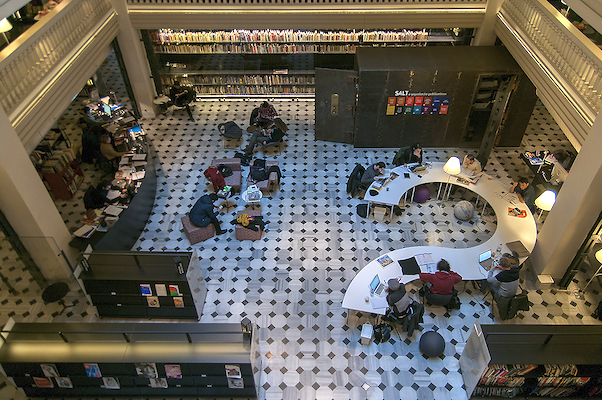
Some Istanbul libraries owe their existence to taxes; others to banks; one to an English monarch. SALT is located in the previous headquarters of the Ottoman Bank, which was founded in 1856 on the orders of Queen Victoria, a friend of the westernizing Sultan Abdulmecid. The building opened at a time when Turkish-British commercial ties were at their peak. Today, its library houses 110,000 books. Last year, it served more than 47,000  readers.

On a recent weekday the library was bustling with bright-eyed readers, and every seat were occupied. A hush fell over after I entered the reading room. On a desk by the entrance, a young man pored over a book; he checked a page number, and he typed a footnote to his thesis; in the little garden outside, two young girls smoked rollies. SALT is paid for by Garanti, a private Turkish bank. This is part of a trend. Read more...

Monday, October 23, 2017

The UK no longer has a national public library system

Public libraries | UK | Funding

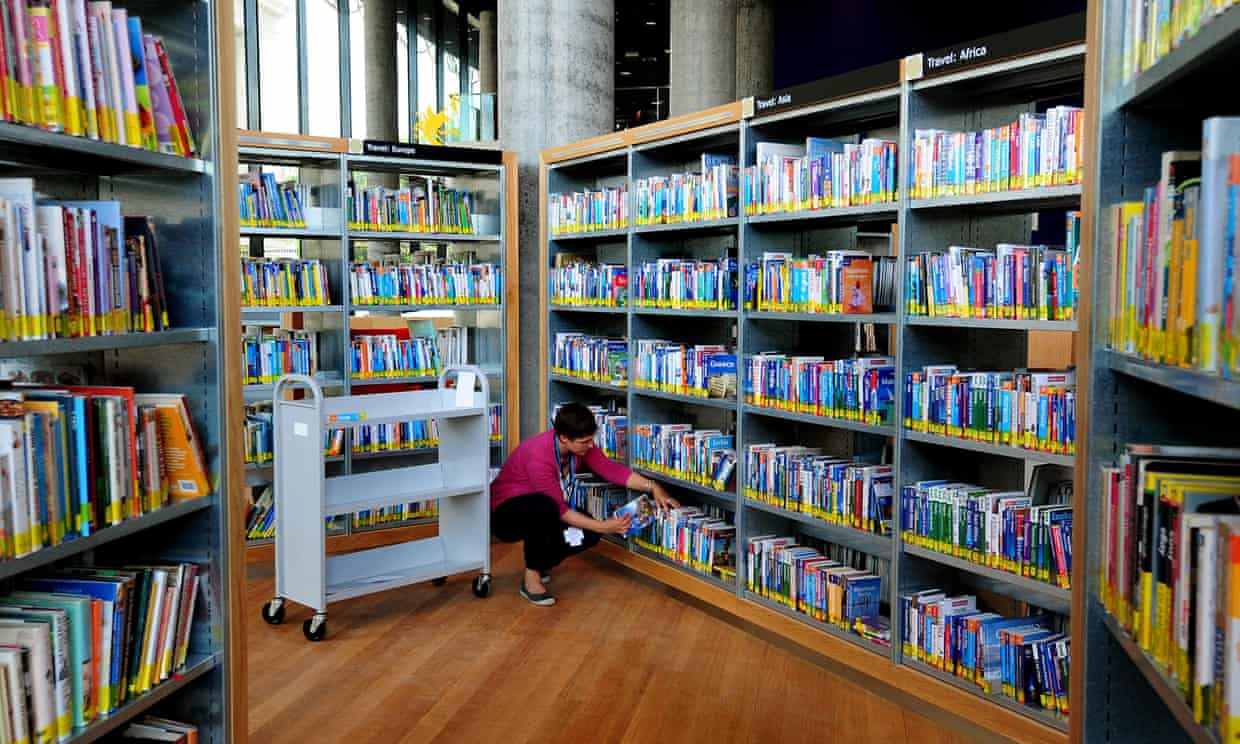
The UK no longer has a national public library system. Photograph: Rui Vieira/PA   
Since 2010, hundreds of local libraries have been handed over from councils to be run by the local community. One estimate is that 500 of the UK’s 3,850 libraries are now being run by local volunteers. Despite talk about empowerment and community involvement, the reality is that local people face a stark choice: take over a local library or it faces closure. Read more...

Thursday, September 28, 2017

How Citizen Action Saved the New York Public Library

Libraries | NYPL | Advocacy

Grassroots activists thwarted a costly and destructive renovation scheme—but the NYPL still lacks effective governance.

by Scott Sherman  | The Nation

(CC BY-SA 2.0)
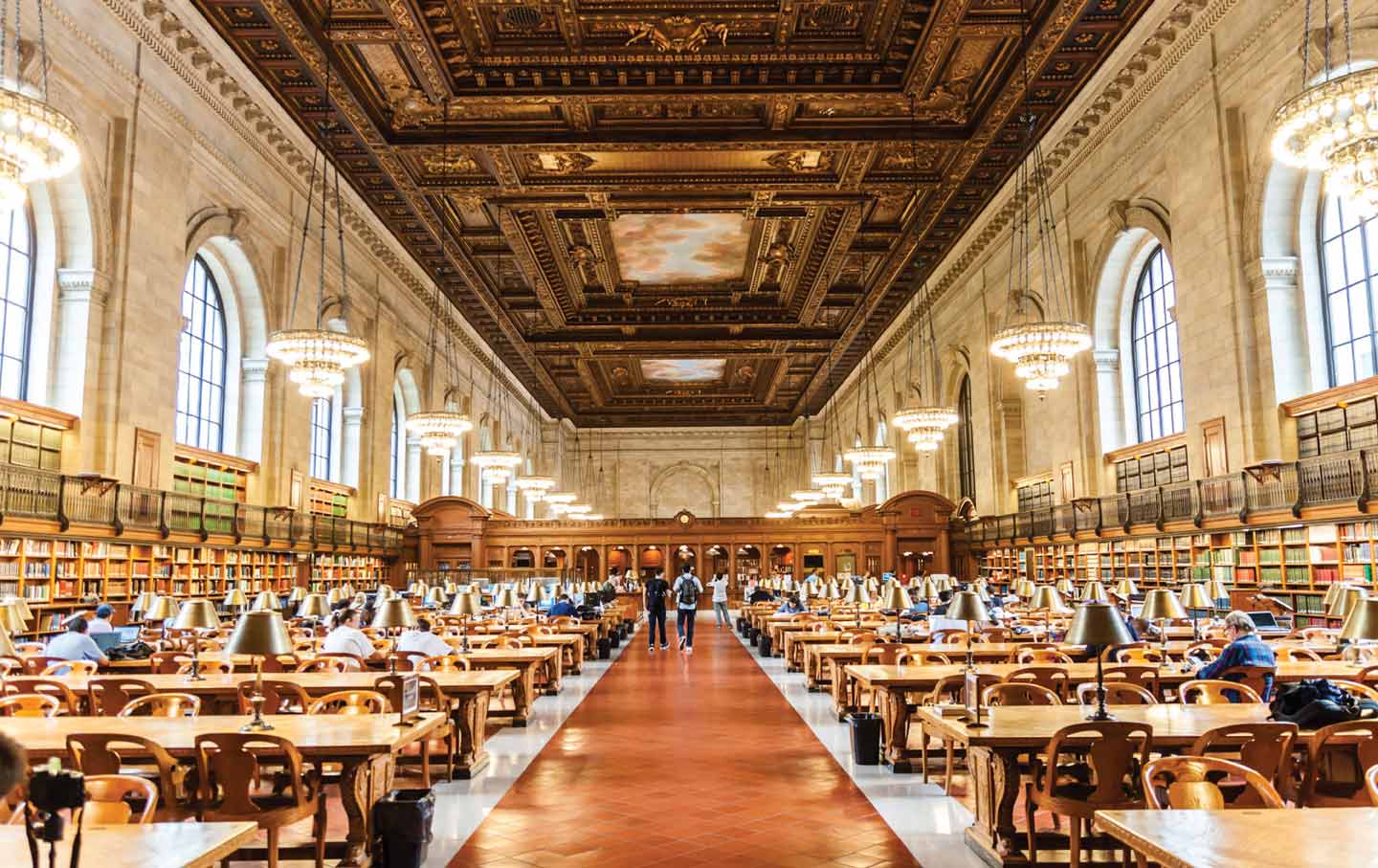
One morning in the spring of 2010, while standing in line in the New York Public Library’s majestic Rose Reading Room, I was approached by a middle-aged librarian, a man I had known for years; we had common interests and would frequently chat while he was on duty. He read The Nation and knew I wrote for it. On this particular morning, he leaned over and whispered into my ear: “Our trustees are planning to sell the library across the street”—by which he meant the Mid-Manhattan Library, a decrepit facility on 40th Street and Fifth Avenue. “It stinks,” he continued. “You should look into it.”

I was busy with other projects and let his tip go. But a year later, I received an assignment from this magazine to profile Anthony Marx, the New York Public Library’s incoming president. Early in my research, I quickly grasped what the librarian had tried to tell me a year earlier: The NYPL’s leadership—aided by the consulting firm Booz Allen Hamilton—had conceived a wildly ambitious transformation plan. The grand library at 42nd Street and Fifth Avenue would undergo a massive renovation in which 3 million books would be removed from the historic stacks in the center of the building and sent to an off-site storage facility; the stacks would then be demolished, and a new, modern library (designed by the celebrated British architect Norman Foster) would be built in the space that, for a century, had held the books. Foster would create a library within a library, one that carried a heavy price tag: $300 million. To pay for this Central Library Plan (CLP), two nearby libraries that occupied prime real estate—the Mid-Manhattan Library and the Science, Industry, and Business Library on 34th Street and Madison Avenue—would be sold. In a soaring Manhattan real-estate market, the NYPL (which is the subject of Frederick Wiseman’s latest film, Ex Libris) would not be excluded from its share of the spoils. Read more...


Wednesday, September 27, 2017

Chris Selley: Libraries feel the heat on freedom of speech

Freedom of Speech | Intellectual Freedom | Public libraries

Nobody wants Nazis in public libraries. But it's tough to find a coherent case to ban them without undermining libraries' most important function


Three masked people stand outside a memorial for Toronto lawyer Barbara Kulaszka at the Richview branch of the Toronto Public Library on July 12, 2017.Cole Burston for National Post 
 
by Chris Selley | September 26, 2017
 
The Canadian Federation of Library Associations’ position paper on intellectual freedom clearly lays out libraries’ “core responsibilities” in that regard. One is “to safeguard and facilitate access to constitutionally protected expressions of knowledge, imagination, ideas, and opinion, including those which some individuals and groups consider unconventional, unpopular or unacceptable.” Another is to “make available their public spaces and services to individuals and groups without discrimination.”

In an era when free speech scrambles for purchase on university campuses, one wonders how long it will last in libraries. In June, Toronto’s excellent public library system came under heavy fire for a paid room-booking that turned out to be a memorial event for Barbara Kulaszka, a lawyer best known for representing alleged Nazi war criminals in Canada and their supporters, notably Ernst Zundel.

An awful gang of bigots showed up, notably Marc Lemire and Paul Fromm. And while a library employee monitored the proceedings and apparently detected nothing untoward, the outrage came thick and fast. “It is truly shocking that individuals who spread hatred, deny the Holocaust and have ties to neo-Nazi groups are being provided a permit by the Toronto Public Library,” said Toronto City Councillor James Pasternak. “If (Fromm’s and Lemire’s histories are) not good enough for the Toronto Public Library to say ‘No thanks’ then what could be?” asked Ottawa human rights lawyer Richard Warman. Mayor John Tory asked the library to consider cancelling the event and, when it said it couldn’t, to reexamine its policies for future bookings. Read more...
 

Tuesday, September 26, 2017

Public libraries can (literally) serve as a shelter from the storm

Public libraries | Advocacy | Disaster preparedness

by Grace Morris | August 30, 2017


After windstorms in the summer of 2012 left thousands in Arlington, Virginia without power, the local public library system urged people who needed a cool place to spend the day at its branches. AP Photo/Cliff Owen  
U.S. public libraries often transform into shelters during emergencies.

After Superstorm Sandy, for example, the Princeton Public Library in New Jersey and Connecticut’s New Canaan Library gave the public somewhere to charge devices, contact loved ones or even just watch movies. Other New Jersey libraries went further: The Roxbury Public Library opened early and closed late. South Orange’s library became its primary evacuation center.

Libraries don’t just pitch in following natural disasters. In August 2014, the Ferguson Municipal Public Library  became a safe space amid the unrest that followed the shooting of Michael Brown, an unarmed black teen, by a police officer in the St. Louis suburb. After local schools started the school year two weeks behind schedule, leaving students in the lurch, the library even hosted informal classes for hundreds of students.

As millions of people in cities, suburbs and towns are reeling from Hurricane Harvey, nearby public libraries will soon play a critical role in creating a sense of normalcy for all ages – but especially for kids and teens. To help more public libraries emulate these examples with their young patrons, I teamed up with three graduate students to create a youth services toolkit to help librarians pitch in during emergencies. It will soon be available in a digital format at the Library of Michigan’s Youth Library Services website.
Read more...

Wednesday, September 20, 2017

Responding to Charlottesville: Episode 17 | ALA Podcast

Podcasts | Library activism | Community relations |Emergency preparedness

American Libraries Dewey Decibel Podcast

     Dewey Decibel is a new podcast series from American Libraries, the magazine of the American Library 
     Association. Each month, your host and American Libraries Associate Editor Phil Morehart will be 
     your beyond.

Host,  Phil Morehart

In Episode 17 of the Dewey Decibel podcast, American Libraries looks at the protests that took place on August 12, 2017, in Charlottesville, Virginia, through the eyes of the library world.

First, American Libraries Associate Editor and Dewey Decibel host Phil Morehart talks to John Halliday, director of Jefferson-Madison Regional Library in Charlottesville, and Krista Farrell, assistant director and branch manager of Jefferson-Madison Regional Library’s Central Library. The Central Library sits on what was the frontlines of the protests. John and Krista shared with Phil the events of that day and how their library handled it.

Next, Phil sits down with Jody Gray, director of the American Library Association’s (ALA) Office for Diversity, Literacy, and Outreach Services, and Kristin Pekoll, assistant director of ALA’s Office for Intellectual Freedom, to discuss ALA’s tracking of hate crimes at and in libraries and what you can do if your library falls victim to hate.

Finally, Phil talks to Peter Berg, associate director for special collections and preservation at Michigan State University Libraries. Michigan State University Libraries holds a massive collection of extremist literature, paraphernalia, and other materials. Phil and Peter examine the collection and why it’s important for libraries and archives to save these materials, despite the repugnant nature of some of them.  

Listen to the podcast:

Thursday, September 7, 2017

Podcast: Nancy Pearl on The Librarian Is In |NYPL

YA Literature | Podcasts |Book recommendations


The legendary book recommender joins to discuss writing her first novel and share her favorite books.


The Librarian Is In Podcast, Biblio File


Missing Persons & Nowhere Girls: The Librarian Is In Podcast, Ep. 54

Welcome to The Librarian Is In, the New York Public Library's podcast about books, culture, and what to read next.

Listen on Apple Podcasts | Listen on Google Play


On the show this week: Gwen reads a book that makes her see the world a little differently, and Frank gets so lost in his book that time disappears.

George and Lizzie by Nancy Pearl 

Famed Documentarian Frederick Wiseman Turns His Camera on NYPL in Ex Libris | NYPL

Advocacy | Documentary | Public Libraries | Films

And check out early reviews for the film, which is screening at the Venice Film Festival:
Additionally, Wiseman himself is coming to LIVE from the NYPL to discuss the film at the Stephen A. Schwarzman Building on September 14. He will be joined by fellow master of documentary Errol Morris. Get your ticket to this unique meeting of minds today.

Frederick Wiseman
Photo by wowe

Thursday, August 31, 2017

Things millennials love about the library | Podcast

Libraries | Millennials | Public services | Podcast

By 


A library at a secondary school in London. - 
Millennials are renowned for loving old things — vinyl records, retro bicycles, film cameras. What about old institutions?

Despite being the generation that grew up hand-in-hand with technology, it turns out the millennial generation — those between ages 18 and 35 — love public libraries.

They're more likely than baby boomers or Gen Xers to visit the local public library or a public bookmobile. A Pew Research Center study found that 53 percent of millennials in the U.S. had used their public library at least once in the year prior to the survey.

What have libraries been doing that's attracting so many young adults? Marketplace Weekend staff discovered a few exciting things: Read more...

Thursday, August 10, 2017

Jeff Bezos Should Put His Billions Into Libraries

Advocacy | Philanthropy | Public Libraries

by Susan Crawford | Backchannel | 09 August 2017

Ira Gay Sealy/Getty Images
 
Imagine that you are Jeff Bezos. For four hours two weeks ago, you were the richest person in the world. And though Wall Street knocked you down a notch, pretty much everyone thinks it’s inevitable that you’re going to be number one again. You’re starting to be aware of the smell of the tar pits and you’re casting about for a way to put all that loot to some good. You're eying the Gates-Buffet Giving Pledge and thinking that if you donate half your fortune it should make a difference. You're comfortable with making older but meaningful institutions great again.
 
So far, you’ve concentrated on things that might benefit our distant successors—space travel, cancer treatments, AI, and a clock that will keep running for 10,000 years. But you want to do something more immediate. You say you want your philanthropic activity “to be helping people in the here and now—short term—at the intersection of urgent need and lasting impact.” You are open to suggestions–so much so that you even recently tweeted a “request for ideas.”  Read more...
 

Monday, June 26, 2017

How Adele sent her love to libraries | #WhyBooksMatter

Library advocacy | Public libraries | Outreach \ Culture

June 12, 2017

 
Adele may have headlined Glastonbury and filled arenas across the globe in a worldwide tour that climaxes next month with four sold-out dates at Wembley Stadium, but 10 years ago she was playing a gig in a library in Lancaster for an audience of 175. “You can check out the show online,” says Stewart Parsons. “I am so relieved we filmed that!”
 Parsons, a librarian with more than 30 years of experience, started the Get it Loud in Libraries scheme 10 years ago to introduce new people to libraries by turning them into live music venues for special concerts. Over the last decade, 36,108 people have attended 279 shows put on by acts including alt-J, Florence + The Machine, Imelda May, British Sea Power, Plan B and, of course, everyone’s favourite balladeer, Adele, whose fee that evening in Lancaster was £50.


Read more...

Thursday, May 18, 2017

Library hosting workshops on ‘adulting’ | Heather Laura Clarke | 05-14-20107

Public libraries | Library services | Adult education |Adulting

Halifax Public Libraries found they were serving lots of people from most age ranges and life experiences, but weren’t seeing many “new adults” come through the library doors. Their adulting series has changed that. (123RF)   
Libraries across the HRM offer programming for babies, kids, teens, adults and seniors, but Jocelyn Covert saw that there was a noticeable absence of one particular demographic.

“We have lots of families with young children, and lots of seniors, but there’s this entire age range — university through the early 20s — we don’t get to see very much,” says Covert, youth service librarian with the Bedford Library.

In library lingo, this demographic is referred to as “new adults.” No one could figure out how to get these young people through the doors until Covert came up with the idea for a How to Adult series.

“Talking about ‘adulting’ or saying you ‘just can’t adult today’ has become a trending theme, and we’re always searching for opportunities to bring in new users, so I just thought I could put the two together,” says Covert. Read more...

Thursday, April 13, 2017

6 Ways to Support Public Libraries | April 9, 2017

Public libraries | Advocacy | Library funding

They may be in jeopardy, thanks to Trump's budget outline.


Public libraries may be in jeopardy. In mid-March, Donald Trump’s “skinny budget” outline was released, which included cuts to the National Endowment of the Arts and National Endowment of the Humanities, among other agencies. The cuts included an extensive $230 million cut for the Institute of Museum and Library Services (IMLS), which directly affects public library funding. The IMLS also receives funding from other agencies subject to termination or budget cuts, such as Innovative Approaches to Literary program through the Department of Education.

“Our initial assessment of [Trump’s] ‘skinny budget’ puts us at over $300 million in cuts, and when we assess individual programs, we’re looking at many more millions,” Julie Todaro, the president of the American Library Association, tells Teen Vogue. “[This budget] cuts across all the agencies who regularly fund our initiatives based on, in some cases, 75 years of partnership.”

In addition to promoting literacy and equitable education for all, libraries provide crucial community resources like access to academic databases, ESL classes, and computer classes for all ages. Librarians also serve as your local experts for the questions a Google search couldn’t answer. In the era of fake news and digital surveillance, libraries both provide media literacy and data privacy. Here are just a few quick ways to support your local branches at this very moment.

1. Check out books. Right now.

Read more...

Wednesday, April 5, 2017

How public libraries help build healthy communities | March 30, 2017

Public libraries | Library services | Community | Health

March 30, 2017

by Marcela Cabello and Stuart M. Butler


They say you can’t judge a book by its cover. Increasingly in the United States, you also can’t judge a library’s value to its community by simply its books. Let us explain.

In a previous blog post, we’ve noted the importance of “third places” in strengthening communities – meaning those places that are neither one’s home (first place) nor workspace (second place). A range of such third places, from churches to beauty salons, play an important role in community building. They are the informal spaces that are often mainstays in a neighborhood, places where both random and intentional in-person relationships are made. Read more...

Tuesday, March 28, 2017

6 Ways to become a power library user | via BookRiot

Public libraries | Library services | Research


by Kelly Jensen 08-22-14

You have a library card and you know the library is more than just a “Netflix for books.” Maybe you know about your library’s e-book offerings and maybe you know you can borrow audiobooks or DVDs. But how can you make the absolute most out of your local library? Here are 6 tips for becoming a power user of the public library.

Worth noting: not all public libraries offer the same services, so not everything mentioned here will be available to all users. Some libraries offer more and some may offer less. These variations exist because of funding differences, library size, location, and a host of other factors, most of which are out of control of the library itself. The one common denominator among these tips, though, is that they’re all things you can ask about at your library.

Likewise, this is geared toward the American public library system, so your mileage in other countries may vary.

1. Get to the top of the holds list for hot titles
Did you know many libraries order books well in advance of their publication date? Librarians are knowledgeable about what’s coming out, and they often put in purchase orders for titles weeks, if not months, before publication. This is especially true for books that are garnering buzz or are new titles by popular authors.  Read more...

Thursday, March 23, 2017

Long Overdue: Why public libraries are finally eliminating the late-return fine | February 6, 2016

Public libraries | Library services | Access

by Ruth Graham

Photo illustration by Slate. Images via jmbatt, simo988/iStock.
In 1906, a reporter for the Detroit Free Press described a scene that had become all too common at the city’s public libraries. A child hands an overdue book to a stern librarian perched behind a desk, and with a “sinister expression,” the librarian demands payment of a late fine. In some cases, the child grumbles and pays the penny or two. But in others—often at the city’s smaller, poorer library branches—the offender cannot pay, and his borrowing privileges are revoked. “Scarcely a day passes but it does not leave its record of tears and sighs and vain regrets in little hearts,” the reporter lamented.

More than a century later, similar dramas are still enacted in libraries across the country every day. In some districts, up to 35 percent of patrons have had their borrowing privileges revoked because of unpaid fines. Only these days, it’s librarians themselves who often lament what the Detroit reporter called “a tragedy enacted in this little court of equity.” Now some libraries are deciding that the money isn’t worth the hassle—not only that, but that fining patrons works against everything that public libraries ought to stand for.  Read more...