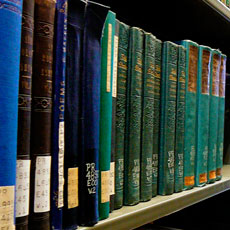
Three years ago we had two classrooms in our library. They looked like this:
These were suitable for training-based instruction but our program
has evolved. Librarians wanted to be able to reach more students (larger
class sizes) as well as utilize many different teaching methods.
We’re
upgrading both rooms this summer.
read more...
Academic cybrarian, bibliophile & culturista. Mentor to library school (LIS) students and graduates. Advocate for all libraries and their users. [Fmr. Organizer, NY Librarians Meetup]
Showing posts with label collaboration. Show all posts
Tuesday, April 14, 2015
Tuesday, August 6, 2013
How to Fill a Library With People Instead of Books – Next City
How to Fill a Library With People Instead of Books
The paper, titled "Library as Co-Working Spaces: Understanding User Motivations and Perceived Barriers to Social Learning," appears in the latest issue of the journal Library Hi Tech.
Marcus Foth and Mark Bilandzic spent five months conducting field research at The Edge, a "‘bookless’ library space" in Brisbane. A project of the State Library of Queensland, The Edge is, the authors write, "explicitly dedicated to co-working, social learning, peer collaboration, and creativity around digital culture and technology." Read more...
Thursday, July 26, 2012
The Benefits of Faculty-Librarian Collaborations | Faculty Focus
By: Andrea Gillaspy-Steinhilper in Instructional Design July 16, 2012
Community College instructors have a great deal to teach: study skills, a college orientation to education, and the actual course information for their discipline. They also know that their students must be information literate, must know how to find supplementary information for each course, how to use information effectively, and how to credit their sources appropriately. In this regard, Washington State Community and Technical Colleges have been working under an LSTA grant on Information Literacy from 2008-2012 (Washington). Lower Columbia College libraries have been using the grant to integrate librarians or library tutorials into face-to-face and online classes, thereby offering information literacy instruction to students without increasing the teaching load of the discipline instructors. When incorporated with research assignments, this instruction, along with embedded librarians, facilitates both student learning and faculty grading of assignments. Read more...
Andrea Gillaspy-Steinhilper is a reference librarian at Lower Columbia College.
References:
“Business Administration subject guide.” (rev. 2011) Lower Columbia College Library Services. Retrieved May 2012 from http://lowercolumbia.edu/nr/exeres/9CC35863-7A1D-4F77-88D0-6E2E2F083DC9.
“Determining the level of scholarship, authorship, and audience of an article.” (2011). Lower Columbia College Library Services. Retrieved 29 June 2012 from https://lstahighlights.files.wordpress.com/2012/06/ppt_scholarly_v_popular.pdf.
GillaspySteinhilper, A. (Winter 2012). “Cancer and genetic mutations.” Tegrity Recording. Lower Columbia College Library Services. Retrieved 11 May 2012 from https://tegr.it/y/aom1.
Washington State Community and Technology Colleges LSTA Grant 2008-2012. (25 April 2012). Retrieved 11 May 2012 from http://informationliteracywactc.pbworks.com/w/page/19923193/FrontPage.
By: Andrea Gillaspy-Steinhilper in Instructional Design July 16, 2012
Community College instructors have a great deal to teach: study skills, a college orientation to education, and the actual course information for their discipline. They also know that their students must be information literate, must know how to find supplementary information for each course, how to use information effectively, and how to credit their sources appropriately. In this regard, Washington State Community and Technical Colleges have been working under an LSTA grant on Information Literacy from 2008-2012 (Washington). Lower Columbia College libraries have been using the grant to integrate librarians or library tutorials into face-to-face and online classes, thereby offering information literacy instruction to students without increasing the teaching load of the discipline instructors. When incorporated with research assignments, this instruction, along with embedded librarians, facilitates both student learning and faculty grading of assignments. Read more...
Andrea Gillaspy-Steinhilper is a reference librarian at Lower Columbia College.
References:
“Business Administration subject guide.” (rev. 2011) Lower Columbia College Library Services. Retrieved May 2012 from http://lowercolumbia.edu/nr/exeres/9CC35863-7A1D-4F77-88D0-6E2E2F083DC9.
“Determining the level of scholarship, authorship, and audience of an article.” (2011). Lower Columbia College Library Services. Retrieved 29 June 2012 from https://lstahighlights.files.wordpress.com/2012/06/ppt_scholarly_v_popular.pdf.
GillaspySteinhilper, A. (Winter 2012). “Cancer and genetic mutations.” Tegrity Recording. Lower Columbia College Library Services. Retrieved 11 May 2012 from https://tegr.it/y/aom1.
Washington State Community and Technology Colleges LSTA Grant 2008-2012. (25 April 2012). Retrieved 11 May 2012 from http://informationliteracywactc.pbworks.com/w/page/19923193/FrontPage.
| Add Comment |
Tags: college librarians, improving student research skills, Librarian-faculty collaboration, teaching undergraduate research
Related articles
Subscribe to:
Posts (Atom)