Academic cybrarian, bibliophile & culturista. Mentor to library school (LIS) students and graduates. Advocate for all libraries and their users. [Fmr. Organizer, NY Librarians Meetup]
Showing posts with label academic librarians. Show all posts
Wednesday, May 17, 2017
Member of the Week: Susanne M. Markgren | ACRLinsider \ May 17, 2017
Member of the Week: Susanne M. Markgren:
Susanne M. Markgren is the assistant director for technical services at Manhattan College in Riverdale, New York. Susanne first joined ACRL in 2008 and is your ACRL member of the week for May 15, 2017.
1. Describe yourself in three words: Adaptable, inquisitive, resilient.
2. What are you reading (or listening to on your mobile device)? I’m currently obsessed with short stories, and I’m alternating between these three amazing collections: Joy Williams’ The Visiting Privilege, Lucia Berlin’s A Manual for Cleaning Women, and Clarice Lispector’s Complete Stories.
In the car and on walks, I like to listen to The Moth Radio Hour, or The Moth Podcast. True stories, well told. Totally addictive.
3. Describe ACRL in three words: Scalable, motivational, community. Read more...
Note: Stephanie L. Gross (blog owner) has served as a mentor with ACRL/NY with Susanne Markgren as Program Coordinator since the program's inception six years ago. For more information about Susanne and the program:
Susanne Markgren
ACRL/NY Mentoring Program Coordinator
email: acrlnymentoring@gmail.com
http://acrlny.org/
Wednesday, August 17, 2016
U of T’s Personal Librarian program eases the university transition for first-year students
The library program offers personalized help to more than 6,200 students in two faculties.
By RYLEY WHITE | August 16, 2016
Using the library is a daunting task for many first-year students. That’s why University of Toronto has established Personal Librarian, a program that pairs first-years with a librarian.
“As a personal librarian, I think of myself as a facilitator between the student and the library, and library resources,” says communications librarian Jesse Carliner. He compares the volunteer role to that of an adviser: he answers students’ questions, helps with citations and works through additional issues with students either by email or one-on-one.
Building off of similar programs like those at Yale and Drexel universities, U of T launched a pilot in 2012. According to student engagement librarian Heather Buchansky, that year 1,000 students were connected to 10 librarian-volunteers. As of 2015, personal librarians reached out to all first-year students in the faculties of arts and science, and of applied science and engineering – more than 6,200 students were contacted by one of 49 personal librarians. About eight to 10 percent of students contacted will participate, says Ms. Buchansky. Read more...
“As a personal librarian, I think of myself as a facilitator between the student and the library, and library resources,” says communications librarian Jesse Carliner. He compares the volunteer role to that of an adviser: he answers students’ questions, helps with citations and works through additional issues with students either by email or one-on-one.
Building off of similar programs like those at Yale and Drexel universities, U of T launched a pilot in 2012. According to student engagement librarian Heather Buchansky, that year 1,000 students were connected to 10 librarian-volunteers. As of 2015, personal librarians reached out to all first-year students in the faculties of arts and science, and of applied science and engineering – more than 6,200 students were contacted by one of 49 personal librarians. About eight to 10 percent of students contacted will participate, says Ms. Buchansky. Read more...
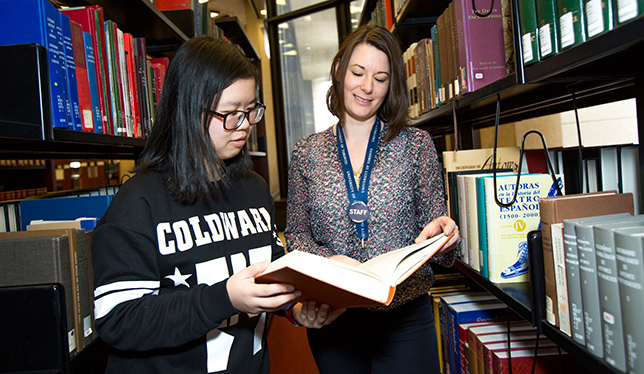
| Student engagement librarian Heather Buchansky helps a student. Photo courtesy of the University of Toronto. |
Thursday, July 26, 2012
The Benefits of Faculty-Librarian Collaborations | Faculty Focus
By: Andrea Gillaspy-Steinhilper in Instructional Design July 16, 2012
Community College instructors have a great deal to teach: study skills, a college orientation to education, and the actual course information for their discipline. They also know that their students must be information literate, must know how to find supplementary information for each course, how to use information effectively, and how to credit their sources appropriately. In this regard, Washington State Community and Technical Colleges have been working under an LSTA grant on Information Literacy from 2008-2012 (Washington). Lower Columbia College libraries have been using the grant to integrate librarians or library tutorials into face-to-face and online classes, thereby offering information literacy instruction to students without increasing the teaching load of the discipline instructors. When incorporated with research assignments, this instruction, along with embedded librarians, facilitates both student learning and faculty grading of assignments. Read more...
Andrea Gillaspy-Steinhilper is a reference librarian at Lower Columbia College.
References:
“Business Administration subject guide.” (rev. 2011) Lower Columbia College Library Services. Retrieved May 2012 from http://lowercolumbia.edu/nr/exeres/9CC35863-7A1D-4F77-88D0-6E2E2F083DC9.
“Determining the level of scholarship, authorship, and audience of an article.” (2011). Lower Columbia College Library Services. Retrieved 29 June 2012 from https://lstahighlights.files.wordpress.com/2012/06/ppt_scholarly_v_popular.pdf.
GillaspySteinhilper, A. (Winter 2012). “Cancer and genetic mutations.” Tegrity Recording. Lower Columbia College Library Services. Retrieved 11 May 2012 from https://tegr.it/y/aom1.
Washington State Community and Technology Colleges LSTA Grant 2008-2012. (25 April 2012). Retrieved 11 May 2012 from http://informationliteracywactc.pbworks.com/w/page/19923193/FrontPage.
By: Andrea Gillaspy-Steinhilper in Instructional Design July 16, 2012
Community College instructors have a great deal to teach: study skills, a college orientation to education, and the actual course information for their discipline. They also know that their students must be information literate, must know how to find supplementary information for each course, how to use information effectively, and how to credit their sources appropriately. In this regard, Washington State Community and Technical Colleges have been working under an LSTA grant on Information Literacy from 2008-2012 (Washington). Lower Columbia College libraries have been using the grant to integrate librarians or library tutorials into face-to-face and online classes, thereby offering information literacy instruction to students without increasing the teaching load of the discipline instructors. When incorporated with research assignments, this instruction, along with embedded librarians, facilitates both student learning and faculty grading of assignments. Read more...
Andrea Gillaspy-Steinhilper is a reference librarian at Lower Columbia College.
References:
“Business Administration subject guide.” (rev. 2011) Lower Columbia College Library Services. Retrieved May 2012 from http://lowercolumbia.edu/nr/exeres/9CC35863-7A1D-4F77-88D0-6E2E2F083DC9.
“Determining the level of scholarship, authorship, and audience of an article.” (2011). Lower Columbia College Library Services. Retrieved 29 June 2012 from https://lstahighlights.files.wordpress.com/2012/06/ppt_scholarly_v_popular.pdf.
GillaspySteinhilper, A. (Winter 2012). “Cancer and genetic mutations.” Tegrity Recording. Lower Columbia College Library Services. Retrieved 11 May 2012 from https://tegr.it/y/aom1.
Washington State Community and Technology Colleges LSTA Grant 2008-2012. (25 April 2012). Retrieved 11 May 2012 from http://informationliteracywactc.pbworks.com/w/page/19923193/FrontPage.
| Add Comment |
Tags: college librarians, improving student research skills, Librarian-faculty collaboration, teaching undergraduate research
Related articles
Subscribe to:
Posts (Atom)