Academic cybrarian, bibliophile & culturista. Mentor to library school (LIS) students and graduates. Advocate for all libraries and their users. [Fmr. Organizer, NY Librarians Meetup]
On June 1, the Philadelphia Inquirer
broke the news that the Free Library of Philadelphia’s McPherson Square
Branch had a serious problem with opioid use among patrons. By June 3,
everybody from the Washington Postto National Public Radio (NPR) had picked up the story.
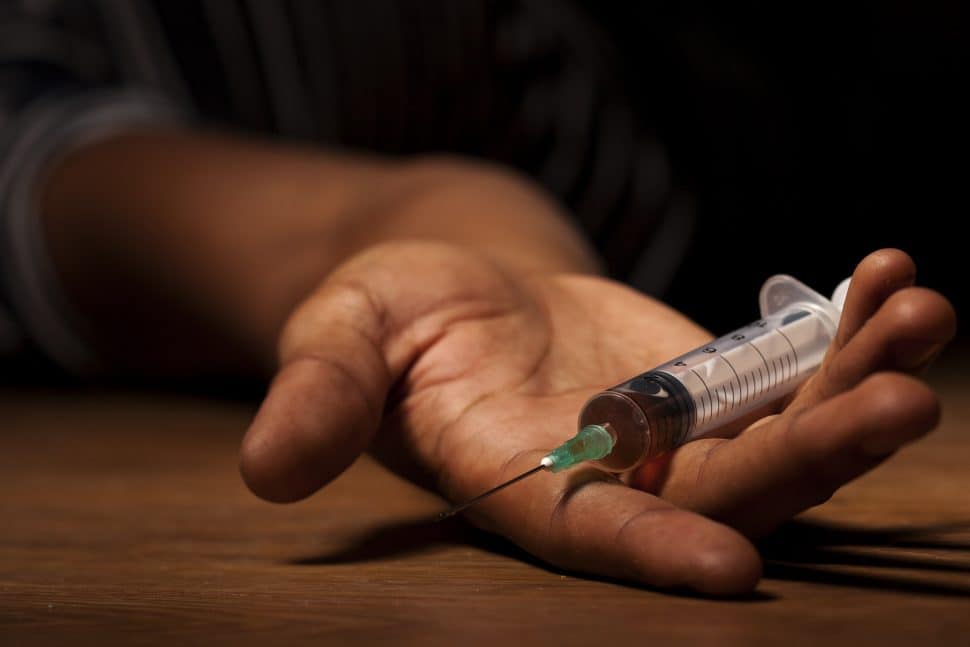
“As this nation’s opioid crisis has exploded, the staff at the public
library … have become first responders,” NPR’s Scott Simon told
listeners. “And I gather the librarians there have been obliged to
become involved in a way that—well, become involved in a way librarians
aren’t usually asked to become involved.”
What Simon didn’t say—but what librarians far and wide know—is that
the McPherson Square branch is just one of many American libraries
struggling with opioid-related issues such as discarded, contaminated
needles; drug use in the library itself; and even on-site overdoses and
fatalities. Libraries from California to Colorado, Pennsylvania to
Missouri, are finding themselves on the front lines of a battle they
never anticipated fighting.
Of course, opiate use isn’t limited to libraries. Neither is anyone
claiming that the problem is more severe in libraries than it is
anywhere else. Still, the fact that libraries are open to all, offer
relative anonymity, and generally allow patrons to stay as long as they
like make them uniquely vulnerable to those seeking a place to use
drugs.
“It’s just like: What is going on? How can we stem this tide?” says
Kim Fender, director of the Public Library of Cincinnati and Hamilton
County (PLCH). Read more...
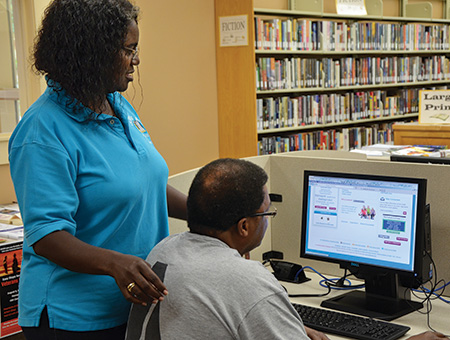
Marilynn Lance-Robb, branch manager at the Carvers Bay Branch Library in Georgetown, South Carolina, assists a patron with health information.Photo: Marilynn Lance-Robb
The first thing that Jennifer Davis tells patrons who come to her seeking medical information is not to Google their symptoms. “It’s the worst thing you could possibly do,” says Davis, director of Hall Memorial Library, which serves the communities of Northfield and Tilton, New Hampshire.
Instead, Davis assists patrons with their health care questions by helping them find information on Medline-Plus, an authoritative, free website where the public can find health information in more than 40 languages.
Although Davis, a former medical librarian, is familiar with health care topics, most public librarians do not necessarily have a medical background. Still they may be faced with an assortment of health-related questions from the public every day.
And I know what you're thinking: "Oh, another writer wanting people to think he’s all intellectual and highbrow."
But it really is my favorite book, only not because it has 1,500
pages of unforgettable characters or a generational plot that is more
compelling than that of any other book I’ve read. It’s because right
before I started reading it, my life was in a rut. I had recently been
passed over for a promotion at Apple and I had just been rejected by a
graduate school I applied to. This double whammy left me doubting
myself, my abilities, and my future. So when I came across the massive
tome that is War and Peace, I thought, "Why not? I’m not doing anything else."
Two months later, I finished the book and immediately knew I had a
new "favorite." But it wasn’t my new favorite book just because it was
so compelling. It was my new favorite because it changed something in
me. It’s almost impossible to explain why, but after reading it I felt
more confident in myself, less uncertain about my future. I became more
assertive with my bosses. I got back on the horse, so to speak, and
applied to three more graduate schools. I attended three interviews and
got accepted to all three schools (without mentioning War and Peace at all). As weird as it sounds, reading War and Peace put me back in control of my life—and that’s why it’s my favorite book.
But according to Dr Josie Billington,
deputy director of the Centre for Research into Reading at the
University of Liverpool, my experience wasn’t so odd. It’s actually the
norm for people who read a lot—and one of the main benefits of reading
that most people don’t know about.
"Reading can offer richer, broader, and more complex models of
experience, which enable people to view their own lives from a refreshed
perspective and with renewed understanding," says Billington. This
renewed understanding gives readers a greater ability to cope with
difficult situations by expanding their "repertoires and sense of
possible avenues of action or attitude."
And those possible avenues of action don’t have to mimic those in the
book. After all, I had no interest in learning the best ways to fend
off a French invasion, even though that was a major part of the story in
War and Peace. Rather it was in reading about the challenges
the dozens of characters in War and Peace faced that I learned to look
at my life’s challenges from a renewed perspective.
"People who read find it easier to make decisions, plan, and
prioritize, and this may be because they are more able to recognize that
difficulty and setback are unavoidable aspects of human life," says
Billington—and astonishingly these aren’t the only hidden benefits of
reading regularly that researchers are now discovering.
If the standard benefits of reading, which include knowledge
absorption and entertainment, were only complemented by the additional
benefits of the ability to refocus, regroup, and make better decisions,
it would be enough to argue that everyone should read for their own
good. But according to Billington and Sue Wilkinson, the CEO of The Reading Agency,
a UK charity that develops and delivers programs to encourage people to
read more, experts are now discovering reading has numerous additional
benefits to physical and psychological health.
"Reading for pleasure in general can also help prevent conditions
such as stress, depression, and dementia," says Wilkinson. "Research has
shown that people who read for pleasure regularly report fewer feelings of stress and depression
than non-readers. Large scale studies in the U.S. show that being more
engaged with reading, along with other hobbies, is associated with a lower subsequent risk of incidents of dementia."
Wilkinson also notes that people who read books regularly "are on
average more satisfied with life, happier, and more likely to feel that
the things they do in life are worthwhile." A recent survey of 1,500
adult readers found that 76% of them said that reading improves their life and helps to make them feel good.
People consulting their local GP over mental health issues may find they are written a surprising prescription, one redeemed at the local library rather than a pharmacy.
The “big guns” of the library and medical worlds have joined for an initiative to help treat those with mild to moderate mental health problems.
Patients could be recommended anything from one of 30 medical volumes dealing with specific conditions to “mood boosting books” – novels and poetry – from writers including Jo Brand, Bill Bryson and Terry Jones.
The Society of Chief Librarians (SCL) and The Reading Agency today announced the scheme dubbed “Books on Prescription” which starts in May. “There’s growing evidence that shows that self-help reading can help people with certain mental health issues get better,” Miranda McKearney, director of The Reading Agency, said. Read more...