Pages

Wednesday, May 30, 2012

Reading As Rebellion | Save NYC Libraries

Reading As Rebellion | Save NYC Libraries


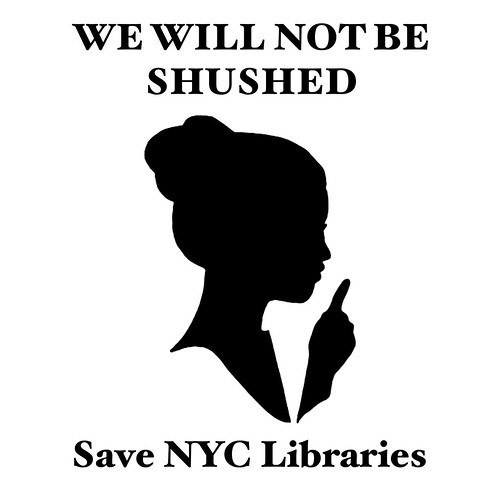
 Come out and read out for public libraries in New York City. Once again the three library systems are facing historic cuts and once again library supporters are pushing back. The third 24 Hour Read In will take place on June 9-10 from 4PM to 4PM and once again we will be on the steps of the Brooklyn Public Library in Grand Army Plaza. It will be another days worth of literary library activism.
This is going to be our biggest year ever. The base of the protest remains the same, over a hundred voices read around the clock. A full 24 hour day is broken into 15 minute intervals and volunteers read pretty much whatever they like for their quarter of an hour. The rules are simple, no speeches only reading. Family storytime is from 8AM to noon on Sunday so select your materials accordingly. The dark hours from 2AM-4AM are for the steamy stuff and heckling is to be expected.  Read more.


Enhanced by Zemanta

10 Top Tips for Attending an ALA Conference by Jo Alcock | Library Adventures.com

10 Top Tips for Attending an ALA Conference by Jo Alcock | Library Adventures.com

by Jo Alcock

Enhanced by Zemanta

Thursday, April 26, 2012

MAS Presents the Art Forum: Libraries as Cultural Hubs

Management Secrets: Core Beliefs of Great Bosses | Inc.com

Management Secrets: Core Beliefs of Great Bosses | Inc.com 

SALES SOURCE | Geoffrey James

Getty


The best managers have a fundamentally different understanding of workplace, company, and team dynamics. See what they get right.
Enhanced by Zemanta

She Needs More Book Reviewers! — Library Journal Reviews

She Needs More Book Reviewers! — Library Journal Reviews

Margaret Heilbrun

Photo courtesy Henrietta Thornton-Verma
Enhanced by Zemanta

Wednesday, April 25, 2012

Dirty books reveal secret lives of people living in mediaeval times


Densitometer
They feared illness, were selfish and fell asleep reading late at night, just like us, new research has revealed about our mediaeval ancestors.
For the first time a new scientific technique has allowed us into the minds and motivations of mediaeval people – through their dirty books.
A new technique invented by Dr Kathryn Rudy, lecturer in the School of Art History at the University of St Andrews, can measure which pages in mediaeval manuscripts are the dirtiest, and therefore, the most read.


Enhanced by Zemanta

Sunday, April 22, 2012

Foundation Center Meetup

The group recently visited the Foundation Center to learn about prospect research. Mrs. Susan Shiroma, senior librarian at the organization, explained the services provided by their library, explored the resources available on the website and gave some career advice ("Never give up tenure!").

First, what is prospect research? Prospect research is the assessment of an individual or organization in order to determine the likelihood (and amount) of that particular entity  giving a donation to a charitable organization.  The website has a helpful worksheet to help researchers keep track of their data. Another useful feature of the website is a portal with many different options to help researchers find potential funders.  Also of interest is the 990 finder which allows one to search IRS tax returns from charitable organizations. Organizations are required to list the previous years donations (the amounts and those who received them) on these returns.The Foundation Center also has an article on finding and maintaining prospects.

Mrs. Shiroma explained that becoming a prospect researcher is a natural choice for a librarian since it involves research and attention to detail. She encouraged us to visit the ARPA webpage (Association of Professional Researchers for Advancement) and to consider becoming a freelancer in the field.

Another interesting feature on the Foundation Center's website is the Trend Tracker which allows users to compare data from different charitable groups. Also helpful are the free webinars to help aspiring prospect researchers work on their fundraising projects. There are also blogs which highlight specific issues including the economic crisis, food security and many more.   In addition to the many free resources available through the Foundation Center's website, the organization also has intensive courses available for a fee.

The presentation was informative and there is much potential for overlap between the library science and prospect research fields.

About the Author: Allison is NYC based librarian who graduated with an MLS from Queens College. 

SLA NY’s International Special Librarians Day Event

By: Alexandra Janvey


The Global Outreach Committee of SLA NY held a special event on April 19 at Baruch College in recognition of International Special Librarians Day. The speakers, Diane Tukman and Mary Jane Fales were from the nonprofit Bridges to Community (http://www.bridgestocommunity.org/) and spoke about the different projects the group gets involved with. The Westchester based community development organization works with local communities in Nicaragua and the Dominican Republic under the program areas of housing, health, education, and economic development. They bring volunteers to build water systems, homes, schools, and more recently libraries. Over 800 volunteers a year go to Nicaragua and they are a diverse group of individuals that range from students to business leaders. The speakers explained some of the reasons that Bridges to Community choose to focus their efforts in Nicaragua and the Dominican Republic.

Why Nicaragua?
  • Lowest education rate in the Western Hemisphere.
  • Suffer from housing deficit of over 500,000 homes.
  • 47.9% of Nicaraguans live below the poverty line.
  • Only 79% of Nicaraguans have access to sources of potable water.
  • Nicaragua is one of the safest countries in the Western Hemisphere with friendly and welcoming citizens. Safety has to be a consideration since hundreds of volunteers are sent to work on projects in these countries. 
Why the Dominican Republic?
  • The western highlands along the border with Haiti contain some of the most impoverished communities in the Western Hemisphere.
  •  Limited economic and educational opportunities.
  • Access to clean water is a major concern.
  • The people are gregarious, inviting, and eager to tackle difficult jobs.
  • Bridges to Community was able to partner with another organization already established in the Dominican Republic. 

The projects that Bridges to Community works on are community generated. The community tells the organization what they need, not the other way around. This year they built their first library for the rural community of Los Lopez in Masaya, Nicaragua. The community’s old school was destroyed in the 2000 earthquake and its replacement was too small, forcing 119 children to squeeze into 4 tiny classrooms. Other children had to cross a busy highway to attend another school. In addition to new classrooms, the community expressed a wish for a library that would provide access to books as well as a quiet, safe place to study. The also wanted the library to have electricity so the adults could come at night to read and study. Several generous and devoted donors made this community’s dream a possibility. The library building was the size of a house and capable of fitting about 20 people. The building also contained a kitchen where healthy lunches could be made for the kids. The kids and community were so excited about the new library that they all came dressed in their uniforms during school vacation to welcome the volunteers from Bridges to Community. The entire community was present at the ground breaking and lined the roads to applaud the volunteers. Getting donated books for the library through customs was a problem so the best option was to buy the books in the country. The teacher who is in charge of running the education program also takes charge of the library and there are still things that need to be figured out. For example, right now no one can take books home with them because a lending library would be problematic in a poor community.

Funding has already been secured for the organization’s second library project that will begin this summer in July. The library will be for the community of Rosa Grande in Siuna, Nicaragua. The rural area is home to mostly farmers and many people walk hours just to obtain water. Few communities in Nicaragua have libraries and so those that do are proud of them. Everyone who attended also received a copy of The Librarian’s Cookbook.