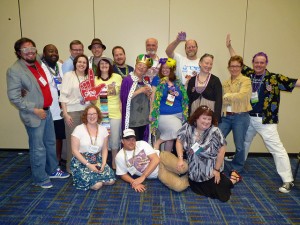
On Saturday, I put a deposit down on my first NYC apartment, and two days later I attended my first NY Librarians Meet-Up Group!
It’s been a whirlwind of activity since I arrived less than five days ago from my beloved hometown of Fresno, California. While I have contended with the usual culture and sticker shocks of most new residents, I felt quite at home at this meet-up. This is no surprise since I love meeting new people, and new librarians especially.
The meet-up was in a hidden gem of SOHO, the NYPL Mulberry Street Branch, which I later learned was once the Hawley & Hoops chocolate factory. The Jersey Street entrance was a little obscured by scaffolding—and I think a few of us got lost—but the branch quickly surmounted the difficulties. Patrons are treated to an almost Alice-in-Wonderland effect as the branch drops two stories underground. Restored brick walls are showcased throughout, and it even smells nice due to the parfumerie next door.
Kate Dietrick, a staffing specialist at InfoCurrent, presented various uses and benefits of the social networking site LinkedIn, which she described as a “Professional Facebook.” Fifteen librarians and students attended. Most of us had LinkedIn accounts, but did not deploy it strategically. While Dietrick had many useful topics, a few stood out in particular:
1) Recruiters use of LinkedIn
Most interesting to me was Dietrick’s perspective as a recruiter. As a recruiter, Dietrick said that she often “lightly stalks” potential hires, especially if she is trying to fill unusual or in-demand positions such as metadata librarians. She runs a keyword search for that title or other skills, and often people in her network will come up as possibilities.
Even more surprising to me was that if Dietrick knows of someone who might be a good fit for a job opening, but that person is not looking for a job, she will SEARCH THIS PERSON’S CONTACTS. This is under the assumption that this person is likely to have other contacts with similar skills or interests. Often as librarians or professionals, we know people through associations or committees. This makes perfect sense, but I had never considered it before.
TIP: Dietrick suggested that users include specialized skills in their “Summary” section or other parts of their account to ensure that they come up in recruiters’ search results. For instance if you know a certain database or standard, but it is not in your job descriptions, put this somewhere in your account so that you will be retrieved for those queries. (As information professionals, I'm sure we are all aware of the power of search retrieval.)
2) Use LinkedIn to research companies or people
I also enjoyed Dietrick’s tip to research future employers through LinkedIn. If you are interviewing at a company or library, LinkedIn can provide useful information on company hierarchy, size and job descriptions. You can also discover information about the person that is interviewing you for the job. This might make it easier to connect or make an impression with that person.
As a career tactic, Dietrick also suggested that we research the backgrounds of other information professionals that we respect or admire. This will give us an idea of how to recreate that path to success.
3) Using LinkedIn to promote yourself professionally
She also recommended that librarians view LinkedIn as a way to “promote your brand as a librarian.” Implicit in this suggestion was that this could be a way to market services to your users— especially since many information positions are vulnerable, misunderstood and/or underutilized.
She suggested, for instance, that if you provide a service to a new lawyer and then later connect to this lawyer on Linked-In, that lawyer will then be able to see your many other services and accomplishments. He or she might then contact you for other information needs.
4) Nuts and Bolts of Linked-In as a tool
The Meet-Up also included a discussion of the nuts and bolts of LinkedIn, such as requesting recommendations from former co-workers or employers, posting pictures, and how to connect with others. It also including general guidelines for what to post.
Unlike a paper resume, LinkedIn does not have to be limited to one or two pages, nor does it have contain library-only experience. Many of us come to librarianship after other careers, and Dietrick recommended that this other experience could be included on LinkedIn to form a full picture of your career. In fact, Dietrick suggested that many degrees and types of professional development should be listed on our LinkedIn accounts—such as chairing a project, attending a conference, or learning a new database.
On the flip side, she cautioned that LinkedIn should be treated similarly to a resume. It should be easy to read, with bullet points, and it should not include too much personal information that would be inappropriate for a resume.
While moving to a new city, and finding my first post-MLIS job during the Great Recession are not ideal, I am happy to have found an active, welcoming (and free) library group so quickly upon arrival. I look forward to joining and sharing in this local library community.
Diwata Fonte, MLIS Drexel University ‘09
Related slideshows:
Thank you Kate!!!