Academic cybrarian, bibliophile & culturista. Mentor to library school (LIS) students and graduates. Advocate for all libraries and their users. [Fmr. Organizer, NY Librarians Meetup]
Theodor “Ted” Seuss Geisel, better known as Dr. Seuss, on his last visit to his hometown of Springfield, Massachusetts in 1986. Photo courtesy of Springfield Union-News
A long-lost manuscript from the beloved author and illustrator Dr.
Seuss will be released next week, marking a quarter-century since his
swan song “Oh, the Places You’ll Go!” empowered us to move mountains.
The posthumous “What Pet Should I Get?” arrives July 28, two years after
the author’s widow unearthed the story’s text and sketches. It features
the siblings from “One Fish Two Fish Red Fish Blue Fish” on a trip to
the pet store, which we know is never that sensible with a Seuss book.
Philip
Nel, author of “Dr. Seuss: American Icon,” and Guy McLain, director of
the Wood Museum of Springfield History, discuss how the author’s
advertising beginnings gave way to Zooks and Zummers, pulling children’s
literature away from the tsk-tsking of the Dick and Jane books and
obliterating the boring belief that young readers ought to be prim and
proper.
Thing 1. He got his sense of poetry from his mother. Read more...
Американский культурный центр, занятия летней школы сценаристов. Июнь 2015-го
Фото:
Photo: American Center's vk.com page
Renowned librarian and cultural critic Ekaterina
Genieva passed away on July 9 in Israel after a battle with cancer.
Genieva had served as the head of the All-Russia State Library of
Foreign Literature for nearly a quarter of a century, right up until her
death. In the late 1990s and early 2000s, she also worked as the
President of George Soros’ Open Society Institute in Russia. This week, the Open Society Institutecame under government scrutiny
for “threatening Russia’s interests.” Authorities had also been paying
special attention to Genieva’s library, asking her to shut down the
American Cultural Center, one of many international organizations her
library hosts. Shortly before she passed away, Ekaterina Genieva was
interviewed by Katerina Gordeeva for Meduza. Genieva
shared her thoughts about the Ministry of Culture, about Russia’s “spy
fever,” and about the importance of cultural exchange.
Requirements
imposed on public educational and cultural projects are becoming ever
more stringent. Against this backdrop, the Library of Foreign Literature
looks almost provocative: it’s a whole community of intellectuals, you
have books about tolerance, you host concerts with musicians who have
gone out of favor with the state, you also host a dozen foreign cultural
centers in this building. How close are you to becoming a “foreign
agent?”
Every kid needs a tablet nowadays. (AP Photo/Eric Gay)
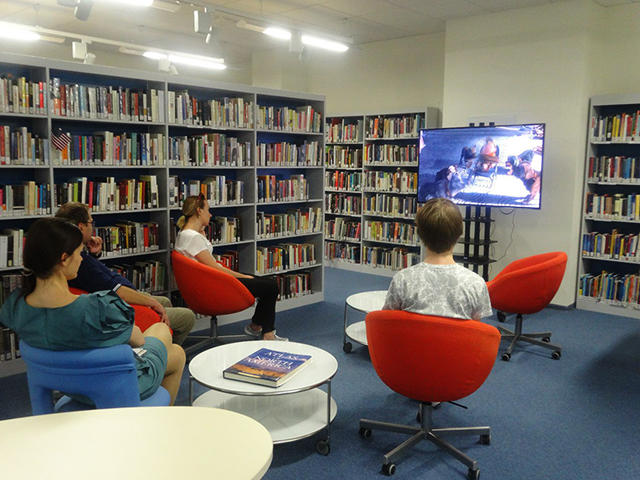
Visit the Central branch of New York City’s Queens Library at 12:55 pm on a Tuesday, and you’ll see about 100 people outside, waiting for the doors to open. At 1 pm they file in: Some settle in the comfy saucer chairs, while others rest in armchairs facing four TVs and open a newspaper. Splashes of blue and green interrupt white walls, and computer areas are separated by category: job information, adult learning center, and “young adult learning.”
But the reach of the Queens Library extends beyond the walls of its 65 physical branches. Dotting the borough are thousands of New Yorkers logged into their own mini-libraries, using the library’s mobile app to do research for homework, or the WiFi hotspots they checked out to fill in the holes in broadband access at home, or accessing e-books on one of the libraries’ tablets they can take home.
Throughout the country, library initiatives are emerging to keep up with technological advances. And libraries are finding that one population they can serve better than anyone else is low-income Americans.
The Senate made great strides this week to ensure needed reform to
the Elementary and Secondary Education Act (ESEA). After much debate
and across the aisle discussion, yesterday the Senate overwhelmingly
passed S. 1177, the Every Child Achieves Act, by a vote of 81-17.
As we discussed in a previous post,
the inclusion in the bill of the bi-partisan Reed-Cochran amendment,
makes S. 1177 a monumental step forward for schools, their libraries and
the millions of students they serve. Most fundamentally and
importantly, the amendment (approved 98-0) makes explicit that ESEA
funds may be used to support school libraries and “effective school
library programs” in multiple ways.
The following was written by author Wayne Wiegand as a compliment to his new book, Part of Our Lives: A People's History of the American Public Library (Oxford University Press, 2015):
Indisputable
fact--Americans love their public libraries. Evidence to support this
statement abounds. A 2013 report by the Pew Research Center’s Internet
and American Life Project noted that in the previous decade “every other
major institution (government, churches, banks, corporations) has
fallen in public esteem except libraries, the military, and first
responders.” The study also found that 91% of those surveyed over
sixteen years old said libraries are “very” or “somewhat” important to
their communities, and 98% identified their public library experience as
“very” or “mostly positive.”
Another Pew study found 94% of parents
believe libraries are important for their children; 84% said because
libraries develop a love of reading and books. Read more...
Percentage who feel some books should be
banned has increased 10 points since 2011; Three in ten Americans are
more likely to read a book if it’s banned
08:00 AM EDT Jul 8, 2015
NEW YORK, N.Y. – In just four years, the percentage of Americans who believe there are any books that should be banned hasincreased
by more than half: 28% believe this to be the case today, vs. 18% in
2011. One-fourth (24%) are unsure, which leaves nearly half of
Americans convinced that no books should be banned completely (48%).
Politically speaking, Republicans are nearly twice as likely as
Democrats or Independents to believe there are any books that should be
banned completely (42% vs. 23% & 22%, respectively).
In addition, adults who have completed high school or less are more
likely than those with higher levels of education to believe there are
any books that should be banned (33%, vs. 25% some college, 24% college
grad, 23% post grad).
These are some of the results of The Harris Poll® of 2,244 U.S. adults surveyed online and in English between March 11 and 16, 2015. “The things they're doing and saying in films right now just shouldn't be allowed.” ― Mae West
When asked to consider other types of media, adults are less likely
to say there are any movies, television programs, or video games which
should be banned completely. Only 16% of Americans each believe there
are any movies or television programs that should be banned completely,
and one fourth say the same about video games (24%). In light of this,
perhaps it’s not surprising that seven in ten adults believe a rating
system (similar to that used for movies) should be applied to books
(71%).
Similar to books, Republicans are more likely than Democrats or
Independents to believe there’s ever a call for outright bans in each of
these categories.
Movies: 24% Republicans vs. 15% Democrats & 12% Independents
Television: 23% Republicans vs. 16% Democrats & 12% Independents
Video games: 32% Republicans vs. 23% Democrats & 20% Independents
To Fans of "To Kill A Mockingbird" We at Brilliant Books want to be sure that our customers are aware that “Go Set A Watchman” is not a sequel or prequel to ‘To Kill A Mockingbird'.
Neither is it a new book. It is a first draft that was originally, and
rightfully, rejected. The book, and some of the characters therein, are
very much a product of this era in the South.
We
suggest you view this work as an academic insight rather than as a nice
summer novel. This situation is comparable to James Joyce's stunning
work 'A Portrait of the Artist as a Young Man', and his original draft 'Stephen Hero'.
'Hero' was initially rejected, and Joyce reworked it into the classic
'Portrait'. 'Hero' was eventually released as an academic piece for
scholars and fans—not as a new 'Joyce novel'. We would have been
delighted to see “Go Set A Watchman” receive a similar fate.
It
is disappointing and frankly shameful to see our noble industry parade
and celebrate this as “Harper Lee’s New Novel”. This is pure
exploitation of both literary fans and a beloved American classic (which
we hope has not been irrevocably tainted.) We therefore encourage you
to view “Go Set A Watchman” with intellectual curiosity and careful consideration; a rough beginning for a classic, but only that.
It’s been a big few weeks for America, hasn’t it? From the heartbreak of the Charleston shootings to the landmark #LoveWins Supreme Court decision to the Girl Scouts donor dust-up, people everywhere are talking about prejudice.
While I’ve seen such a beautiful swell of love, support and
compassion for all kinds of people all over my social media this past
month, I’ve also talked to lots of moms who are wondering how to talk to
kids about prejudice and racism. Because even as my kids help me pick
out wedding presents for all our friends, prejudice most
definitely still exists whether it’s because of the color of your skin
or the country your family came from.
One of my favorite go-to tools for starting hard conversations with
my kids is by reading books together. Reading a great story is an easy
way for me to get my kids talking about concepts like open-mindedness,
embracing people who are different from them, and fighting for the
rights of people who have been marginalized. Even if marginalization is still a word that’s a little over their heads.
by Jen Li, INALJ Contributor I
have a ‘library bucket list’. Although my PhD research focuses on three
case study libraries in Sydney, my reading and travels have taken me
beyond Sydney and those three libraries. I have a mental list of
libraries that I would like to visit one day, libraries that I would
love to return to, and whenever I’m in a new city I will visit their
libraries and discover ones that I didn’t realise I wanted to visit but
am glad that I found them. The bucket list is developed through hours
upon hours of reading books and articles about libraries, following
libraries and librarians on Twitter, and reading websites like BookRiot
on an almost daily basis. There are many lists out there that proclaim
the ‘Most Beautiful Libraries in the World’ or ‘Libraries You Should
Visit Before You Die’, and I like to read them for two reasons: to see
how many libraries I can tick off and say, “Yes, I’ve been there!”, and
to add new libraries to my list.
A note on these lists, however: these lists typically contain grand,
beautiful libraries. There are palatial and majestic libraries out there
in the world, libraries with marble floors and columns, and what seem
like endless rows of bookshelves. You know the ones. They are
spectacular libraries that intimidate. These are generally national
libraries, or a city’s first or central library, or academic libraries.
My bucket list contains these libraries, and I will never say no to an
opportunity to visit them. But I also love the library that never
makes it onto those lists; the humble neighbourhood library that perhaps
isn’t as well funded, or is open as many hours as its users would like,
or whose decor and furnishings might not have been updated for a number
of years because its budgetary priorities lay elsewhere. Read more...
1.5
million digitized images contain an estimated four million names of
formerly enslaved people. The names were originally collected by the Freedmen's Bureau,
a program established by Congress to help newly freed Black people
transition into citizenship post-Civil War. Because the bureau was a
government agency, the records were kept by the National Archives until now.
A partnership with National Archives and the Church of Jesus Christ of
Latter-day Saints will allow the handwritten records to be digitized and
archived for public access. The effort to make these records available
to the public online free of charge will coincide with the opening of
the Smithsonian National Museum of African-American History and Culture at the National Mall in the fall of 2016. Access to these records appropriately coincides with the 150 year anniversary of the abolition of slavery.
Approximately four million names of formerly enslaved people will be released in hopes of helping Black Americans trace their ancestry
These records will allow Black Americans to trace their ancestry further back than previously possible.
Paul Nauta, a spokesman for FamilySearch says,
“African Americans who tried to research their family history before
1870 hit a brick wall because before 1870 their ancestors who were
slaves and showed up as tics or hash marks on paper. They didn’t have a
name. The slave master would just have tick marks.”
Photo: theGrio.com
Joneka Percentie is a junior studying Communications, Africana
Studies, and Women's and Gender Studies. When she is not working as an
editorial assistant with For Harriet, she enjoys blogging for SPARK, singing, dancing, tweeting @jpercentie, eating, and sleeping. E-mail her at joneka.percentie@forharriet.com
Laughing students walk into the renovated
Woodrow Wilson Library in May. The library is used by local elementary
schoolchildren as a space to hang out with friends and use the Internet.
(Erin Schaff/For The Washington Post)
The
hallmark of public libraries — the printed book, bound by covers and
centuries of page-turning — is being shoved aside by digital
doppelgangers.
Around the country,
libraries are slashing their print collections in favor of e-books,
prompting battles between library systems and print purists, including
not only the pre-pixel generation but digital natives who represent a
sizable portion of the 1.5 billion library visits a year and prefer
print for serious reading.
Some
of the clashes have been heated. In New York, protesters outside the
city’s main branch have shouted: “Save the stacks! Save the stacks!” In
Northern Virginia, the Fairfax County library system chief recently
mused that the Friends of the Library were no longer friends — a feud
fueled by outrage over a print collection that has shrunk by more than
300,000 books since 2009. The drop in the District is even more
dramatic: Nearly 1 million books have vanished since 2009.
Li Xiaodong, a prize-winning
architect, was inspired by the branches of local fruit trees, which he
used to cover the Liyuan library's roof and exterior walls.Credit
Sim Chi Yin for The New York Times
JIAOJIEHE,
China — Nestled among the shimmering chestnut, walnut and peach trees
of a deep valley surrounded by craggy hills, the tiny village of
Jiaojiehe suffers from being close to the nation’s capital. The young
flee easily to the big city, leaving the elderly behind, lonely and
poor.
In today’s China,
villages like this often try to engineer a sense of well-being by
opening a new medical clinic, say, or by upgrading the water supply.
But
Li Xiaodong, an award-winning architect who fuses traditional Chinese
ideas of design with Western themes, had a different idea for Jiaojiehe.
He was captivated by the potential he saw in the village’s most
abundant natural resource, the branches of its thousands of trees, which
the locals harvest for fuel.
So
he built a library — with a twist. At its base, it is a steel and glass
box in the vein of a Philip Johnson open-plan creation from the 1950s,
but its exterior walls and roof are clad with fruit-tree twigs
What went wrong at one of the world’s eminent research institutions?
Alamy
The
Rose Main Reading Room in the New York Public Library’s main branch, on
Fifth Avenue at 42nd Street. A group of scholars spearheaded a
successful protest to stop radical changes at the library, but now it
looks as if they may have lost anyway.
By Scott Sherman
Scholars who use the New York
Public Library are boiling with frustration. It wasn’t supposed to be
this way. In 2014 the library, under pressure from a coalition that
included four senior scholars, abandoned its controversial Central
Library Plan, which entailed gutting the stacks at the 42nd Street
Library and selling the popular Mid-Manhattan Library across the street.
But the situation hasn’t turned out how many critics had hoped.
Paula Glatzer, an independent Shakespeare scholar, has been engaged
in research at the library since 1963 and has recently used the
collections for her contribution to the new Variorum Shakespeare
editions, published by the Modern Language Association. On January 15 she sent a letter
to Anthony W. Marx, the library’s president: "Sadly, I have had to tell
my Variorum colleagues that the NYPL is over … for now." Many books are
stored off-site, some mislabeled as on-site; others have been lost or
discarded, she wrote. "I requested a series. It couldn’t be found. I
said it was hard to lose 21 volumes. A librarian overheard me and
offered to look. He later emailed. All 21 volumes were indeed missing." Read more...
Once upon a time, when Gerald Ford was
president, I had a grant to be Assistant Archivist at Columbia University
Teacher’s College Archives. Many years later, I was told the archives had
closed. By then my career moved on to law librarianship. But that’s another
story. I’m always glad to visit archives whenever I get a chance.
The American Museum of Natural History was
founded in 1869. Theodore Roosevelt’s father was president of the Board of
Trustees.The Museum’s purpose is to
provide scientific education and research. On Sunday, October 5, 2014, the
American Museum of Natural History Library explained some of its archival
holdings as part of National Archives Week.
Having completed a project for the New York
City Department of Health and Mental Hygiene reporting on best standards and
practices for long term digital objects, I was eager to find out how the AMNH
was approaching this problem, Vicky Steeves, a fellow from the National Digital
Stewardship Registry has a grant funded by the Library of Congress to develop a
preservation plan for the scientific papers with input from the
scientists.Vicky is applying a three pronged
approach: following trends in technology; using interoperative file formats and
migration to newer formats when required. This is what I learned from my
project. AMNH is keeping the original material.
Next I spoke to Barbara Rhodes, the Library Conservator,
whose purpose is to repair and restore materials as well as preserve them for
research and display purposes. One thing she does is make photocopy facsimiles of
materials that are displayed. Barbara had some examples. I particularly liked a
facsimile of a work by Anton von Leeuwenhoek, inventor of the microscope (www.ucmp.berkeley.edu/history/leeuwenhoek.html ) she photocopied the
original work on handmade paper and then bound it into a book. Except for the
binding, it gave a good impression of a 17th Century work.
Stacy Schiff, the Visual Resources Librarian,
explained how they plan to eventually provide online access to the Library’s
one million photographic images. These include glass plates and lantern slides.
Sometimes the museum gives lectures using the lantern slides.Right now the photographic
materials are arranged by size. So there can be all sorts of material in one
box. So far the Digital Special Collections (images.library.amnh.org/digital) has curate 8500
items by topic and format. Stacy explained that there were three stages to
loading an image onto the database: scanning the image; standardizing the data
and adding the cultural context. For that purpose, Library applies Encoded
Archival Description (EAD) and Encoded Archival Context (EAC) for
metadata.The website’s platform uses
Omeka open source software. As a former cataloger, I was interested to learn
that the material was described using Library of Congress subject headings, the
Getty Thesaurus of Geographic Names (www.getty.edu/research/tools/vocabulary/tgn/index.html
)and
a local controlled vocabulary.
Thomas (Tom) Baione, the Library Director,
presided over the Expeditions Table which displayed artifacts from Franz Boas’ ‘(http://www.britannica.com/EBchecked/topic/70705/Franz-Boas) photo scrapbook form
Jessup North Pacific Expedition to Northwest Coast of North America and
Siberia. Also displayed was a sweater worn
On the Central Asiatic Expedition to China
and Mongolia lead by Roy Chapman Andrew (www.britannica.com/EBchecked/topic/24006). It was a little
ragged and still had sand from the Gobi Desert. This expedition found a full
set of dinosaur eggs. Later on, in the film preservation section, I saw a film
of this discovery. Alas, it turned out the discovery of the eggs was staged or
“reenacted” as we now say in documentary film and television.
Also
on display was a beautifully stuffed canary that looked ready to fly away
except it was in a glass case. Twelve year old Carl Akeley, of the Museum’s
Akeley Hall of African Mammals, was the soon to be revolutionary taxidermist.
Akeley was also involved with the Field Museum in Chicago (http://www.fieldmuseum.org/carl-akeley). The film
preservation section also had film of a camp of one of Akeley’s many
expeditions to Africa. You see an African man ironing a table cloth. The
expedition members sit down at a table and are served by other men. Along comes
Akeley whose chair looked like a throne to me.
Barbara Mathe, Museum Archivist and Head of
Special Collections, showed us a scrapbook of photos of Native Americans. In
one photo, you can see the photographer in the subject’s eye. Barbara told us
that, in discussions with the Zuni, they were told certain photos could not be
displayed or otherwise observed as they were taken at a secret ceremony. Even
other Zuni may not look at these photos. It’s a good example of how the Museum
is sensitive to the people they study.
Then it was on to the film preservation
section where Gregory Rami, Special Collections Librarian, explained how they
preserved films and then digitizing them. I believe he said it was in the
1980’s they copied the films onto video tape in a format that was obsolete
before the invention of the DVD. This is a good example of the difficulty in
preserving archival film.
It’s
very expensive to digitize from film. It would cost about $16,000.00 to
digitize the 1920’s 10 minute films Gregory showed. So digital copies are made
from the tape copies played on the obsolete machines. I watched the films with
my niece Brynn (soon to be a student at Pratt Library School). We both
pronounced them “cool”. The Museum is still sponsoring expeditions which are
recorded digitally.
My final stop was the Hidden Collections Table.
The Institute of Museum and Library Services (IMLS) and the Council for Library
and Information Resources (CLIR) are funding an inventory and description of
all the archives in the Museum Library and Scientific Departments. Becca Morgan
is the Project Archivist. Metadata Analyst Iris Lee has what I consider a
really fun job. She visits all the departments, talks to scientists, and
discovers connections that no one knew existed.
When I was a child, it was a real treat to
come to the American Museum of Natural History to see the dinosaur bones. The
planetarium was also fun. I am an adult. I know that there is an overwhelming
and ongoing amount of treasure in the MuseumIt was real treat to learn about what is being done to catalog and
preserve it.
The Research Library (library.amnh.org) is open to the
public Tuesday, Wednesday and Thursday 2:00-5:30 and by appointment. Email libref@amnh.org or phone
212-769-5400.
In exciting news for our three public library systems, New York City’s FY16 budget includes an additional $39M in funding
for library services. This significant increase will keep branch
library doors open 6 days a week throughout the boroughs and will bring
500 new jobs. The de Blasio administration has also committed to a
ten-year $300 million capital improvement budget for our libraries, a
sorely needed commitment given the steady deterioration of our libraries’ infrastructure.
The city’s FY16 budget was announced late on Monday evening by Mayor
Bill de Blasio and City Council Speaker Melissa Mark-Viverito. The
budget also includes a major increase in funding for the NYPD, the parks department, and the city’s public schools.
This historic increase in funding comes after a multi-faceted
advocacy campaign set forth by New York Public Library, Brooklyn Public
Library, and Queens Library. The three systems teamed up on investinlibraries.org, which includes a white paper detailing their infrastructure issues. The libraries also promoted the hashtag #investinlibraries,
held rallies around the city, created a letter-writing campaign, and
gathered testimonials by the likes of Judy Blume, Junot Diaz, and Tom
Wolfe.
Meanwhile, Urban Librarians Unite staged a 24-hour read-in on June 11 at City Hall. In his interview with Library Journal,
city council majority leader Jimmy Van Bramer called the read-in “a
steady drumbeat” that “made a compelling case that, in a city that sees
growing income disparities and has too many people falling into poverty,
unemployed, struggling, that public libraries are the first line of
defense in the war against inequality and library workers are really at
the front line.” Read on metro.org
Photo by Jonathan Blanc/The New York Public Library)
Can't pop open a Corona and stare at the turquoise waters while flipping through your beach read in the sand? Well, the NYPL has a fine, free alternative: their outdoor reading rooms will reopen tomorrow, and this year they've got swanky umbrellas to shade the sun from your pale winter skin.
The Outdoor Reading Room
will be located on the plaza of the Stephen A. Schwarzman Building on
5th Avenue, where there will be chairs and artificial grass to sit upon.
If solitary reading isn't your thing, they'll also have author talks
and other events, food trucks, and librarians who will help you find
your soulmatebook.
The reading room will include colorful lounge chairs
arranged on a plush "grass" carpet of soy bean based turf. Its
mid-century modern design was inspired by the iconic 1970 Slim Aarons
photograph Poolside Gossip, which epitomized the chic poolside social
scene of the times.
A cookbook published in 1938 in Yiddish doesn’t sound
like a slam dunk to be a bestseller in 2015, and yet that’s precisely
what happened with The Vilna Vegetarian Cookbook: Garden-Fresh Recipes Rediscovered and Adapted for Today’s Kitchen
by Fania Lewando, translated by Eve Jochnowitz (Schocken). The book,
released on May 26, debuted at #8 on PW's cookbook bestseller list.
With only about 1,000 copies printed and sold
throughout Europe before WWII broke out, the cookbook would have been
lost to history if it had not been for two women, Wendy Waxman and
Barbara Mazur, who found a copy of the long out-of-print book in the
rare book room at the YIVO Institute for Jewish Research in New York
City. The women found a champion of the book in Jewish cookbook author
Joan Nathan who, in turn, brought the book to the attention of Schocken
editorial director Altie Karper.
Bringing new life to a long-forgotten gem is one challenge,
but promoting a book in which the author is deceased (Lewando died in
1941 while fleeing from the Nazis), and therefore doesn’t have a current
platform, is even trickier. In order to do the book and its history
justice, Schocken went back to the cookbook's roots, which are
surprisingly current. “With all of Fania Lewando’s excellent advice
about using the freshest, best quality fruit and vegetables you can get,
and about using every part of the fruit or vegetable, and about not
discarding even the cooking water, it seemed as though the book was
written last week, and not 70 years ago,” said Karper. “I was
particularly intrigued by the vegetable juice and fruit juice recipes.
How much more 21st century can you get?” Read more...
We have been advocating for libraries for years and it always comes up in conversation that libraries are “book warehouses” or that we are outdated in the time of Google and ebooks. This could not be further from the truth. Here at Urban Librarians Unite we apply a lot of Library Science to the work we do. These are how we see libraries DIRECTLY addressing some of the most pressing issues in New York City every single day.
Services to Older Adults
New York City’s libraries offer many special programs and events tailored to the 50+ audience. These include lectures, films, performances and educational programs that reflect the wide interests of today’s older adults. Library outreach staff regularly visit nursing homes, senior centers, and adult care centers to run programs and loan books and other library materials.
ESOL/Citizens/New Americans
New York’s branch libraries provide a wide array of services for immigrants and are perhaps the most trusted government institution by foreign-born New Yorkers. Libraries offer English training for those who are not native speakers, preparation for the U.S. citizenship test and computer literacy classes. The libraries partner with immigrant and community groups to put on a wide variety of events and classes, from financial literacy seminars to courses on parenting, health and immigrant and tenant rights. In Queens, the library’s New Americans Program (NAP) organizes nearly 80 cultural programs each year. These programs include festivals, dance shows, music events, performances and much more. We have been advocating for libraries for years and it always comes up in conversation that libraries are “book warehouses” or that we are outdated in the time of Google and ebooks. This could not be further from the truth. Here at Urban Librarians Unite we apply a lot of Library Science to the work we do. These are how we see libraries DIRECTLY addressing some of the most pressing issues in New York City every single day.
Services to Older Adults
New York City’s libraries offer many special programs and events tailored to the 50+ audience. These include lectures, films, performances and educational programs that reflect the wide interests of today’s older adults. Library outreach staff regularly visit nursing homes, senior centers, and adult care centers to run programs and loan books and other library materials.
ESOL/Citizens/New Americans
New York’s branch libraries provide a wide array of services for immigrants and are perhaps the most trusted government institution by foreign-born New Yorkers. Libraries offer English training for those who are not native speakers, preparation for the U.S. citizenship test and computer literacy classes. The libraries partner with immigrant and community groups to put on a wide variety of events and classes, from financial literacy seminars to courses on parenting, health and immigrant and tenant rights. In Queens, the library’s New Americans Program (NAP) organizes nearly 80 cultural programs each year. These programs include festivals, dance shows, music events, performances and much more. Read more...
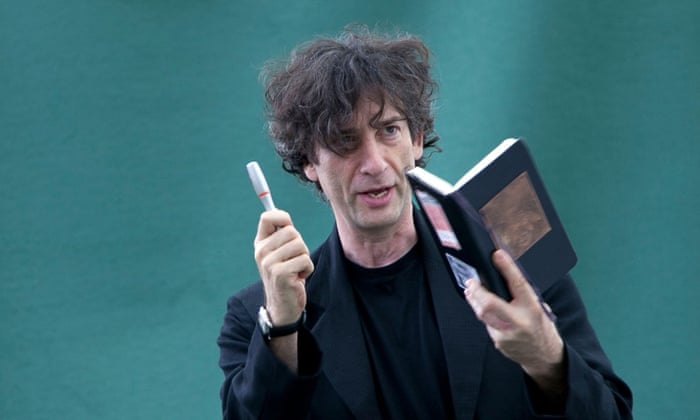
Neil Gaiman with ‘a little empathy machine’.
Photograph: Lebrecht Music and Arts Photo Li/Alamy
A feral child who was raised in libraries
Toby Litt: You’ve described yourself as a “feral
child who was raised in libraries”. What age were you when you were
first drawn into a library, and why do you think they hooked you?
Neil: I was probably three or four when I first
started going to libraries. We moved up to Sussex when I was five, and I
discovered the local library very, very quickly. But I wasn’t really
hooked until I got to the point where I was old enough to persuade my
parents to just take me to the library and leave me there, which would
have probably been about seven or eight. And at that point it was like
being given the keys to the kingdom. Read more...