Pages

Thursday, January 17, 2019

7 statements library professionals should rethink in 2019

Public libraries | Library services | Library advocacy | Best practices | Access

by Jane Cowell and Ian Anstice | Princh

 
Another year has ended and now it is a great time for library professionals to look back at their activity and plan for 2019 with a fresh view.

Another year has ended and now it is a great time for #library professionals to look back at their activity and plan for 2019 with a fresh view. Click To Tweet
  There are many things that libraries got attached to in their long history such as fines, the library card, the Dewey classification and many other things that librarians have tested: the switch of focus from books to other activities, the removal of quiet zones and more. Some of them are not that successful anymore or still need more time to see the actual results.

To get more insights about a few statements library professionals should rethink in 2019, we have talked with two library experts for their insights and advice: Ian Anstice, editor of Public Libraries News (United Kingdom) and Jane Cowell, Chief Executive Officer at Yarra Plenty Regional Library (Australia). Here is what they said: Read more...

Wednesday, January 16, 2019

The Hunt for the Nazi Loot Still Sitting on Library Shelves

Nazi Loot | Stolen books | Holocaust | Jewish libraries

The Nazis left the task of creating inventories for the millions of books they seized to a special task force, members of which are seen here in Estonia.CreditCreditYad Vashem Photo Archives
 
By Milton Esterow
The hunt for the millions of books stolen by the Nazis during World War II has been pursued quietly and diligently for decades, but it has been largely ignored, even as the search for lost art drew headlines. The plundered volumes seldom carried the same glamour as the looted paintings, which were often masterpieces worth millions of dollars.

But recently, with little fanfare, the search for the books has intensified, driven by researchers in America and Europe who have developed a road map of sorts to track the stolen books, many of which are still hiding in plain sight on library shelves throughout Europe.

Their work has been aided by newly opened archives, the internet, and the growing number of European librarians who have made such searches a priority, researchers say.

“People have looked away for so long,” said Anders Rydell, author of “The Book Thieves: The Nazi Looting of Europe’s Libraries and the Race to Return a Literary Inheritance,” “but I don’t think they can anymore.”  Read more...

Wednesday, November 28, 2018

Bibliotherapy: how reading and writing have been healing trauma since World War I

Bibliotherapy | War trauma | World War I | Wounded veterans

15 November 2018

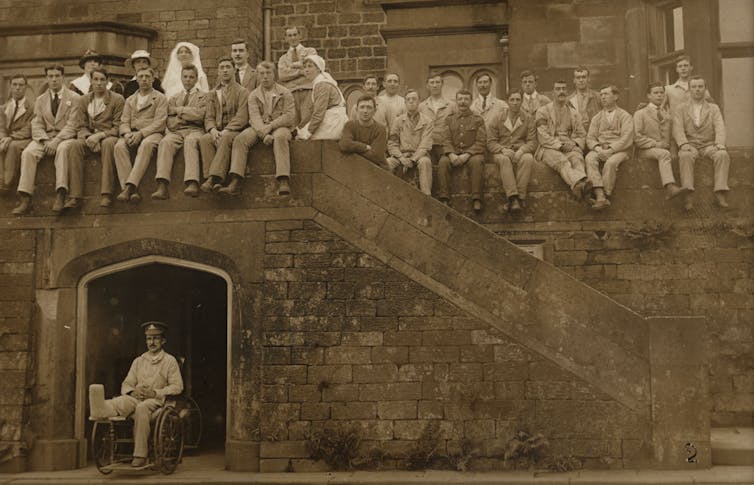
Longshaw Lodge Convalescent Home for Wounded Soldiers, Grindleford, near Sheffield. Tyne & Wear Archives & Museums


Bibliotherapy – the idea that reading can have a beneficial effect on mental health – has undergone a resurgence. There is mounting clinical evidence that reading can, for example, help people overcome loneliness and social exclusion. One scheme in Coventry allows health professionals to prescribe books to their patients from a list drawn up by mental health experts. 

Even as public library services across Britain are cut back, the healing potential of books is increasingly recognised.

The idea of the healing book has a long history. Key concepts were forged in the crucible of World War I, as nurses, doctors and volunteer librarians grappled with treating soldiers’ minds as well as bodies. The word “bibliotherapy” itself was coined in 1914, by American author and minister Samuel McChord Crothers. Helen Mary Gaskell (1853-1940), a pioneer of “literary caregiving”, wrote about the beginnings of her war library in 1918:
Surely many of us lay awake the night after the declaration of War, debating … how best we could help in the coming struggle … Into the mind of the writer came, like a flash, the necessity of providing literature for the sick and wounded.
The well-connected Gaskell took her idea to the medical and governmental authorities, gaining official approval. Lady Battersea, a close friend, offered her a Marble Arch mansion to store donated books, and The Times carried multiple successful public appeals. As Gaskell wrote:
What was our astonishment when not only parcels and boxes, but whole libraries poured in. Day after day vans stood unloading at the door.

Read more...

Remembering the Howard University Librarian Who Decolonized the Way Books Were Catalogued

African-American History | Cataloguing |Racial bias

by Zita Cristina Nunes

American Historical Association's Perspectives on History

Smithsonian.com

November 26, 2018

Dorothy Porter challenged the racial bias in the Dewey Decimal System, putting black scholars alongside white colleagues 


In a 1995 interview with Linton Weeks of the Washington Post, the Howard University librarian, collector and self-described “bibliomaniac” Dorothy Porter reflected on the focus of her 43-year career: “The only rewarding thing for me is to bring to light information that no one knows. What’s the point of rehashing the same old thing?” For Porter, this mission involved not only collecting and preserving a wide range of materials related to the global black experience, but also addressing how these works demanded new and specific qualitative and quantitative approaches in order to collect, assess, and catalog them.

As some librarians today contemplate ways to decolonize libraries—for example, to make them less reflective of Eurocentric ways of organizing knowledge—it is instructive to look to Porter as a progenitor of the movement. Starting with little, she used her tenacious curiosity to build one of the world’s leading repositories for black history and culture: Howard’s Moorland-Spingarn Research Center. But she also brought critical acumen to bear on the way the center’s materials were cataloged, rejecting commonly taught methods as too reflective of the way whites thought of the world.

Read more: https://www.smithsonianmag.com/history/remembering-howard-university-librarian-who-decolonized-way-books-were-catalogued-180970890/#pY8YYwIXYHSpxhcc.99


Thursday, October 11, 2018

TBLC Talk: Andrew Beman-Cavallaro on Mentoring in Librarianship – March 2015

Mentoring | Librarianship | Professional advice | Career Development

Andrew Beman-Cavallaro, Associate Director of Libraries at Pasco-Hernando State College Spring Hill Campus, talks about Mentoring in Librarianship in this session of TBLC Talks.

Open Invitation: Fall Reception of the New York Library Club, Inc. Thursday, 18th October 2018

Library event  | Networking | Professional Library Organizations

Are you a librarian? Library Student? Writer? Publisher? Looking to network with other like professionals?

The New York Library Club, Inc. invites you to their annual Fall kick-off reception:

John Ashbery: The Construction of Fiction

UPCOMING EVENTS
October 18, 2018, 6PM-8PM

  • Fall Social at the Pratt Manhattan Gallery (144 West 14th Street, New York, NY 10011).
  • We would Love to meet you and hear your thoughts and concerns on Librarianship as a career! Learn about the club including its social events, members, history and its vision.
  • Take advantage of Networking/Mentoring and Leadership Opportunities
  • Explore the details regarding our available yearly Scholarship Award
  • Light refreshments will be served
Please RSVP to membership@nylibraryclub.org with your name and affiliation by October 17th so we can get a list to Security and assure your entry.

Reclaiming Reference at the Library

Reference | Public libraries | Information seeking

For librarians, reference work today is increasingly about community service