 |
| About the only drawback is dismissiveness from my friends and family. A working-class male taking a degree to be a what? Photograph: Denis Charlet/AFP/Getty Images
“Who would want to become a librarian now?” asked an anonymous public servant on National Libraries Day, seeing before them a graveyard of dead libraries and old reference desks filled by volunteers. A valid question, and one to which I’ll reply: “You know what? I’ll have a go.”
I’m training to be a professional librarian, having just finished a lecture on “semantic web ontologies” and “linked data”, and sat dumbstruck in front of a “Dewey Decimal assembler” without a clue as to what I’m looking at. The course is challenging – it’s a three-year master’s degree that bites eye-watering chunks out of my wages. Why am I doing it to myself?
The fact is, I can’t not. It’s a sort of calling – like becoming a priest, only with warmer business premises. I can’t stand by and let public libraries sink. I won’t.
Forget all about reading as a pleasure, forget that children should have unlimited access to books, throw away arguments about libraries being lifelines for those less fortunate – they’re falling on deaf ears. You just have to look at the comments beneath pro-library articles to gather a general response: Kindles, the internet replacing information needs, and so on. And the one we wheel out about libraries being the centre of the community – there’ll be someone swatting that old classic aside with a “and yet the majority of the population doesn’t use them”.
For me, it boils down to one important point: the internet is a shallow (but extremely wide) surface-level summary of secondary, often opinionated information that sits on a bedrock of substantive knowledge that either isn’t on the internet, or lives behind a paywall, or is too expensive to purchase. Public libraries broker equal access to all that stuff. Get rid of them, and your information becomes drip-fed through Google filters (if you have a computer to access it). Read more...
|
Tuesday, March 8, 2016
Who would be a librarian now? You know what, I'll have a go (Anonymous)


The Fabric of Memory: Preserving Met Opera History Friday, March 04, 2016 - 10:58 AM By Fred Plotkin
 The Metropolitan Opera archivist Robert Tuggle (Jonathan Tichler/Metropolitan Opera)
I am often asked who is the Belmont for whom the Belmont Room on the Metropolitan Opera’s Grand Tier is named. This is where donors at a certain level to the Opera Guild go for coffee and conversation before performances and during intermissions. A painting there by Simon Elvis of a warmly elegant lady depicts Eleanor Robson Belmont (1879-1979), who was the first woman on the board of directors of the Met and was crucial in creating the Metropolitan Opera Guild in 1935.
Mrs. Belmont always sat in box 4 in the Golden Horseshoe at the old Met. When the company was in its most parlous financial condition in the early 1930s, she raised $300,00 to create the guild. In 1940, it was she who had the idea to cut up the gold silk curtain at the old Met and have the pieces stitched to make handbags, bookmarks, eyeglass cases and other items whose sale raised $11,000.
Mrs. Belmont proudly declared that, with the establishment of the guild, “democratization of opera has begun!” In the spring of 1936 she hired Mary Ellis Peltz, whom she described as a “gifted walking encyclopedia of opera” to edit the newsletter that would become Opera News. Mrs. Peltz also created educational programs, a lecture series and backstage tours. She edited the magazine until 1957, at which point she initiated the Metropolitan Opera archives and was its director until her death in 1981. They were then headed by Robert Tuggle, who died on Jan. 24 at the age of 83. Read more...
Thursday, March 3, 2016
Wednesday, March 2, 2016
Bob Dylan’s Secret Archive By BEN SISARIO MARCH 2, 2016
 |
| Bob Dylan working in a room above the Cafe Espresso in Woodstock, N.Y., in 1964, left. On the right are items from his archive. Douglas R. Gilbert, left; via the Bob Dylan Archive, right. |
TULSA, Okla. — For years, Bob Dylan scholars have whispered about a tiny notebook, seen by only a few, in which the master labored over the lyrics to his classic 1975 album “Blood on the Tracks.” Rolling Stone once called it “the Maltese Falcon of Dylanology” for its promise as an interpretive key.F
But that notebook, it turns out, is part of a trinity. Sitting in climate-controlled storage in a museum here are two more “Blood on the Tracks” notebooks — unknown to anyone outside of Mr. Dylan’s closest circle — whose pages of microscopic script reveal even more about how Mr. Dylan wrote some of his most famous songs. Read more....
There’s A Village In Wales That Is Basically One Big Library
 |
1. This is the Welsh village of Hay-on-Wye. |
Thursday, February 25, 2016
Visiting the oldest bookstore in America – and its resident ghost: The Moravian Book Shop in Bethlehem, Pennsylvania, is still thriving, some 270 years after its founding
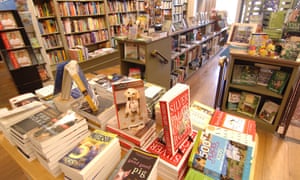 |
| ‘We’ve created something here,’ says the Moravian book shop’s manager. ‘What you hear people say is we’re an experience.’ Photograph: Moravian Book Shop |
On a recent Friday morning, I showed up to Moravian Book Shop a little before the store was to open. Moravian is the oldest bookstore in the United States, founded in 1745, and has expanded many times over the years, taking over neighboring buildings. It now occupies 15,000 square feet on Main Street in downtown Bethlehem, Pensylvania. I wasn’t sure where to go in. Such a large footprint means the store has a few front doors.
Lisa Girard quickly spotted me from inside, brought me in out of the wind blowing up from the Lehigh river, and began explaining just how a bookstore (a warm one, I might add) has managed to stay open for so long. Moravian even opened a second location in nearby Allentown last year. That’s an unusual longevity for a business in this corner of the country, where one of the world’s mightiest steel mills, Bethlehem Steel, couldn’t keep a business going long into the new century. Read more...
Wednesday, February 24, 2016
Introducing Open eBooks

"Today, the White House announced that the Open eBooks app to put ebooks in the hands of lower-income children and young adults aged 4-18, is up and running. The Open eBooks service to provide age appropriate reading materials, was developed in partnership with the Digital Public Library of America, the New York Public Library, FirstBook, and Baker & Taylor. With the app, the Open eBooks service can begin."
First Lady Michelle Obama released a video (1:02) explaining the initiative.
Wednesday, February 17, 2016
Indie Bookstores Are Back, With a Passion By FRANCIS X. CLINES FEB. 12, 2016

Thursday, February 4, 2016
The loss of libraries is another surefire way to entrench inequality Mary O'Hara Mary O'Hara
 |
| ‘Having a library within walking distance of home was a way for a young girl from a poor background to access the same breadth of reading material as anyone else.’ Photograph: Getty Images |
Having a library within walking distance of home was a way for a young girl from a poor background to access the same breadth of reading material as anyone else – at no expense. It stripped away at least some of the disadvantage that came with being from a low-income family. So every time I hear of another library closure – and there were more than 100 last year alone in Scotland, Wales and England, according to official figures – it hits a nerve. The loss of libraries is simply another surefire way to entrench inequality.
From providing books for people of all ages and backgrounds, to kids clubs and hubs for older people, to computer terminals that those with no access to the internet can use to find job vacancies, libraries are about as democratic and diverse as is possible to imagine. When properly funded and resourced they are educational and social anchors in communities everywhere. Yet, despite knowing all this, in the past five years the relentless funding constraints placed on local authorities have seen library budgets slashed by an astounding amount. Read more...
Wednesday, February 3, 2016
February, 2016 is...Library Lovers Month

Stop hugging that library. No wait, my mistake, I forgot that it’s Library Lovers Month – and it seems to have come at just the right time as many local libraries are struggling during the economic downturn.
So why love your local library? Libraries are a sanctuary away from the hustle and bustle of everyday life; they offer security and peace and quiet. They are also a place where you can focus surrounded by likeminded people with the desire to acquire knowledge.
It’s important to understand that not everything is available on the internet (yet), libraries can have vast digital stores of qualitative and quantitative information escaping from opinion led snippets and snapshots from online. There may be some crossover of information but in most cases libraries are a much more economically viable solution when looking for information than the internet.
Love your library for what it is, a community meeting place or treasure trove of ideas. Why not push against the declining attendance of libraries and go and learn something new that will expand your knowledge of who you are, of where you live or what you do?ou live or what you do?
Monday, February 1, 2016
What happens when libraries are asked to help the homeless find shelter By Marc Vartabedian January 27
And staffs are totally unsure how to handle the influx of low-income people with special needs
 |
| (iStock) |
In 2008, the San Francisco Public Library considered a very unusual question. How, they asked the city’s homeless, can our library better serve you?
Officials weren’t looking for book club ideas. Over the past decade, the shrinking social safety net has turned many libraries into major care providers for the underprivileged. The homeless, in particular, rely on libraries for daytime shelter. It’s a big job, one that libraries — perpetually cash-strapped and understaffed — aren’t sure they’re equipped to handle.
Take San Francisco. Officials knew that homeless patrons had a range of special needs. Some had immediate medical concerns. Others wanted help finding temporary shelter or using the Internet to apply for unemployment benefits, disability insurance and jobs. These needs required time and full-time staff, not harried librarians. Read more...
Thursday, January 28, 2016
He's 48, just graduated from high school and owes it all to the library
 |
Ron Hagardt at his graduation at the L.A. Public Library ceremony for adults who earned high school diplomas from the Career Online High School.
(Barbara Davidson / Los Angeles Times) |
Now he’s 48, four years sober -- and a high school graduate. On Tuesday, Hagardt wore a blue cap and gown and moved the golden tassel across his mortarboard during a ceremony at the Los Angeles Public Library in downtown.
The library paid the $1,100 tuition, and Hagardt spent eight hours a day in front of a computer for about six months, either in the library or at home, finishing high school. He’s one of 30 L.A. adults who earned a high school diploma through a partnership between Los Angeles Public Library and Career Online High School, an accredited high school degree program for adults.
In 2014, 8.4% of California’s adults over the age of 25 had attended high school without earning a diploma. That percentage was higher in the city of Los Angeles, where almost one-tenth of adults over 25 fell into the same category, according to 2014 U.S. Census Bureau estimates from the American Community Survey.
With each diploma or degree, Americans are poised to make more money, and are less likely to be unemployed. Read more...
5 Ways to Make the Most Out Of Your Library Card

With the start of the new year, many of us like to start everything with a blank slate: lose weight, get healthy … SAVE MONEY.
What if I told you I had a perfect way for you to stream movies, music, listen to audio books, have access to thousands of books and magazines both online and in person FOR FREE?
It’s TRUE! All you need is a library card!
I know, you are probably like, wait a minute, I have a library card, but I don’t have time to get to the library to check out books or magazines.
That’s the awesome thing: You don’t even have to get out of your pajamas to start the next book in that series you are loving that you finish at 1 in the morning. You can binge read if you want, just like when you started watching Making a Murderer on Netflix. (Don’t lie, you know you did it too during the holiday break.)
Seriously, pin this post or save it to your Facebook links because here are five ways to make the Most out of your Library Card!!!
Hoopla
Hoopla is an app available through the library that is like Netflix, Audible, iTunes, and Kindle all bundled into one, but FREE. Yes, you read that correctly, FREE. Most of our local parishes (St. Charles, St. Tammany, Orleans, Tangipahoa and Jefferson) offer Hoopla access. Download the app to your computer, tablet, or phone; create a user id and log into your library’s account. From there you will have access to hundreds of movies, audiobooks, ebooks, tv shows, comic books, and music. All of the downloads are FREE with your library card through the app. You can borrow up to 30 titles a month, too! Some of the movie downloads available include Silver Linings Playbook, Django Unchained, Duck Tales: Treasure of the Lost Lamp and A Goofy Movie. They have television show downloads like Thirtysomething, The Librarians, and most of Jillian Michaels’ Shred workouts! The Hoopla app was a life saver for us on our September drive down to Disney. Before we left, I downloaded a couple of movies onto the tablet and that helped tremendously to entertain our son. Hoopla also features music downloads (so you can try before you buy!), comic books, ebooks, and audio books. I always check Hoopla first when I am looking for a new book to read, and if it isn’t available there, I move on to the next way you can make the most out of your library card … Read more...
The New York Public Library Now! | The New York Public Library
The New York Public Library Now! | The New York Public Library: Free Classes, Programs, Exhibitions Discover free Library programs for adults, kids, and teens! Pick up a copy today at any Library location or flip through it online.
Tuesday, January 26, 2016
How to Read 100 Books a Year
by • 01/25/16 10:03am

http://observer.com/2016/01/how-to-read-100-books-a-year/
Does your reading list keep growing? Did you buy books that you’ve never read? It might be time to cross more books from your list this year than ever.
If you’re reading less than you want, you’re not the only one. One year ago I looked at my Goodreads page and noticed that I had read only five books in 2014. That realization frustrated me.
I love books, but since I graduated college in 2011, I’d been reading fewer books every single year. My work and life got in the way of reading as much as I wanted.
Why read 100 books in a year? You read because you want to learn from other people’s experience. Otto von Bismarck put it best:
Read more....“Fools learn from experience. I prefer to learn from the experience of others.”
http://observer.com/2016/01/how-to-read-100-books-a-year/
Thursday, January 14, 2016
You are not what you read: librarians purge user data to protect privacy
US libraries are doing something even the most security-conscious private firm would never dream of: deleting sensitive information in order to protect users |
| ‘Library ethics have long leaned towards protecting the privacy of user data,’ says Graduate Center librarian Polly Thistlethwaite Photograph: Alamy Stock Photo
Last week, with little fanfare, the Graduate Center at the City University of New York did something very few private companies would ever do to protect its users’ privacy: it quietly began to purge its interlibrary loan records.
“This policy change is motivated by the idea that libraries should not keep more information about their users’ requests than necessary,” wrote Beth Posner, head of library resource sharing at the school.
“We will continue to keep all requests from 2013 forward until further notice; eventually we will only keep a rolling history of one year or less, though, in order to help ensure that ILL requests remain confidential,” she told students and faculty in the email. “Previously, you could find a list of everything you ever requested through ILL.” Read more...
|
Tuesday, January 12, 2016
The Secret Life of a Public Library Security Guard By Dana Bialek

Making the rounds at the Portland Public Library means sporadically checking inside the bathroom. It’s not uncommon for security guard Marko Petrovich to uncover suspicious materials, like hypodermic needles and beer cans. Then the gumshoe work begins: Whodunnit? And sometimes whoever done it is still doing it. Long occupancy is call for suspicion. Spend too much time in the john and Petrovich will wind up in there with you, asserting in broken and unabashed English that “you not take shit forty-five minutes.”'
It’s in the bowels of the library where people really sneak around, though. The biography section is tucked deep in the basement, a thicket of high shelves and narrow aisles — a natural hotspot for dubious behavior. There might be drugs slipped between the life stories of Fredrick Douglass and Stephen A. Douglas, and the orange carpeting seems to call to people looking for a nap or even sex, Petrovich says, lowering his voice to a whisper. Troll around with him long enough and you’ll discover that folks do all kinds of things in the library. In a city of more than 66,000, there might be as many as 2,000 visitors every day. Indoor spaces that are actually open to the public are a rare find, and in a city like Portland, Maine — with months upon months of winter and an immense homeless population — the library becomes a living room of sorts. Keeping good guard of the library is delicate work. One must disrupt as few people as possible. Keeping the building safe and comfortable while at the same time truly public can be a precarious balance.
read more:
http://mentalfloss.com/article/72924/secret-life-public-library-security-guard
Thursday, January 7, 2016
On the anniversary of the Charlie Hebdo attack dissenting voices must be protected [IFLA January 7, 2016]
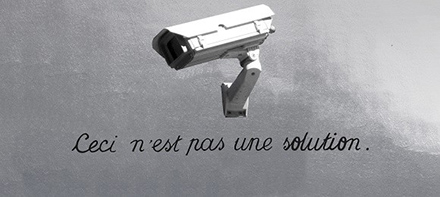
Reaffirming our commitment to protecting free expression
On the anniversary of the Charlie Hebdo attacks, PEN International has issued a statement aimed at encouraging governments to protect critical voices and freedom of expression.
IFLA and dozens of other free-speech organisations, institutes, and associations have added their signature to the statement in support of the crucial principles outlined and addressed.
The statement calls on all Governments to:
- Uphold their international obligations to protect the rights of freedom of expression and information for all, and especially for journalists, writers, artists and human rights defenders to publish, write and speak freely;
- Promote a safe and enabling environment for those who exercise their right to freedom of expression, and ensure that journalists, artists and human rights defenders may perform their work without interference;
- Combat impunity for threats and violations aimed at journalists and others exercising their right to freedom of expression, and ensure impartial, timely and thorough investigations that bring the executors and masterminds behind such crimes to justice. Also ensure victims and their families have expedient access to appropriate remedies;
- Repeal legislation which restricts the right to legitimate freedom of expression, especially vague and overbroad national security, sedition, obscenity, blasphemy and criminal defamation laws, and other legislation used to imprison, harass and silence critical voices, including on social media and online;
- Ensure that respect for human rights is at the heart of communication surveillance policy.
- Laws and legal standards governing communication surveillance must therefore be updated, strengthened and brought under legislative and judicial control. Any interference can only be justified if it is clearly defined by law, pursues a legitimate aim and is strictly necessary to the aim pursued.
Wednesday, January 6, 2016
New York Public Library Invites a Deep Digital Dive By JENNIFER SCHUESSLERJAN. 6, 2016

Mansion Maniac, a whimsical online toy created by the New York Public Library, may seem like envy bait for the real-estate have-nots. With the help of a Pac-Man-like icon, users can explore the floor plans of some of the city’s most extravagant early-20th-century residences, culled from the library’s archives.
But the game is what you might call a marketing teaser for a major redistribution of property, digitally speaking: the release of more than 180,000 photographs, postcards, maps and other public-domain items from the library’s special collections in downloadable high-resolution files — along with an invitation to users to grab them and do with them whatever they please.
Digitization has been all the rage over the past decade, as libraries, museums and other institutions have scanned millions of items and posted them online. But the library’s initiative (nypl.org/publicdomain), which goes live on Wednesday, goes beyond the practical questions of how and what to digitize to the deeper one of what happens next. Read more...
Friday, January 1, 2016
Lifting the Veil on the New York Public Library’s Erotica Collection
***, the symbol was called.
When *** was handwritten on books and periodicals in the New York Public Library’s permanent collection, it meant one thing: supervision required.
The triple-star code, created some time in the first part of the 20th century, identified the printed works that were considered too hot for the general reader to handle.
Playboy was once classified with a triple star. So were raunchy pulp novels, fliers for Times Square massage parlors, business cards offering phone sex for $2 a minute, even playing cards with illustrations of naked women.
For decades, they were kept in locked cages, accessible only with special permission and viewed in a small, secured area in the main research library.
 |
| Isaac Gewirtz, a curator at the New York Public Library, examines a first edition copy of “Lolita” that is held in the library's collections. Fred R. Conrad for The New York Times |
“Erotica was not something we were particularly going after, but we needed to collect life as it was lived,” said Jason Baumann, a collections curator. “We needed to understand and document for history what the city of New York was like. That meant collecting the good and the bad. It was always part of our mandate.”
The triple-star collection is a miniature version of the vast archive of erotica at France’s National Library. That collection, called “L’Enfer” (“Hell”), dates from the 19th century, when the library, in Paris, isolated any work considered “contrary to good morals.” In 2008, the National Library mounted its first major exhibition of highlights from the collection. It drew record crowds; no one under 16 was admitted.
The New York Public Library, by contrast, has never had a similar exhibition. The materials are not as rich, and the standards of what is considered proper for an exhibition in a public institution differ in France from those in the United States. read more...
Subscribe to:
Posts (Atom)