Pages

Monday, November 2, 2015

EXCLUSIVE: Municipal Archives offer rare glimpse into NYC’s nearly 400-year history most people will never know BY GINGER ADAMS OTIS

NEW YORK DAILY NEWS

Australian historian Shane White at the New York County Clerk Records office, which he said has "the best set of records I have ever seen."


Some of the city’s best-kept secrets are all hidden in one place — but you have to know what you’re looking for to find them.
Inside the Municipal Archives, there’s a remarkable set of records full of forgotten history: the District Attorney’s Indictment Papers.
They’re part of an incredible 221,000 cubic feet of documents kept by the city’s team of archivists and conservationists. Almost anything related to New York City life can be found there, from 1645 all the way through the Bloomberg years.
This includes things like the very earliest etchings of the green space that became Central Park, tales of a black millionaire who got his start running brothels in the city and Robert Moses’ vision to create a huge expressway in lower Manhattan.
Moses’ plan to turn Tribeca into a highway will be re-created for a city Department of Records’ exhibit opening Wednesday. It will feature a large-scale model of what the expressway would have looked like.

NEW YORK DAILY NEWS

White has found records on libel cases, drunken brawls, murders and even some old evidence from long-ago cases within the archives.


Read more: http://nydn.us/1RuqJ0x

CULTURE Finish That Book! You suffer when you quit a story midway through—and so does literature.

Porsche Brosseau/Flickr
I finish every single novel I start. If I happen upon the first line of a 1,000-page novel, I of course don’t feel compelled to read to the end. But as a matter of personal policy, when I decide I’m going to read a novel, I read the whole thing.
I’ve gathered over the years that my persistence—or stubbornness, depending on your point of view—is unusual. Most people I encounter think nothing of dropping a novel halfway because they find it boring or because they can see where it’s going or because they forgot it on the subway and moved on to the next thing.

This behavior, common though it may be, seems lazy to me. Wrong, even. Once you start a book, you should finish it.

I realize that cultural judgments like this are no longer broadly acceptable.  When Ruth Graham wrote in Slate that adults should feel embarrassed if they read literature written for children, she was attacked as a condescending snob. Didn’t she understand, critics argued, that fun-seeking was the only reason anyone did anything anymore? And if a 45-year-old enjoyed reading Harry Potter, then who was Ruth Graham to say he should feel ashamed? How dare she even use the word “should”? (I’m caricaturing, but only a little.) Read more...

Long Line at the Library? It’s Story Time Again By WINNIE HU NOV. 1, 2015

Forty strollers were double- and triple-parked on the main floor of the Fort Washington Library in Upper Manhattan. As another one came through the door, Velda Asbury waved toward a spot beside a book stack.
Officially, Ms. Asbury is a library clerk, checking books in and out. But every Wednesday she doubles as a parking attendant during one of theNew York P ublic Library’s most popular programs: story time.
 A library tradition is being refashioned to emphasize early literacy and better prepare young children for school, and drawing many new fans in the process.
 By WINNIE HU on Publish DateNovember 1, 2015. Photo by Sam Hodgson for The New York Times.Watch in Times Video »


“Good morning, little people,” she called out, as the library’s youngest patrons climbed, or were carried, up an old wooden staircase to the second floor for a 45-minute romp through books and music.
Among parents of the under-5 set, spots for story time have become as coveted as seats for a hot Broadway show like “Hamilton.” Lines stretch down the block at some branches, with tickets given out on a first-come-first-served basis because there is not enough room to accommodate all of the children who show up.  Read more...

Children settled into spots on the floor during story time at the Fort Washington Library last month. CreditSam Hodgson for The New York Times

Tuesday, October 27, 2015

Can We Create a National Digital Library? Robert Darnton

The following talk was given at the opening of a conference at Harvard on October 1 to discuss the possibility of creating a National Digital Library.
The purpose of this meeting is to discuss a question of vital importance to the cultural life of our country: Can we create a National Digital Library? That is, a comprehensive library of digitized books that will be easily accessible to the general public. Simple as it sounds, the question is extraordinarily complex. It involves issues that concern the nature of the library to be built, the technological difficulties of designing it, the legal obstacles to getting it off the ground, the financial costs of constructing and maintaining it, and the political problems of mobilizing support for it.
Despite the complexities, the fundamental idea of a National Digital Library (or NDL) is, at its core, straightforward. The NDL would make the cultural patrimony of this country freely available to all of its citizens. It would be the digital equivalent of the Library of Congress, but instead of being confined to Capitol Hill, it would exist everywhere, bringing millions of books and other digitized material within clicking distance of public libraries, high schools, junior colleges, universities, retirement communities, and any person with access to the Internet.
The ambition behind this project goes back to the founding of this country. Thomas Jefferson formulated it succinctly: “Knowledge is the common property of mankind.” He was right—in principle. But in practice, most of humanity has been cut off from the accumulated wisdom of the ages. In Jefferson’s day, only a tiny elite had access to the world of learning. Today, thanks to the Internet, we can open up that world to all of our fellow citizens. We have the technical means to make Jefferson’s dream come true, but do we have the will?

What Libraries Can (Still) Do James Gleick

Deutsches Historiches Museum/Arne Psille/Art ResourceHeinrich Lukas Arnold: The Reading Room, circa 1840
Of the many institutions suffering through the world’s metamorphosis from analog to digital (real to virtual, offline to online), few are as beleaguered as that bedrock of our culture, the public library. Budgets are being slashed by state and local governments. Even the best libraries are cutting staff and hours. Their information desks are seemingly superseded by Google, their encyclopedias are gathering dust. And their defining product, the one that lines their shelves, now arrives in the form of a weightless doppelgänger that doesn’t require shelves.
In the technocracy, all the world’s information comes to us on screens—desk, pocket, wrist, goggles—and no one trudges through wind and rain with library card in hand to find a single worn object. After all, when you want the text of Magna Carta, you don’t track down the original. Same with books? “Libraries are screwed,” said Eli Neiburger, a Michigan library director, in a much-quoted presentation at a Library Journal conference in 2010. “Libraries are screwed because we are invested in the codex, and the codex has become outmoded.”
So is the library, storehouse and lender of books, as anachronistic as the record store, the telephone booth, and the Playboy centerfold? Perversely, the most popular service at some libraries has become free Internet access. People wait in line for terminals that will let them play solitaire and Minecraft, and librarians provide coffee. Other patrons stay in their cars outside just to use the Wi-Fi. No one can be happy with a situation that reduces the library to a Starbucks wannabe.
Perhaps worst of all: the “bookless library” is now a thing. You can look it up in Wikipedia.

Read more: http://www.nybooks.com/blogs/nyrblog/2015/oct/26/what-libraries-can-still-do-bibliotech/

Monday, October 26, 2015

The Library: a new short film on the wonder of libraries - video

Director Jason LaMotte was profoundly affected by his neighbourhood library in Houston Texas – and the magical feeling it carried was the inspiration behind his new film The Library

When Dickens Is a Distraction


Brian Taylor for The Chronicle Review
By Ivan Kreilkamp October 25, 2015 

A recent issue of the Yale Alumni Magazine offers a promising feature: "Guilty (and not-so-guilty) reads of the Yale faculty: What your professors read when nobody’s watching." It’s a potentially juicy idea that yielded disappointingly tepid results.

The editors of the magazine admit, "The first thing we learned when we asked faculty across the campus to share their guilty reads: Not all Yale professors know how to relax. Their summer reading lists included the likes of Bloodlands: Europe Between Hitler and Stalin — a groundbreaking work by Yale historian Timothy Snyder, but not exactly escapist. Other books sounded suspiciously like fodder for future papers."

As I leafed through the article, I found myself mentally awarding points to any prof whose supposed "guilty reads" were in fact even remotely embarrassing or guilt-inducing.

It’s no surprise that detective fiction — long the acceptable light reading of the professoriate — often turns up in the responses. Robert Stern, dean and architecture professor, recommends Georges Simenon’s Maigret thrillers and Christopher Fowler’s Bryant and May series, documenting the Peculiar Crimes detective unit in London; Sidney Altman (biology and chemistry) likes mysteries by Philip Kerr and Andrea Camilleri; Diana E.E. Kleiner (art history and classics) suggests Diane Mott Davidson’s culinary mysteries about "a spunky heroine named Goldy Bear."

OK, the Goldy Bear whodunit does sound a little silly. But if a taste for detective fiction was possibly, once upon a time, considered mildly outré in Ivy League faculty clubs, it’s been more than 70 years since Edmund Wilson declared (in his 1944 "Why Do People Read Detective Stories?") that he was "always being reminded that the most serious public figures of our time, from Woodrow Wilson to W.B. Yeats, have been addicts of this form of fiction." Detective fiction has long been a safe harbor for professors who wish to show they can unwind without risking any true status demerit.

Read more....http://chronicle.com/article/When-Dickens-Is-a-Distraction/233854?cid=cr&utm_source=cr&utm_medium=en&elq=c37ffb9c7d8c49b7a558f67709142014&elqCampaignId=1690&elqaid=6681&elqat=1&elqTrackId=ed0194c854254d77aa2cef02d2008094

Friday, October 23, 2015

Reinventing the library by Alberto Manguel

The Oberlausitzische Library of Sciences in Gorlitz, Germany. CreditFlorian Monheim/Arcaid via Corbis
Plato, in the “Timaeus,” says that when one of the wisest men of Greece, the statesman Solon, visited Egypt, he was told by an old priest that the Greeks were like mere children because they possessed no truly ancient traditions or notions “gray with time.” In Egypt, the priest continued proudly, “there is nothing great or beautiful or remarkable that is done here, or in your country, or in any other land that has not been long since put into writing and preserved in our temples.”
Such colossal ambition coalesced under the Ptolemaic dynasty. In the third century B.C., more than half a century after Plato wrote his dialogues, the kings ordered that every book in the known world be collected and placed in the great library they had founded in Alexandria. Hardly anything is known of it except its fame: neither its site (it was perhaps a section of the House of the Muses) nor how it was used, nor even how it came to its end. Yet, as one of history’s most distinguished ghosts, the Library of Alexandria became the archetype of all libraries.
Libraries come in countless shapes and sizes. They can be like the Library of Congress or as modest as that of the children’s concentration camp in Auschwitz-Birkenau, where the older girls were in charge of eight volumes that had to be hidden every night so that the Nazi guards wouldn’t confiscate them. They can be built from books found in the garbage, like the Yiddish Book Center in Amherst, Mass., set up in 1980 by the 24-year-old Aaron Lansky from volumes discarded by the younger generations who no longer spoke the tongue of their elders, or they can be catalogued in the mind of their exiled readers, in the hope of resurrection, like the libraries plundered by the Israeli soldiers in the occupied territories of Palestine. It is in the nature of libraries to adapt to changing circumstances and threats, and all libraries exist in constant danger of being destroyed by war, vermin, fire, water or the idiocies of bureaucracy.
Read more: http://nyti.ms/1R0E2G8

Wednesday, October 21, 2015

After 10 Years, Google Books Is Legal Thanks to a landmark ruling, information just got a little more free.

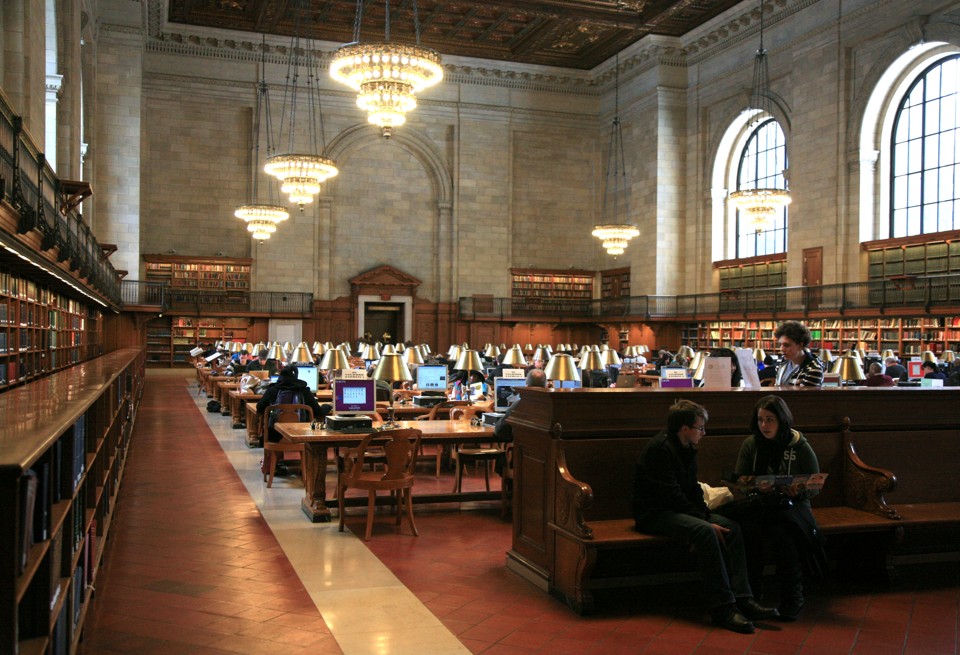
The New York Public Library was an early partner in the Google Books scanning program.


On Friday, a federal circuit court made clear that Google Books is legal. A three-judge panel on the Second Circuit ruled decisively for the software giant against the Authors Guild, a professional group of published writers which had alleged Google’s scanning of library books and displaying of free “snippets” online violated its members’s copyright.

To some digital-rights followers, the Google Books case had seemed to drag on forever: The Authors Guild first filed suit 10 years ago. But the theory behind the eventual ruling was a quarter-century in the making.
In 1990, a district-court judge named Pierre Leval published an article in theHarvard Law Review proposing a new theory of fair use. In fact, the article was named “Toward a Fair Use Standard.” (The Harvard Law Review, by the way, had one month earlier elected its first black president.)

Fair use—which lets people use and adapt copyrighted works without getting the explicit permission of their owner—is a distinctly American concept. Instead of setting out specific statutory exemptions to copyright, as many other countries do, U.S. law issues four broad factors which guide whether the permission-less use of a copyrighted work is fair. This means that fair use can evolve and change over time; it also means that the only real way to find out if something is “fair use” is to ask a federal court.


Read more:http://www.theatlantic.com/technology/archive/2015/10/fair-use-transformative-leval-google-books/411058/?utm_source=SFFB

Friday, October 9, 2015

Suffragette Movie: 3 Alternative Books to Read BY NICOLE FROIO

The movie Suffragette, featuring Helena Bonham Carter, Meryl Streep and Carey Mulligan, premiered in the UK on Wednesday, October 7. In true feminist fashion, the movie was welcomed by feminists who stormed the red carpet to protest against UK government cuts that have been harming British women.
It was a badass show of activism by SistersUncut and I absolutely loved it.
However, I am the feminist killjoy who pops your suffragette-admiring bubble to say that Emmeline Pankhurst (and other suffragettes) was kind of racist (and very pro-colonisation in her later years). As much as the suffragettes were absolutely essential to the fight for equality, they often compared (white) women’s lack of rights to slavery – effectively excluding black women from their fight for women’s suffrage. This was extensively pointed out in social media after Suffragette actresses were picturedwearing shirts with one of Pankhurst’s most famous (and offensive) quotes: “I’d rather be a rebel than a slave.” (As if slavery was a choice but OK EMMELINE, WELL DONE). (ALSO, can we talk about why these actresses thought wearing this quote across their chest was OK?!!? Meryl, I thought you were cool.)
There’s a lot to be said about whether it’s right or wrong to admire the suffragettes if we look at the movement with an intersectional feminist lens, but I believe the best way to make that decision is to educate yourself. All of our idols will be problematic in one way or another and while I will definitely be watching the movie, I will also be reading some additional materials to make sure I understand the full picture of the suffragette movement in terms of intersectionality (or lack thereof). Below are the books I will be reading to seek this knowledge.
On a quick side note, it’s important to say that the racism in the British and American suffragette movements were very different (it was definitely more overt in the US, with suffragettes arguing against black men having the right to vote) but that it existed in both countries.

Wednesday, September 30, 2015

It’s Banned Books Week again. Can we stop yelling at each other about it?

Author Jacqueline Woodson (Marty Umans)

   
Early in her career as a writer, Jacqueline Woodson got some disturbing news from none other than Judy Blume.
Blume was editing an anthology of works by banned authors and wanted to include her.
“But I haven’t been banned,” Woodson said.
“Oh, yes you have!” Blume told her.
Woodson, the author of such books as “Brown Girl Dreaming” and “Hush,” has since won a National Book Award and been named Young People’s Poet Laureate by the Poetry Foundation. Yet she still finds her work under fire in libraries and schools around the country for its depiction of sexuality, drug use, prison and interracial relationships.
According to the American Library Association, books for young adults — the kind Woodson writes — are now “the majority of the most frequently challenged books.”
During Banned Books Week (Sept. 27 to Oct. 3), you’ll see the usual celebrations of censored classics, such as “I Know Why the Caged Bird Sings” and “The Catcher in the Rye,” alongside more recent works, such as “The Kite Runner” and the “Harry Potter” series. Many bookstores, like One More Page Books in Arlington, Va., have set up special displays to promote titles that have weathered persistent objections.
Read more: https://www.washingtonpost.com/entertainment/books/its-banned-books-week-again-can-we-stop-yelling-at-each-other-about-it/2015/09/27/d7860518-6399-11e5-9757-e49273f05f65_story.html?postshare=661443447417043

Wednesday, September 23, 2015

The Plot Twist: E-Book Sales Slip, and Print Is Far From Dead By ALEXANDRA ALTER SEPT. 22, 2015

Penguin Random House last year doubled the size of its distribution center in Crawfordsville, Ind., to speed up book distribution. CreditA J Mast for The New York Times
Five years ago, the book world was seized by collective panic over the uncertain future of print.
As readers migrated to new digital devices, e-book sales soared, up 1,260 percent between 2008 and 2010, alarming booksellers that watched consumers use their stores to find titles they would later buy online. Print sales dwindled, bookstores struggled to stay open, and publishers and authors feared that cheaper e-books would cannibalize their business.
Then in 2011, the industry’s fears were realized when Borders declared bankruptcy.
“E-books were this rocket ship going straight up,” said Len Vlahos, a former executive director of the Book Industry Study Group, a nonprofit research group that tracks the publishing industry. “Just about everybody you talked to thought we were going the way of digital music.”

Read more....

Thursday, September 10, 2015

My Grandfather Built a House of 20,000 Books From the Ashes of War By Sasha Abramsky

n July 1920, when my grandfather Chimen was nearly four years old, the town of Smalyavichy, in which his father Yehezkel was the rabbi, was besieged. It had changed hands several times during the civil war that had broken out following Lenin’s October Revolution. This time, it was a triumphant Red Army that readied itself to push Polish nationalist soldiers, allied with the pro-Tsarist White Armies, out of the town and the broader region. As the Polish soldiers retreated, they set fire to large parts of the town, especially in the Jewish quarters, indulging in a last frenzied bout of pogrom-like brutality.
Yehezkel was not present as the flames rose skyward—he had an appointment in the nearby city of Minsk. But his wife Raizl was at home, and so were his four young sons. The flames caught hold of their house, and Raizl barely had time to grab her children, rush them out into the street, and run for safety before the fire began reducing their home to ash. Inside, Yehezkel’s books, as well as his large personal correspondence with the leading rabbis of Byelorussia and Lithuania, went up in smoke.
Yehezkel, who had lived on bread and water during the Russian-Japanese war, was no stranger to deprivation and loss. Yet even with such a training and a history, and even knowing that in rabbinic lore the words from burned holy books and scrolls find their way up to Heaven, losing the bulk of his library must have been a bitter blow. Perhaps it was the story of the fire, repeated in subsequent years around the family dinner table, which triggered in Chimen his life-long obsession with collecting books.


Read more...http://www.newrepublic.com/article/122753/my-grandfather-built-house-20000-books-ashes-war

Thursday, September 3, 2015

Top 10 Things You Need To Know About The Library

Here are 10 important things you need to know about the Albert S. Cook Library at Towson University. Know your stuff so you can utilize these amazing resources!

1. Your own personal research assistants! Get help student to student with the A-LIST crew.

Your own personal research assistants! Get help student to student with the A-LIST crew.
Our fellow A-LIST students are here to help you on your academic journey. If you need help starting your research paper, finding a book, or have any questions related to the library find them in their gold shirts on the reference desk on the 3rd floor or around the library. Appointments can be scheduled as well, students helping students.

2. Hidden gems within the library! STARBUCKS-COPIESPLUS-LAUNCHPAD

Hidden gems within the library! STARBUCKS-COPIESPLUS-LAUNCHPAD
Cook library has many resources and services inside the library, did you know? You thirsty or need a quick snack while studying? We have a Starbucks in our library, problem one solved. You need to fax papers, resume paper, or copy or print papers in bulk? Copies plus is here to help, problem two solved. Do you have a business start-up? Are you an entrepreneur? Oh wait, we have Student Launch Pad, Problem three solved.  Read more...

Library Card Spokesdog Snoopy helps unleash 2015 Library Card Sign-Up Month


Wednesday, September 2, 2015

Garbage Collector Rescues Discarded Books for Children


Of the 19 public libraries in Bogotá, Colombia, all are located far from the poorer regions of the city, thus restricting many people’s access to books.

Thankfully, 53-year-old garbage collector Jose Gutierrez is working hard to ensure that children everywhere are exposed to the joy of reading. As ABC News reports, Gutierrez began “rescuing books from the trash almost 20 years ago, when he was driving a garbage truck at night through the capital’s wealthier neighborhoods.” Due to the shockingly large number of abandoned books, Gutierrez was able to create a “makeshift community library stacked…with some 20,000 books” in his own home.

Gutierrez champions the power of books, regarding them as “luxuries” for children in poverty-stricken areas. He recalls how his mother, despite being unable to keep him in school past the second grade, still endeavored to read him stories every night during his childhood. Gutierrez therefore refers to books as our “salvation,” which I certainly can’t disagree with. His favorite books include One Hundred Years of Solitude and The General in his Labyrinth, written by fellow Colombian and Nobel-Prize winning novelist Gabriel García Márquez.

Gutierrez is known as “Lord of the Books” in Colombia, and due to his fame he frequently receives book donations. I can’t help but wish we had an American equivalent of “Lord of the Books,” especially considering the existence of  its antithesis: the “Literary Litterbug,” a Colorado man recently found guilty for tossing unwanted books out of his vehicle. Gutierrez could have undoubtedly offered those novels a home in his library. If only!

8 Children's Libraries That Make You Wish You Were A Kid Again Jill Harness • Tuesday, September 2, 2014 at 5:00 AM •

I  don't know about you guys, but I loved my local library when I was a kid. But with all the distractions of mobile devices, games, and more, many kids never even visit the library and when they do, they find it to be boring. That's why some libraries have really made an effort to encourage kids not only to keep reading but also to see just how much fun can be had at the library. Here are a few branches that go above and beyond when it comes to keeping kids entertained.

1. Brentwood Library

Perhaps one of the most visually impressive children's museums in America, the Brentwood Library's children's area features a charming entrance adorned in oversized books and a massive storybook tree. An animatronic owl greets visitors when it is triggered by a motion sensor. Inside the kid's section, the walls are covered in paintings of fairytale forests and between the rows of books are charming artificial trees.
The second Friday of each month means LEGO Mania time and summer reading programs feature musicians, puppets, magicians, live animals and more. During the school year, they have an after-school program that includes snacks, crafts, games and books.
Image Via CajunKev [Flickr]

2. Laramie County Library

Seeing pre-teen zombies roaming around the library after dark is no big deal at the Laramie County Library, where there are lots of tween activities including an after-hours program that hosts a yearly Zombie Prom.
The library is so popular with the young set that over 3,500 children visit each week and the entire second floor is dedicated to kiddos. The children's space features an oversized chess board, board games, computer stations, story areas and a kid's-size bookmobile to distribute imaginary books. Librarians say parents have a hard time getting children to leave.
Part of the reason the library is so popular with kids is that they can actually volunteer there as long as they are 12 and older. The library even offers a Teen Advisory Board to help decide on what programs would be the most popular with their peers.
Image Via Preston Stafford [Flickr]

Read more...http://www.neatorama.com/2014/09/02/8-Childrens-Libraries-That-Make-You-Wish-You-Were-A-Kid-Again/

Do any of you know of a children's library that should be added here? Or do you maybe have some memories of a special librarian who helped you love the library as a youngster? Share your thoughts in the comments.


Introducing the Archive Corps Meet the man behind a new effort to save documents and other artifacts before they disappear.


Jason Scott / Flickr

Jason Scott has something of a reputation. He’s a historian who works for the Internet Archive, and he’s known in some circles as the guy who can save bits of history right before they disappear.
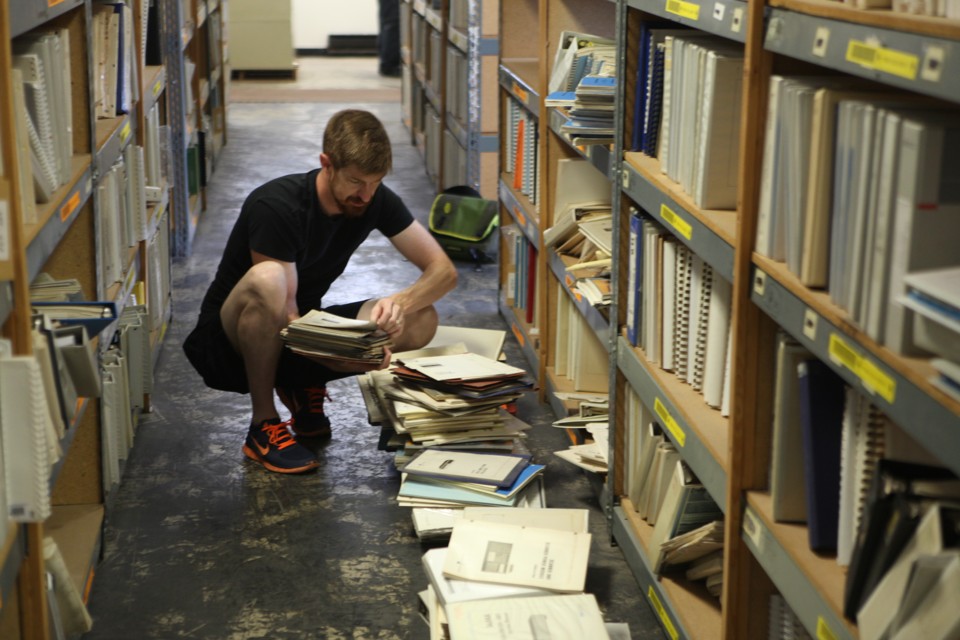
So when he found out that a small store in Maryland that sold manuals for machinery was going out of business, and was going to get rid of its collection of nearly 200,000 obscure booklets in just a few days, Scott got to work. 

He got to Maryland on a Friday to check out the stockpile at Manuals Plus. By Wednesday of the next week he had rallied over 70 volunteers to put together 1,600 boxes of manuals (nobody counted exactly how many booklets fill those boxes, but the guess is between 50,000 and 75,000) that now sit in three storage containers. The whole endeavor cost about $9,000, most of which was donated to the project.

Read more: http://www.theatlantic.com/technology/archive/2015/09/introducing-the-archive-corps/403135/?utm_source=SFTwitter

Tuesday, September 1, 2015

12 Ways Your Parents Turned You Into A Book-Lover by Julia Seales


My mom got her degree as a reading specialist. So, it'd probably be an understatement to say that when I was growing up, books were a pretty important part of everyday life. There's no way I could have grown up NOT loving books, because I was surrounded by them all day, every day.

At one point, my mom actually owned a used book business, and she would take me to book sales and let me get as many five-cent Nancy Drew Notebooks as I could fit in my scrawny arms... and then some. (Side note: If you’ve never experienced a book sale, you’re missing out. We would wake up at about 4 a.m., go to a huge warehouse, and straight-up fight other lit-lovers over old library copies of rare books. Literally, imagine a fashion sample-sale scene, replace the Louboutins with books, and you’d have an accurate mental picture of a book sale.)

Anyway, if you're a fellow book-lover, you probably have a similar story. No, I don’t mean you fought some woman with a blonde updo over a rare children’s book… I mean that if you love to read, your parents are at least partially to thank for that. After all, chances are they're the first people who even told you what this beautiful and wonderful thing called a "book" was, and that's just one of the many ways they turned you into the lit-lover you are today.

Read more: http://www.bustle.com/articles/107146-12-ways-your-parents-turned-you-into-a-book-lover

Why We Need Diverse Libraries By Rachel Smalter Hall Sep 1, 2015

www.nationofchange.org


Public librarians fight the good fight: we’re champions of literacy and intellectual freedom, we oppose book bannings, and we’re pro-education and public service. We’ve had a bit of a public image problem what with our shushing and our late fees, but we’ve been hard at work reinventing our image as welcoming, affirming professionals who are here to spread the love of books and information. We even have literary tattoos and bookish roller derby names.

All of this makes it harder to say this next thing: Public librarians need to do better with race.
When I recently read about the Napa Valley Wine Train that apologized for wrongfully escorting a book club of 11 black women off the train for being “too boisterous” (i.e. #laughingwhileblack), my first thought was of how many times I’ve seen the same thing happen in public libraries — I’ve witnessed many similar microaggressions against people of color throughout my time in libraries.

The nature of microaggressions makes them tricky to define, especially since they’re often so specific and personal, but I’ll do my best to describe a few of the instances I’ve seen.

The homeless man who turned his life around by offering book reviews instead of begging


Meet Philani Dladla, a.k.a. the Pavement Bookworm.  He’s 24 and lives in Johannesburg, South Africa, and his story is quite incredible.

pavement bookworm-crop
Philani Dladla. Photo: http://facebook.com/jacaranda942

As a child growing up in KwaZulu Natal he had always loved books. But after moving to Johannesburg to find work, he started taking drugs.

“I left my job and couldn’t afford rent anymore – I lost everything. While living on the streets I noticed how many beggars there were getting money for nothing on street corners. I thought I could be different and actually give people something worthwhile – like a book or book review – in exchange for money.”

So he started selling books on the streets – but only after he had read them and could offer passers by a detailed review.


Read more:

http://www.one.org/international/blog/the-homeless-man-who-turned-his-life-arround-by-offering-book-reviews-instead-of-begging/