Tuesday, September 26, 2017
Top Ten Challenged Books of 2016
Banned Books Week kicked off yesterday! You can raise awareness of banned books in your community and learn more about how to respond to challenges to library materials through the ALA Office for Intellectual Freedom. Here are the top challenged books from 2016:


Banned Books Week: Why are illustrated books being challenged more than ever?
Banned books | Graphic novels | Censorship | YA Literature | Book awards
by Michael Cavna | September 25, 2017 | |
| A panel from “This One Summer,” by Mariko Tamaki and artist Jillian Tamaki. (First Second) |
Last year, for the first time, the top two most challenged works were graphic novels for young adults, and half of the top 10 most challenged books were illustrated narratives. It also bears noting that of the 323 challenges filed against stocked books in 2016, many of them, according to the American Library Association’s Office for Intellectual Freedom, were for reasons related to sex or gender.
Landing at the ALA’s top spot was “This One Summer,” written by Mariko Tamaki and illustrated by Jillian Tamaki. A year earlier, the YA graphic novel received a Printz Honor, and became the first graphic novel to receive a Caldecott Honor. But last spring, the ALA reported that “This One Summer” was “restricted, relocated and banned because it includes LGBT characters, drug use, and profanity,” and that it was “considered sexually explicit with mature themes.”
Read more...
Monday, September 25, 2017
13 Timely Books to Read During Banned Books Week | Off theShelf
Banned Books | Censorship | Access
by Sara Jane Abbott | September 25, 2017Growing up, I discovered some of the most formative and thought-provoking books I’ve ever read on the Banned Books Week displays at my local library, from A CLOCKWORK ORANGE to THE HANDMAID’S TALE. The freedom to read books that challenge us, that open windows into the experiences of others, and that reflect the issues of our times, is crucially important. Every Banned Books Week is an opportunity to celebrate these books and to reaffirm our commitment to keeping them on the shelves. If you’ve read the incredible banned books on our 2015 and 2016 Banned Books Week lists, here are some more banned and challenged books to read this year to mark the occasion.

The House on Mango Street
Told in a series of vignettes—sometimes heartbreaking, sometimes
deeply joyous—THE HOUSE ON MANGO STREET is the remarkable story of
Esperanza Cordero, a young Latina girl growing up in Chicago and
inventing for herself who and what she will become. Read more...
Libraries from Puerto Rico to Florida Respond to Hurricane Irma | ALA
Disaster planning | Hurricanes | Libraries
by Lisa Peet | September 18, 2017 |
| Downed trees outside the Miami-Dade Public Library System’s Coconut Grove Branch after the storm Photo courtesy of Miami Dade Public Library System |
Arriving hard on the heels of Hurricane Harvey, Irma cut a destructive swath through the northeastern Caribbean and Florida Keys. More than $50 billion worth of damage was reported in the United States, as well as 39 fatalities.
Despite Irma’s size and power, Florida libraries had fewer tales of destruction to relate than their counterparts in Texas did after Harvey. While most larger systems reported some leakage and damage to property, delays in opening were mainly due to lack of electricity or running water or exterior obstructions such as fallen trees and debris.
Florida Governor Rick Scott declared a state of emergency on September 4, and ordered that all public schools and colleges across the state close from Friday, September 8 through Monday, September 11. Thousands of Floridians evacuated their homes on both coasts and headed north—the largest evacuation in the state’s history. Read more...
Wednesday, September 20, 2017
Responding to Charlottesville: Episode 17 | ALA Podcast
Podcasts | Library activism | Community relations |Emergency preparedness
American Libraries Dewey Decibel PodcastDewey Decibel is a new podcast series from American Libraries, the magazine of the American Library
Association. Each month, your host and American Libraries Associate Editor Phil Morehart will be
your beyond.
Host, Phil Morehart
In Episode 17 of the Dewey Decibel podcast, American
Libraries looks at the protests that took place on August 12, 2017, in
Charlottesville, Virginia, through the eyes of the library world.
First, American Libraries Associate Editor and Dewey Decibel host Phil Morehart talks to John Halliday, director of Jefferson-Madison Regional Library in Charlottesville, and Krista Farrell, assistant director and branch manager of Jefferson-Madison Regional Library’s Central Library. The Central Library sits on what was the frontlines of the protests. John and Krista shared with Phil the events of that day and how their library handled it.
Next, Phil sits down with Jody Gray, director of the American Library Association’s (ALA) Office for Diversity, Literacy, and Outreach Services, and Kristin Pekoll, assistant director of ALA’s Office for Intellectual Freedom, to discuss ALA’s tracking of hate crimes at and in libraries and what you can do if your library falls victim to hate.
Finally, Phil talks to Peter Berg, associate director for special collections and preservation at Michigan State University Libraries. Michigan State University Libraries holds a massive collection of extremist literature, paraphernalia, and other materials. Phil and Peter examine the collection and why it’s important for libraries and archives to save these materials, despite the repugnant nature of some of them.
Listen to the podcast:
First, American Libraries Associate Editor and Dewey Decibel host Phil Morehart talks to John Halliday, director of Jefferson-Madison Regional Library in Charlottesville, and Krista Farrell, assistant director and branch manager of Jefferson-Madison Regional Library’s Central Library. The Central Library sits on what was the frontlines of the protests. John and Krista shared with Phil the events of that day and how their library handled it.
Next, Phil sits down with Jody Gray, director of the American Library Association’s (ALA) Office for Diversity, Literacy, and Outreach Services, and Kristin Pekoll, assistant director of ALA’s Office for Intellectual Freedom, to discuss ALA’s tracking of hate crimes at and in libraries and what you can do if your library falls victim to hate.
Finally, Phil talks to Peter Berg, associate director for special collections and preservation at Michigan State University Libraries. Michigan State University Libraries holds a massive collection of extremist literature, paraphernalia, and other materials. Phil and Peter examine the collection and why it’s important for libraries and archives to save these materials, despite the repugnant nature of some of them.
Listen to the podcast:
Using Our Words : Getting it right on neutrality and libraries | American Libraries
Intellectual freedom |Libraries and neutrality
by Joseph Hanes | 09-01-17
I’ve always been a wordy sort of person. Yes, that too,
but I mean word-y. I was the sort of kid who spent time with a thesaurus
and dictionary as well as Tinkertoys and Matchbox cars. I was
fascinated by words, their uses, and shades of meaning.
So the Webster’s dictionary has taken a side, or at least a perspective. Based on what I know of Noah Webster’s own colorful history and antipopulist views, I think he might approve. All of which puts an intriguing gloss on an emerging discussion within our own profession on what some may think a bedrock principle of librarianship: neutrality. This discussion includes my fellow AL columnist Meredith Farkas’s excellent piece on the critical librarianship movement (Jan./Feb., p. 70).
In one important sense, we aren’t neutral and never can be—nor should we be. Naturally, each of us has his or her own biases, prejudices, and preferences; we represent a sample of the breadth of society, so this is inevitable and necessary to avoid homogeneity of thought and action. Together, though, we advocate strongly on matters critical to our success. We fight in public for the rights of our patrons to read and think freely without fear of exposure, surveillance, or censure, as well as for open and equal access to a range of materials. We stand for the principle that government and public information shouldn’t depend on the whims of the moment. We are engaged with, represent, and fight for our communities and strive to improve them through our institutions and our work. Read more...
I want to be sure that we’re fighting the right fights on the right terms and, yes, using the right words.
Radical restructuring: Library renovations lead to personnel and process reorganization | American Libraries
Library design | Human resources | Academic libraries
by Catherine Murray-Rust | September 1, 2017
As librarians, we’ve all felt, at some point or another,
like one of the great loves of our lives has been judged hopelessly
irrelevant. In an era when information is digital and abundant,
demonstrating the value of libraries and librarians is more urgent—and
can be more difficult—than ever.
When we started four years ago, the project largely centered on building renovations. Over time we realized that renovations are the easy part of a transformation. We are fortunate to have creative architects, designers, engineers, and construction experts. We have the financial and political support of the administration and the University System of Georgia. And we benefit every day from the advice of consultants and subject-matter experts.
The biggest challenge to our transformation was organizational. We soon saw that we had to change the culture of the library from passive to active, and we had to retire models that focused narrowly on the library rather than those that supported the larger institution. We had to commit to organizing in a way that envisions a future that is digital.
How? We are adapting techniques used in disciplines such as supply chain thinking and portfolio management to radically restructure the way we operate. Our goal is to make the transactional parts of the library’s work as efficient as possible in order to free up resources to sustain new services such as intelligent agents, visualization, and data science.
Read more...
Tuesday, September 19, 2017
91-year-old former congressman shows millennials how to tweet about Trump | Mashable
Social media | Politics | Public activism
by Sasha Lekach | 09-16-27/https%3A%2F%2Fblueprint-api-production.s3.amazonaws.com%2Fuploads%2Fcard%2Fimage%2F593679%2F16159d95-e092-4c96-b9bb-84ec66b56050.jpg) | |
| John Dingell has been owning Twitter for years. |
91-year-old former congressman John Dingell has been quick, witty, and on fire with his 140 characters for years.
Despite his age, he knows how to use the tweet machine the way it was intended: biting commentary, playful retweets, and insightful and smart reactions. Time and again he's shown he's mastered Twitter.
After tweeter-in-chief Donald Trump was elected, Dingell's Twitter game has become even more relevant and fiery.
After the violence in Charlottesville and Trump's bumbling mess of a response to the anti-Semitism and white supremacy on display, Dingell took to Twitter in the days following. One particular tweet resonated, with thousands praising the longtime Michigan lawmaker for posting what the president struggled to say.
Just look at those likes. Read more...
16 Genre Recs Based on Your Myers-Briggs Type | BookRiot
Book lists | Reading | Bibliotherapy
by Kate Scott | 09-18-17
I made a list of genres and Myers-Briggs types and paired them up. Sure enough, certain Myers-Briggs types and genres go together like ham and cheese. Of course, there will be exceptions, but here’s which genre I think best fits each personality type. Read more...

Monday, September 18, 2017
Volunteers rescue thousands of books from Mosul library destroyed by Islamic State
Advocacy | Libraries | Mosul
by Linda Mottram and Connie Agius September 17, 2017 | ||||||
| Photo
Volunteers help carry out books from the Mosul library destroyed by Islamic State.
Supplied: Ali Al-Barood |
They occupied the city's university library, where last week festival-goers celebrated a rich culture and donated books.
The volunteer effort to save what was left of Mosul University library after it was destroyed by IS has renewed hope for the city after more than two years of occupation.
The library once contained hundreds of thousands of ancient documents, including a ninth-century Koran, before it was burned down in a deliberate attempt to erase culture.
But Mosul local and amateur photographer Ali ِAl-Baroodi, who once taught at the university, has been part of a community campaign led by independent blogger Mosul Eye to restore what remained of the library's collection.
"At the beginning when we went by the library, we couldn't hold back our tears, and we thought it was all over," Mr Al-Baroodi said.
Read more...
Thursday, September 14, 2017
Essential Anthologies: Poetry, Essays, and Letters in the Age of Trump
Books | Politics | Diversity
by Jennie Yabroff | September 7, 2017
Sad. Huge. Sick. Bigly. Unproud. Covfefe. Despite the fact that
President Trump handles the English language like a three-year-old
wearing frozen mittens, his words, both spoken and tweeted, have proved
alarmingly successful tools of bullying, misdirection, and
blame-shifting, enabling him to shape reality into an alternate version
in which he is infallible and his critics are – another favorite –
pathetic. As a literary critic wrote in The Guardian
recently, Trump has used (or abused) the English language to “undermine
the notion of objective truth more successfully than most novelists can
dream of doing.”
What can you do when your enemy uses your weapon against you? Starting a few years ago, writers around the world began publishing essays, speeches, stories, and even, in a few prescient cases, novels warning of what awaited us were Trump to be elected. He was, and the weeks that followed were marked by reaction pieces by those same writers and others, many of them simply asking, what the hell just happened? Some two hundred-odd days later, Trump remains in office, and writers keep fighting his regime with the most powerful weapon at their disposal, trusting, or hoping, in its essential efficacy.
The fact that writers keep writing, keep putting their faith in words to accurately describe reality, keep believing that there are still readers out there who will be moved, possibly even changed, by what they’ve written, is in some sense the most audacious act of protest against this singularly linguistically hostile president. So many writers are feeling moved to record and resist not just Trump’s abuses of Americans’ civil liberties but his more basic lack of respect for human decency and civilized discourse, that we are now seeing several anthologies of writers responding to the Trump regime.
What can you do when your enemy uses your weapon against you? Starting a few years ago, writers around the world began publishing essays, speeches, stories, and even, in a few prescient cases, novels warning of what awaited us were Trump to be elected. He was, and the weeks that followed were marked by reaction pieces by those same writers and others, many of them simply asking, what the hell just happened? Some two hundred-odd days later, Trump remains in office, and writers keep fighting his regime with the most powerful weapon at their disposal, trusting, or hoping, in its essential efficacy.
The fact that writers keep writing, keep putting their faith in words to accurately describe reality, keep believing that there are still readers out there who will be moved, possibly even changed, by what they’ve written, is in some sense the most audacious act of protest against this singularly linguistically hostile president. So many writers are feeling moved to record and resist not just Trump’s abuses of Americans’ civil liberties but his more basic lack of respect for human decency and civilized discourse, that we are now seeing several anthologies of writers responding to the Trump regime.

Tales of Two Americas
Stories of Inequality in a Divided Nation
Edited by John Freeman
Tales of Two Americas, edited by John Freeman, examines the growing economic and class divide in our country through lenses fictional, factual, and poetic. Thirty-six writers, including Joyce Carol Oates, Edwidge Danticat, and Karen Russell contribute pieces set in Appalachia, the Rust Belt, and other divided regions of our increasingly conflicted country.Read more...
14 Back-to-School Reads for Life-Long Learners
Booklists | Reading | Lifelong Learning | Non-fiction

September 14, 2017
By KERRY FIALLO14 Back-to-School Reads for Life-Long Learners: We may not be kids anymore, but there’s still time to expand your mind and learn something new.

A timely and invaluable exploration of the evolution of racism in
America’s modern age of so-called colorblindness. From the Jim Crow laws
of the Reconstruction era to today’s mass incarceration of black men,
this is an expertly researched, deeply engaging, and profoundly
important call to action in the United States.


Read more...
Monday, September 11, 2017
11 Novels About 9/11 Worth Reading
September 11th | Book lists | Reader's Advisory

September 11, 2017
By JULIANNA HAUBNEREveryone has a story about where they were when the world changed on September 11, 2001. It’s simultaneously the most upsetting, most uncomfortable, and most fascinating conversation to have—to hear what people remember, what they felt, and how they responded. Though it’s been nearly two decades, the reminders of that day are constant, and the pain is still fresh for many. The role of fiction, now and always, is to explore experiences, emotions, and the extent to which we can share our humanity. These profound, powerful, and perspective-shifting novels set on 9/11 and beyond do all of those things, and are valuable additions to any bookshelf.

Mohsin Hamid’s novel should be required reading for anyone looking to
understand the event from all sides. Changez is a Pakistani immigrant
living the American dream, with an elite career and a beautiful
girlfriend, when 9/11 changes everything. Suddenly, people look at him
differently, and his proclamations of love for his adopted country seem
worthless to those around him—and as the cultural relations continue to
shift, so does Changez’s outlook. This book is a powerful reminder of
what happens to those caught in the middle of extreme situations, the
influence of prejudice in the wake of disaster, and how every action has
an equal, opposite reaction.
Read more...
understand the event from all sides. Changez is a Pakistani immigrant
living the American dream, with an elite career and a beautiful
girlfriend, when 9/11 changes everything. Suddenly, people look at him
differently, and his proclamations of love for his adopted country seem
worthless to those around him—and as the cultural relations continue to
shift, so does Changez’s outlook. This book is a powerful reminder of
what happens to those caught in the middle of extreme situations, the
influence of prejudice in the wake of disaster, and how every action has
an equal, opposite reaction.
Read more...
Despite protests, State Department says it will return trove of Jewish artifacts to Iraq
Judaica | Access | Artifacts | Iraq | Jewish texts
by Josefin Dolsten | September 8, 2017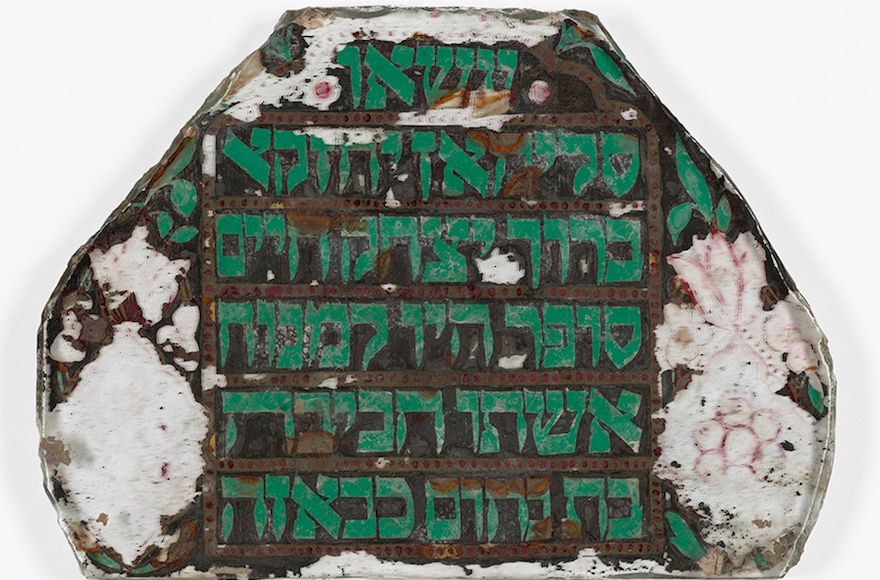 | ||
| Detail of Tik (Torah case) and Glass Panel from Baghdad, 19th-20th centuries, part of the Iraqi Jewish Archive. (National Archives) |
A four-year extension to keep the Iraqi Jewish Archive in the U.S. is set to expire in September 2018, as is funding for maintaining and transporting the items. The materials will then be sent back to Iraq, spokesman Pablo Rodriguez said in a statement sent to JTA on Thursday.
Rodriguez said the State Department “is keenly aware of the interest in the status” of the archive.
“Maintaining the archive outside of Iraq is possible,” he said, “but would require a new agreement between the Government of Iraq and a temporary host institution or government.”
The archive was brought to America in 2003 after being salvaged by U.S. troops. It contains tens of thousands of items including books, religious texts, photographs and personal documents. Under an agreement with the government of Iraq, the archive was to be sent back there, but in 2014 the Iraqi ambassador to the U.S. said its stay had been extended. He did not say when the archive was to return. Read more...
Friday, September 8, 2017
Trust and Distrust in Online Fact-Checking Services
Fact Checking | Fake News | Media literacy

While the internet has the potential to give people ready access to relevant and factual information, social media sites like Facebook and Twitter have made filtering and assessing online content increasingly difficult due to its rapid flow and enormous volume. In fact, 49% of social media users in the U.S. in 2012 received false breaking news through social media.8 Likewise, a survey by Silverman11 suggested in 2015 that false rumors and misinformation disseminated further and faster than ever before due to social media. Political analysts continue to discuss misinformation and fake news in social media and its effect on the 2016 U.S. presidential election.
Read article:
Trust and Distrust in Online Fact-Checking Services: Even when checked by fact checkers, facts are often still open to preexisting bias and doubt.
Thursday, September 7, 2017
Blood, bookworms, bosoms and bottoms: the secret life of libraries
Libraries | Rare books | Book collecting | Book trade
by Stuart Kells August 26, 2017 |
My trip was not unlike the pilgrimages made by 18th-century library tourists. On my journey I noticed two trends that are changing how we think of old books and old libraries.
The first is a stronger focus on provenance research. Through whose hands have the books passed? How did those handlers use and mark and protect their books? This branch of bibliography is helping to humanise it.
The other trend involves breaking away from traditional ideas of what constitutes a meritorious book, and from the traditional oppositions of high and low literature. Thanks to this, pulp novels – featuring what Allen Lane called “bosoms and bottoms” cover art – have infiltrated rare book collections. Crime pulps and sci-fi paperbacks are now prized by such hallowed institutions as the Smithsonian, the Houghton and the British Library.
Old-school bibliographers and librarians would probably be mortified by the incursion of pulps, which are fighting not only for shelf space but also for influence. But instead of being corralled and appropriated into old models of scholarship and curation, the pulp sensibility is spreading. Traditional bibliography and librarianship are being reread and reshaped with a pulp mentality.
Pulps, in short, are about lust, sex, theft, betrayal and degradation. Pulp men and women are dangerous, duplicitous, damaged. What is coming from this Gonzo-esque rereading of books and their stories? A new history of old books that is human, messy, fascinating and appalling, shot through with desire and criminality, heroism and dereliction.
Read more...
Podcast: Nancy Pearl on The Librarian Is In |NYPL
YA Literature | Podcasts |Book recommendations
The legendary book recommender joins to discuss writing her first novel and share her favorite books.
 |
The Librarian Is In Podcast, Biblio File |
Welcome to The Librarian Is In, the New York Public Library's podcast about books, culture, and what to read next.
On the show this week: Gwen reads a book that makes her see the world a little differently, and Frank gets so lost in his book that time disappears.
Listen on Apple Podcasts | Listen on Google Play
On the show this week: Gwen reads a book that makes her see the world a little differently, and Frank gets so lost in his book that time disappears.
 |
| George and Lizzie by Nancy Pearl |
Fake News Isn't New: Researching Its History with NYPL's E-Resources | NYPL
Research | Electronic resources | Fake news | Literacy

Cincinnati Commercial Tribune, December 4, 1890
Famed Documentarian Frederick Wiseman Turns His Camera on NYPL in Ex Libris | NYPL
Advocacy | Documentary | Public Libraries | Films
And check out early reviews for the film, which is screening at the Venice Film Festival:
-
“If this ends up being Frederick Wiseman’s last film I can think of no better swan song.” - Jordan Hoffman, The Guardian.
 |
| Frederick Wiseman Photo by wowe |
Tuesday, September 5, 2017
Unearthing the history made by well-behaved women | BookRiot
Booklists | Non-fiction | Women in history
by Ann Foster August 5, 2017You have likely come across Laurel Thatcher Ulrich’s well-known quote, “well-behaved women seldom make history,” on ironic cross-stitch samplers, tote bags, and fridge magnets. Removed of its original context, it has become a rallying cry for women to make history by misbehaving, suggesting that the only way to stand out is to misbehave. In context of Ulrich’s original writing, though, the quote is less a rallying cry and more a depressing truism: women born outside of royal families, who followed the rules, who stayed out of trouble, tended not to have their actions recorded. The women we best know from history did so because they stood out from the crowd: as royals, saints, murderers, murder victims, performers, artists, and more. This doesn’t mean the “well-behaved” women weren’t as interesting or worthy, only that we have few documents left to let us know who they were. The following nonfiction works use letters, diaries and other primary sources to help excavate the lives of women who — like Eliza Schuyler in Hamilton — found themselves removed from the narrative.

The Immortal Life of Henrietta Lacks by Rebecca Skloot
This bestselling biography outlines both the unknowing medical contribution Henrietta Lacks made, as well as the nuances of both her life and that of her daughter, memorably portrayed in the recent HBO film by Oprah Winfrey.
Read more...
Subscribe to:
Posts (Atom)